

Outplacement services exist to close that gap. Yet despite appearing regularly in severance packages, they're widely misunderstood — underused by employees who don't know what they include, and undervalued by employers who view them as a cost rather than a risk management tool.
This article covers what outplacement services actually are, what they include, and the concrete benefits they deliver — for the individuals going through a transition and for the organizations managing one.
Key Takeaways
- Outplacement is employer-funded career transition support — distinct from severance pay, and typically free to the employee.
- For departing employees, it speeds reemployment, reduces stress, and sharpens how they present to hiring managers.
- For employers, it protects brand reputation, reduces legal exposure, and steadies morale among remaining staff.
- Quality varies dramatically; generic platforms rarely deliver the same results as specialized providers.
- Lawyers pivoting out of legal practice need specialized transition support, not one-size-fits-all outplacement.
What Are Outplacement Services?
Outplacement services are employer-sponsored programs that help departing employees find new roles following a layoff, restructuring, or reduction in force. The employer pays; the employee receives the support at no personal cost. It is not severance — severance is a cash payment, while outplacement is a service benefit. The two are complementary but not interchangeable.
Challenger, Gray & Christmas describes outplacement as employer-sponsored support that helps displaced employees land new opportunities while protecting employer brand reputation — framing that positions outplacement as strategic, not merely compassionate.
What Outplacement Typically Includes
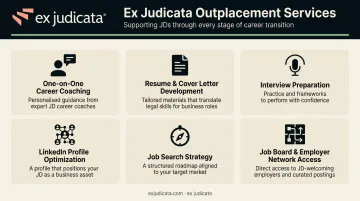
Most established outplacement programs cover the following:
- One-on-one career coaching — structured sessions with a professional coach guiding the job search
- Resume and cover letter development — updated materials written for current hiring expectations
- LinkedIn profile optimization — reframing professional identity for the platform where most recruiters operate
- Interview preparation — practice sessions, feedback, and confidence-building
- Job search strategy — targeted guidance on where and how to apply, not just a generic plan
- Job board and employer network access — connections to roles that aren't always publicly listed
Quality varies considerably. Large outplacement platforms often provide template-driven services with time-limited access and limited coach availability. Boutique or specialized providers typically offer more personalized support, longer engagement windows, and coaches with genuine sector expertise.
That distinction matters most for professionals making a full career pivot — such as lawyers transitioning out of legal practice. Standard outplacement is designed to place people back into the same field, not to move them into a different one. For lawyers leaving practice, that gap is significant: generic programs weren't built for a JD navigating compliance, risk, finance, or any of the dozens of nonlegal paths where legal training is genuinely valuable.
Key Benefits of Outplacement Services for Employees
The most immediate beneficiaries are the departing employees themselves. These benefits aren't just emotional — they're measurable and operational.
Faster Path to Reemployment
Without structured support, most job seekers significantly underestimate how long their search will take. They apply too broadly, submit weak materials, and miss early application windows when competition is lower.
Outplacement addresses each of these failure points by giving participants a structured process from day one. LHH reports that individualized outplacement support helps candidates land roles 32 days faster than those without it — a meaningful advantage when income continuity is the primary concern.
The impact shows up in measurable KPIs:
- Time to reemployment (shortened)
- Job search activity volume (increased early in the process)
- Offer acceptance rate (improved through better targeting)
The urgency window matters. Immediately after a layoff, participants are most motivated — and most likely to make avoidable mistakes. Outplacement steps in before those mistakes compound.
Emotional and Psychological Support During an Uncertain Period
That operational urgency has a psychological counterpart. Job loss isn't just a financial event. It disrupts identity, daily routine, social connection, and sense of purpose simultaneously. The APA confirms that unemployment is detrimental to both mental and physical health, even when severe financial strain isn't present — and a review of 16 studies by the Institute for Work & Health found that 14 of 16 showed a significant negative association between unemployment and mental health.
Unaddressed, that psychological burden actively impairs job search effectiveness. Anxiety compresses decision-making. Low confidence shows up in interviews. Isolation removes the informal networks that often produce the best leads.
Outplacement counters this through:
- Structured coaching sessions — replacing the lost structure of the workplace with a forward-looking action plan
- Peer communities — connecting participants with others in transition, reducing isolation
- Accountability touchpoints — maintaining momentum through regular check-ins
The result isn't just emotional relief — it's faster engagement with the job search and fewer self-defeating decisions along the way.
Practical Career Tools and Market-Ready Positioning
Most job seekers cannot independently assemble what outplacement provides: professional resume writers, interview coaches, current labor market data, and employer connections — all coordinated around a single job search.
The combination matters more than any individual piece. Strong materials without interview prep means landing conversations that go nowhere. Coaching without updated positioning means fewer conversations reach the offer stage. Each element depends on the others to convert.
KPIs that improve when all elements work together:
- Interview conversion rate (more conversations turning into offers)
- Quality of roles landed relative to the previous position
- Salary outcomes — candidates who enter negotiations prepared and confident consistently secure stronger offers
Key Benefits of Outplacement Services for Employers
While outplacement centers on the departing employee, the organizational benefits are equally strategic — and they compound over time.
Protecting Employer Brand and Reputation
Layoffs are public events. How a company handles them is visible to current employees, future candidates, clients, and the wider market — and review platforms amplify that visibility fast.
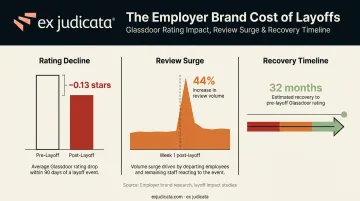
Glassdoor's analysis of 304 layoff events at 197 companies found that layoffs reduce overall Glassdoor ratings by an average of 0.13 stars, increase review volume by 44% in the first week, and that recovery to pre-layoff ratings takes an estimated 32 months. That's years of compounding recruiting friction, not a temporary dip.
Offering outplacement signals that the organization values people beyond their current role. That signal influences:
- How remaining employees perceive the company's values
- Whether future candidates choose to apply or accept offers
- How clients and partners view the organization's culture
The risk is highest during large-scale or high-profile restructurings, when public attention is concentrated and employee sentiment is volatile.
Reducing Legal and Financial Risk
Employees who feel abandoned during offboarding are more likely to file wrongful termination claims. Reductions in force implicate a range of legal risks — WARN Act compliance, discrimination exposure, disparate impact, and the enforceability of separation agreements — and poorly handled exits create the conditions for those risks to materialize. Outplacement reduces that exposure by demonstrating a deliberate, supportive exit process. It doesn't eliminate legal risk, but it changes the departing employee's experience in ways that lower grievance rates.
There's also a financial dimension: in states that use experience-rated unemployment insurance systems — including Texas, California, Minnesota, and New York — benefit charges to an employer's account can affect tax rates over time. When outplacement helps employees find new roles faster, it can shorten benefit claim duration. The safe framing is that faster reemployment may reduce benefit charges in experience-rated states; no state agency explicitly names outplacement as a UI tax reduction mechanism.
Sustaining Morale and Productivity Among Remaining Employees
The employees who stay are watching. How their colleagues were treated on the way out directly shapes their own sense of psychological safety — and their decision about whether to stay.
Harvard Business Review cites research showing that a 1% workforce reduction leads to a 31% increase in voluntary turnover the following year. Gallup estimates that replacing a single employee costs between 0.5x and 2x their annual salary. The math on survivor attrition is sobering.
Outplacement addresses this by demonstrating to retained employees that the company's values hold even at the moment of departure. That demonstration:
- Lowers anxiety among retained staff — "if I'm ever let go, I won't be abandoned"
- Maintains engagement and discretionary effort
- Slows voluntary departures at the moment the organization can least afford them
What Happens When Outplacement Is Skipped
Companies that skip outplacement don't avoid a cost — they trade a known, manageable expense for a set of harder-to-quantify ones.
The pattern is predictable:
- Departing employees leave with unresolved frustration, which surfaces as negative reviews, social media commentary, and sometimes legal action
- Remaining employees notice the signal — and draw conclusions about how the company would treat them in the same situation
- Employer brand damage compounds over months and years, increasing recruiting costs and extending time-to-hire for future roles
The false economy becomes visible when you stack the actual costs:
| Consequence | Research Finding |
|---|---|
| Employer brand recovery | Glassdoor rating declines take ~32 months to reverse |
| Retention fallout | A 1% workforce reduction correlates with a 31% spike in voluntary turnover |
| Replacement cost | Backfilling a departed employee runs up to 2x their annual salary |
Against that baseline, a well-designed outplacement program pays for itself — often before the next hiring cycle begins.
How to Get the Most Value from Outplacement Support
Outplacement works best when both parties treat it seriously.
For employees:
- Engage immediately — don't wait weeks to activate support
- Treat coaching sessions as working sessions, not conversations
- Use the program's full scope, including interview practice and materials review
For employers, the selection criteria matter more than the brand name:
- Evaluate providers on time-to-placement data, satisfaction scores, and placement rates
- Assess coach quality and availability — not just platform features
- Match the provider to the employee population's specific career situation
Large outplacement firms often provide generic, template-driven support that works adequately for same-field job placement. For professionals making a full career pivot, the fit is frequently poor.
When Standard Outplacement Falls Short: The Lawyer Transition Example
Lawyers transitioning out of legal practice face a challenge that standard outplacement tools aren't built to solve. The problem isn't their skills — it's how their CV and professional identity read to non-legal hiring managers. A lawyer's resume signals "overqualified, overpriced, will return to law in 18 months" to corporate hiring teams, killing applications before human review.
Standard outplacement treats this as a formatting problem. It's actually a positioning and identity problem — one that requires domain-specific knowledge most generalist providers don't have.
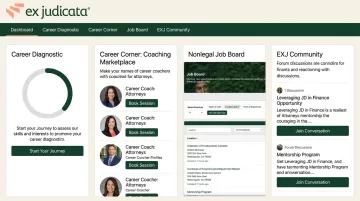
Ex Judicata is purpose-built for this specific transition. Its platform connects JDs with organizations actively hiring legal-trained talent for nonlegal roles across business, government, nonprofits, and academia. The offering includes:
- EXJ Career Diagnostic — a PhD-validated assessment mapping eight attorney traits against 25 business careers, producing fit scores no generic tool replicates for JDs
- Career Corner coaching marketplace — 10 vetted specialists selected specifically for the JD-to-nonlegal transition, covering positioning and identity, not just resume mechanics
- 100% nonlegal Job Board — every listed role is a nonlegal position for lawyers, removing the noise of searching LinkedIn or Indeed
- EXJ Community — the first peer-to-peer network for non-practicing lawyers, providing mentorship from JDs who have already made the transition to specific industries and functions
- Outplacement programs for law firms and corporate legal departments — enterprise-priced, confidential, and designed specifically for departing lawyers
For law firms or legal departments separating attorney talent, this is a meaningfully more targeted option than routing those individuals through a generalist outplacement platform.
Conclusion
Outplacement services reduce legal and financial risk, accelerate reemployment, protect employer brand, and signal organizational values at one of the most visible moments in the employee lifecycle. How an organization handles exits is remembered — by the people who leave and the people who stay.
The quality and fit of the program determines whether it delivers real outcomes. Generic support produces generic results. For organizations managing exits, the selection decision matters. For lawyers navigating a full career pivot out of practice, generic outplacement misses the core challenge: repositioning a legal identity into a nonlegal market. Specialized support — built around JD career paths, not general workforce transitions — is what closes that gap. Ex Judicata's outplacement programs are designed specifically for law firms and corporate legal departments managing exactly these exits.
Frequently Asked Questions
What is typically included in an outplacement services package?
Most packages include one-on-one career coaching, resume and cover letter development, LinkedIn profile optimization, interview preparation, and job search strategy support. Scope varies significantly by provider and budget — some offer digital-only tools while others provide dedicated coaching throughout the transition.
How long do outplacement services last?
Program length typically depends on seniority. Randstad RiseSmart's published tiers show 3-month programs for entry-level and individual-contributor roles, 6-month programs for managers, and 12-month programs for directors and above. Some providers offer support until placement is achieved rather than capping at a fixed date.
How much do companies pay for outplacement services?
Costs vary based on seniority, provider, and scope. Randstad RiseSmart publishes U.S. package pricing ranging from $899 for a 3-month entry-level program to $6,499 for a 12-month director-level program. Enterprise and executive arrangements are typically priced separately through direct negotiation.
Are outplacement services worth it?
When delivered by a quality provider, outplacement consistently shortens time to reemployment, improves employer brand outcomes, and reduces legal exposure. Those gains typically outweigh the program cost once you factor in avoided turnover, Glassdoor recovery, and potential legal disputes.
What is the difference between outplacement services and severance pay?
Severance is a cash payment tied to length of service or seniority and may be legally required depending on jurisdiction and employment agreement. Outplacement is a service-based benefit offered at employer discretion to support career transition. They serve different purposes and are most effective when offered together.
Do outplacement services help with career changes, not just job searches in the same field?
Traditional outplacement is designed primarily for same-field placement and handles cross-industry repositioning poorly. Professionals making full career pivots — lawyers moving into compliance, wealth management, or board service, for example — need specialized platforms with deep expertise in that specific transition. Ex Judicata is built exactly for that gap.