

Introduction
Nearly half of all attorneys are looking to leave — or at least open to it. Bloomberg Law's 2024 Attorney Well-Being Report found that 48% of attorneys were either actively job hunting or open to new opportunities at the end of 2023. The same report found lawyers felt burned out 48% of the time in the second half of that year, working an average of 50 hours per week.
These aren't fringe numbers. They describe the daily reality for most practicing attorneys.
The JD is not a cage. The analytical depth, persuasive communication, and research precision that make a great lawyer also translate directly to executive, compliance, policy, and entrepreneurial roles. A growing number of organizations outside law have figured this out — and they're actively recruiting JD talent.
This article covers why lawyers are leaving, which skills travel best, which career paths offer the strongest fit, how employers are changing their approach to JD hiring, and how to execute a transition strategically.
Key Takeaways
- Nearly half of lawyers are open to leaving — burnout and values misalignment are the cause, not personal failure
- Legal training builds a portable skill set: analytical thinking, risk assessment, persuasion, and research under pressure
- Top nonlegal paths include corporate roles, consulting, government, nonprofit leadership, and financial services
- Organizations in insurance, compliance, and risk management are actively recruiting JDs for nonlegal roles
- Successful transitions take six to nine months and require deliberate strategy — not just a resume update
Why Lawyers Are Leaving: It's Not Just Burnout
Burnout is real, but it's only part of the story. The structural forces pushing lawyers out of practice run deeper.
The Pressure Is Relentless
Bloomberg Law's 2025 workload data found that 97% of attorneys worked while out of office and 73% worked on at least half of their days off. Mid- and senior-level associates reported burnout rates of 51%. When work is this consuming, it becomes nearly impossible to explore alternatives — which is why so many lawyers stay despite wanting to leave.
The billable hour model compounds the problem. Every minute spent thinking about a career change is a minute not being billed. The structure of the profession makes self-reflection expensive.
The Expectation Gap
Many lawyers entered law for intellectual challenge, problem-solving, or a genuine desire to help people. What they found instead was a narrow subject-matter focus, adversarial dynamics, and a daily reality that bore little resemblance to their expectations.
This is a values misalignment, not a personal failure. Ex Judicata's coaching work points to a consistent pattern: the subject matter of a lawyer's work matters far less than what they're actually doing day-to-day, who they're working with, and how the job fits into the rest of their life. Many lawyers discover their dissatisfaction isn't with law itself — it's with the experience of practicing it.
The Identity Trap
Across Ex Judicata's Career Diagnostic, coaching sessions, and interview series, the real obstacle for most lawyers isn't the job market. It's psychological.
Leaving means walking away from a professional identity built over seven to nine years of training — shaped by law school debt, parental expectations, peer-group norms, and bar admission status. Most lawyers simply haven't had the time or space to seriously explore what else they might do. That's the gap Ex Judicata was built to close.
The JD Toolkit: Skills That Travel
Lawyers systematically undervalue their own training when considering a pivot. The JD isn't just a legal credential. It's a problem-solving and communication credential — one that employers in consulting, finance, corporate strategy, and government have increasingly learned to seek out.
What Legal Training Actually Builds
| Skill | Where It Travels |
|---|---|
| Analytical thinking and issue-spotting | Consulting, strategy, private equity, finance |
| Persuasive written and oral communication | Policy, marketing, PR, executive leadership |
| Contract interpretation and risk assessment | Compliance, operations, procurement |
| Research and synthesis under pressure | Journalism, academia, government |
| Negotiation and conflict resolution | HR leadership, investment management, mediation |
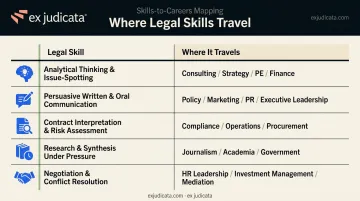
These aren't soft skills. They're core professional competencies that take years to develop, and most professionals without legal training don't have them.
Practice Area as a Natural On-Ramp
Specific legal backgrounds create direct pathways to specific nonlegal fields:
- Employment law → HR leadership
- M&A and transactional work → private equity, contract management, transaction advisory
- Regulatory practice → compliance, government affairs, ESG leadership
- Litigation → investigations, risk management, compliance
- Insurance defense → claims, underwriting, brokerage
These pathways are drawn from Ex Judicata's coaching work with transitioning attorneys. The JD Advantage isn't generic — when a lawyer can draw a straight line from their practice area to a business function, the transition becomes substantially easier to explain and to execute.
On the "Overqualified" Concern
Many lawyers assume nonlegal employers will discount their JD or see them as overqualified and likely to return to practice. That assumption is wrong, and the evidence is clear. McKinsey, BCG, and Bain all maintain formal advanced-degree hiring pipelines that explicitly include JDs — because consulting firms have learned that legal training produces the analytical rigor their work demands.
The real work is translation: converting legal experience into business language that non-legal hiring managers can recognize, evaluate, and get excited about.
Alternative Career Paths Worth Exploring
Business and Corporate Roles
The most common nonlegal destination for departing lawyers is the corporate world. Contract oversight, regulatory navigation, and risk identification are functions businesses need daily — and exactly what legal training produces.
High-fit roles include:
- Compliance officer — BLS 2024 median: $78,420, with approximately 33,300 annual openings
- Contract manager — average base around $94,000–$133,000 depending on seniority and sector
- Risk manager — Salary.com average: $130,651
- Chief of Staff — Salary.com average: $228,698 at the senior level
These roles offer legal-adjacent work without the billing pressure, adversarial dynamics, or the subject-matter narrowness that comes with a practice area.
Financial Services and Consulting
Transactional lawyers in particular are well-positioned for roles in management consulting, private equity, and financial analysis. BLS data shows management analyst roles growing 9% from 2024–2034, with roughly 95,700 annual openings.
McKinsey, BCG, and Bain actively recruit JDs through dedicated programs because the analytical overlap is real, not as a courtesy. BCG explicitly lists JDs as Advanced Degree Candidates in its recruiting materials.
For lawyers who thrive on complex problem-solving and client-facing work, consulting is often the closest cultural match to law firm life, minus the billing structure.
Government, Policy, and Public Sector
Legal training and policy work were built for each other. Congressional Research Service data shows that in the 119th Congress, 31% of House members and 47% of Senators held law degrees and had practiced law. For lawyers with regulatory, public interest, or administrative backgrounds, the transition into legislative affairs, government agency roles, or policy analysis is often smoother than expected.
Lobbying, government affairs, and public-sector strategy all require the same skills lawyers already have: issue analysis, argumentation, and stakeholder communication.
Nonprofit, Academia, and Entrepreneurship
These paths appeal to lawyers motivated by mission over compensation:
- Nonprofit leadership: Executive director and program leadership roles value the ability to analyze complex situations, manage stakeholders, and operate with limited resources — all JD-trained skills
- Academia: Law professor roles require additional credentials, but legal writing instruction, academic administration, and research administration are accessible at various levels
- Startups: JD founders and early-stage hires bring real advantages : comfort with contracts, risk analysis, and regulatory exposure that most early-stage teams lack
Ex Judicata's 44+ interview series documents lawyers who've built distilleries, bakeries, wineries, and photography businesses alongside more conventional corporate pivots. The range is wider than most lawyers realize.
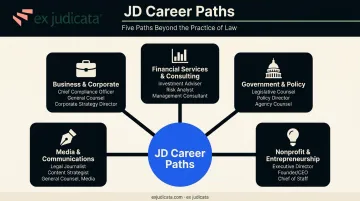
Media, Communications, and Writing
Legal journalism, content strategy, public relations, and book authorship are viable paths for lawyers whose strongest skill is written advocacy. The transition from legal writing to public-facing writing requires unlearning legalese. The underlying discipline, precision, and research depth, though, are competitive advantages few other writers can match.
Key entry points include:
- Legal journalism and trade media — covering courts, regulation, and policy for specialist outlets
- Content strategy — translating complex topics for business audiences
- Public relations and communications — drafting statements, managing messaging, navigating crises
- Book authorship and ghostwriting — especially in business, legal self-help, and policy
Companies Are Actively Looking for JD Talent
The conversation about lawyers leaving law usually focuses on what lawyers want. There's a parallel story worth telling: what employers want.
Organizations outside the legal world are actively seeking JD-trained candidates for nonlegal roles that demand sophisticated judgment, ethical grounding, and analytical rigor. Employers who have figured this out include:
- Insurance and risk firms
- Financial services companies
- Healthcare organizations
- Technology companies with regulatory exposure
- Large nonprofits
These employers have learned that a lawyer with business curiosity can outperform a business professional without legal literacy in certain high-stakes roles.
This matters for lawyers in transition because it reframes the search entirely. The question isn't just "can I make myself fit somewhere new?" It's "which organizations are already looking for someone exactly like me?" — and that's a much more empowering starting point.
That question has a concrete answer. Ex Judicata was built specifically to bridge this gap, connecting JDs seeking to leave practice with organizations actively recruiting for nonlegal roles. EXJ Search — a first-of-its-kind recruiting category at the nexus of legal and executive search — exists because employer demand for JD talent has grown sophisticated enough to warrant dedicated search services.
Documented EXJ Search placements illustrate the range:
- Nicolas Dumont (former Cooley partner) → VP and Transaction Advisory Leader, Lockton's Technology Risk Team
- Lee Garner (former Skadden counsel) → Managing Director of Compliance & Investigations, Guidepost Solutions
- Alan Kornberg (former Paul Weiss partner) → Senior Adviser, Marsh McLennan

That response rate tells its own story. When EXJ Search approached senior bankruptcy partners about one nonlegal role, 48 out of 50 called back — far above typical law firm recruiting benchmarks.
How to Transition Out of Law: A Practical Roadmap
Start With Self-Assessment, Not Job Titles
Before targeting roles, identify what you want more of — autonomy, mission, creativity, human interaction — and what you want less of: billing pressure, adversarial dynamics, subject-matter narrowness. Then map those preferences to the skill categories above.
Ex Judicata's $25.95 EXJ Career Diagnostic was built specifically for this step. The PhD-validated assessment maps eight attorney personality traits against 25 business career categories, delivering a personalized compatibility report that shows where your profile fits strongest.
Navigate the Job Search Deliberately
Once you know your direction, the search itself requires a different approach. Most nonlegal opportunities for senior JDs don't surface on general job boards. A few approaches that work:
- Informational interviews with JDs who've already pivoted (the EXJ Community's member directory makes this concrete)
- Reconnecting with law school contacts in business roles — they understand your background and speak the hiring manager's language
- Targeted outreach to companies in sectors that align with your practice area
- Specialized platforms like the Ex Judicata Job Board, where 100% of posted roles are nonlegal positions for JDs
The infrastructure matters: tools built for general candidates weren't designed around the JD-to-business move.
Manage the Timeline and the Risk
With a clearer target in hand, expect the actual transition to take six to nine months. Exploring options while still practicing is normal — and often necessary. Use that runway to build real conviction before committing.
One caution: research what a target role actually looks like day-to-day, not just how it reads in a job description. Talking directly to people in those roles — through the EXJ Community or informational interviews — will tell you more than any job posting will.
Making the Identity Shift: Embracing Life After Law
Leaving law is not just a logistical challenge. It's an identity challenge.
Many lawyers have built their sense of self around the credential and the title. The transition asks them to let go of a professional identity that took years to construct — and that process is harder than updating a resume. This is a widely shared experience among lawyers who leave practice, not a personal weakness.
Hundreds of thousands of JDs in the US are already working in nonlegal careers — across every industry, sector, and role type imaginable. And they've built community around it.
The EXJ Community, launched by Ex Judicata in January 2026, is the first peer-to-peer network built specifically for non-practicing lawyers. Membership is free for NPLs (no credit card required). The platform includes:
- The first-ever NPL directory
- Mentorship matching by career type and industry
- Member-only investment opportunities
- On-demand courses and webinars
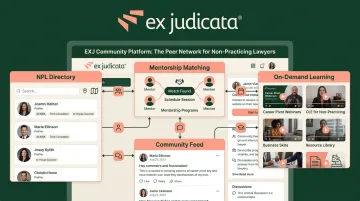
For lawyers who've already made the move, it's a place to connect with people who understand what it means to be a JD in a nonlegal career. For lawyers still weighing the pivot, it offers direct access to people who've been exactly where they are.
Frequently Asked Questions
What are alternative careers for lawyers?
The major categories include business and corporate roles (compliance, contract management, risk, chief of staff), financial services and consulting, government and policy, nonprofit leadership, academia, entrepreneurship, and media and communications. Employers in nearly every sector actively seek JD-trained candidates for roles that demand sharp analysis, sound judgment, and persuasive communication.
How do I transition out of being a lawyer?
Start with a self-assessment of your skills and values, then conduct targeted informational interviews with JDs who've already pivoted. Skip general job boards — use platforms and resources built specifically for lawyers in transition. Most successful pivots take six to nine months from first serious exploration to offer.
Can I leave law without wasting my JD degree?
The JD is a portable credential. It signals rigorous analytical thinking, ethical judgment, and communication ability to employers across many industries. Many nonlegal employers — particularly in compliance, risk, consulting, and financial services — specifically seek JD-trained candidates for roles that require sophisticated judgment.
Do lawyers make less money in nonlegal careers?
Compensation varies by sector. Consulting and financial services can approach or exceed legal salaries over time; nonprofit and government roles typically pay less than BigLaw. NALP's 2025 median first-year associate salary is $200,000; BLS reports management analyst median pay at $101,190 — a gap many lawyers accept in exchange for autonomy and better work-life balance.
What is the 80/20 rule for lawyers?
In law firm finance, it describes how a small percentage of clients drive the majority of revenue. For career pivots, the logic translates directly: identify the 20% of your skills and experiences that will generate 80% of your value in a nonlegal role, then lead with those in your positioning, resume, and hiring conversations.
What skills from law practice transfer best to business roles?
Analytical thinking, persuasive communication, contract and risk literacy, negotiation, and research synthesis are the most consistently valued legal skills in business contexts. These are exactly the skills organizations recruiting JD talent for nonlegal roles are looking for — and ones most business professionals without legal training simply don't have.