

That gap still exists for most lawyers who reach this turning point. The tension is real — significant educational investment, a professional identity wrapped up in the JD, and genuine dissatisfaction pulling in the opposite direction. According to Bloomberg Law's Attorney Workload Survey, attorneys reported feeling burned out 42% of the time in 2024, with mid-level and senior associates hitting 51%.
The question most lawyers are actually asking isn't "Is it okay to leave?" It's "How do I do it without blowing up my finances, my reputation, or my future options?"
Here are four practical answers.
Key Takeaways
- Financial preparation — not job searching — is the right first move before leaving law.
- Self-assessment comes before applications; knowing what you want matters more than knowing what you can get.
- JDs bring in-demand skills to nonlegal employers across business, compliance, policy, and beyond.
- Platforms like Ex Judicata — with a job board, career diagnostic, coaching marketplace, and peer network built for JDs — cut the guesswork out of the transition.
- How you exit matters — the legal world is smaller than it appears.
Why So Many Lawyers Are Considering a Career Change
Lawyer dissatisfaction is documented, widespread, and not a personal failing.
A joint study by the California Lawyers Association and D.C. Bar found that about one-quarter of women and 17% of men had contemplated leaving the legal profession due to mental health concerns, burnout, or stress. Those aren't outliers — that's a substantial share of the practicing bar.
The drivers behind this trend are well-documented:
- Billable-hour pressure, round-the-clock client demands, and chronic stress that accumulates over years
- Work that conflicts with personal values or simply stops feeling meaningful
- An identity built entirely around "being a lawyer" — and the exhaustion that comes with it
- A salary that looks good on paper, but a lifestyle that often doesn't
What's shifted is the framing. Leaving law used to feel like failure. For a growing number of attorneys, it now feels like a legitimate — and increasingly well-traveled — career move. The practical question is how to make that move successfully — which is exactly what the tips below are designed to help you answer.
Tip 1: Get Your Financial House in Order First
Financial preparation is where most career pivots succeed or fail. Get this wrong, and even the right next move becomes unsustainable.
Know What You're Walking Into
The income gap between legal practice and most nonlegal roles is real. The BLS reports the median annual wage for lawyers at $151,160 as of May 2024. Common nonlegal destinations pay considerably less at the entry point: compliance officers earn a median of $78,420, management analysts $101,190, and fundraisers $66,490. Human resources managers, at $140,030, come closest, but still represent a step down for many practitioners, particularly those coming from BigLaw.
Ex Judicata's Money Management content hub is direct about this: a BigLaw associate or non-equity partner leaving practice typically takes a 20–60% near-term compensation cut, with the expectation of catching up over three to seven years if the career fit is right. That's not a deterrent — it's a planning variable. Knowing the number lets you prepare for it.
Concrete Steps Before You Move
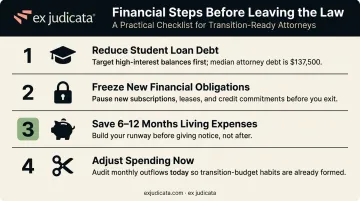
- Reduce student loan debt before you exit. The ABA YLD/AccessLex 2024 survey found young lawyers carried a median of $112,500 in J.D. loans at graduation and $137,500 in total education debt — and three-quarters said debt had altered their career plans.
- Freeze new financial obligations now. New mortgages, car upgrades, and large purchases while still earning a lawyer's salary can lock you in longer than you want.
- Save 6–12 months of living expenses as a transition cushion before making any move — this is the buffer that keeps decisions rational rather than reactive.
- Adjust your spending while you're still earning. The lifestyle that comes with a legal salary — dining, travel, discretionary costs — can become a financial anchor. Cutting back now creates real options later.
Consider a Phased Exit
Not every transition has to be a hard stop. Some lawyers move to lower-pressure legal roles, take on consulting work, or shift to part-time arrangements before exiting fully. Ex Judicata's Money Management hub addresses bridge-income strategies explicitly — because the transition window, when income drops but fixed costs haven't, is where most pivots fail.
Build enough runway to make the right decision — one based on fit, not financial pressure.
Tip 2: Get Clear on What You Actually Want to Do Next
Most lawyers skip this step and go straight to job hunting. That's how you end up in another role that feels wrong — just in a different setting.
Ask Better Questions First
The real question isn't "What job can I get with a JD?" It's:
- What kind of work actually energizes me?
- What does my ideal workday look like — structure, autonomy, collaboration?
- What industries or causes do I feel drawn to?
- What skills do I most enjoy using, and which ones drain me?
- What lifestyle do I need this career to support?
Many lawyers have never seriously engaged with these questions. As Ex Judicata's wellbeing resources note, some attorneys have nothing going on outside their legal careers — not from lack of interest, but because Big Law consumed the time and mental space those interests needed to develop.
Address the Identity Layer
Letting go of the "attorney" label is harder than most lawyers expect. It's not just a job title — for many, it's the source of validation, professional identity, and social standing they've built over years of grueling education and practice.
Reframing helps. The transition isn't "leaving law" — it's bringing a JD's skills to a new field. That framing is additive rather than subtractive, and it's accurate. The analytical training, writing discipline, and instinct for risk — none of that disappears. It becomes a differentiator in fields where those skills are rare.
Once you're clear on what you're bringing, the next question is where to take it.
Know Where JDs Land
NALP identifies a wide range of JD Advantage roles where legal training provides genuine career value:
- Compliance and risk management
- Privacy and data roles
- Management consulting and corporate strategy
- Policy analysis and government affairs
- Human resources and people operations
- Contract administration and legal operations
- Patent agency work
- Nonprofit leadership and fundraising
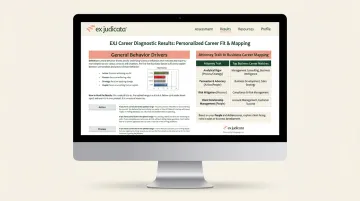
Ex Judicata's EXJ Career Diagnostic takes this further — a PhD-validated assessment that maps eight attorney personality traits against 25 specific business careers, producing a personalized fit score for each path. At $25.95, it's a practical way to move from "I don't know where to start" to a ranked list of paths matched to how you actually think and work.
Test Before You Commit
Explore interests while still employed. Freelance writing, volunteer board work, industry events, online courses — these aren't detours. They're data. If a side project gains traction, that's often the clearest signal of where to go next.
Tip 3: Tap Into the Right Resources and Community
Tip 3: Tap Into the Right Resources and Community
One of the biggest obstacles lawyers face when leaving practice is simply not knowing what they don't know — which career paths exist, which employers actively hire JDs for nonlegal roles, and what the transition actually looks like from the inside.
Work With Specialists, Not Generalists
Generic career advice rarely addresses what lawyers specifically face: the identity component, the financial complexity, the challenge of rewriting a CV that screams "overqualified" to corporate hiring managers. Career coaches who specialize in legal transitions understand these dynamics and can provide structured guidance that a general career counselor won't.
Ex Judicata's Career Corner connects lawyers with 10 vetted specialists — covering CV and LinkedIn rewriting, personal branding, interview prep, leadership development, and reverse recruiting (where recruiters pitch you, not the other way around) — each with a complimentary discovery consultation.
Connect With People Who've Done It
Talking to lawyers who have already made the transition is one of the most valuable things you can do when considering a pivot. It delivers what no article or coach can fully replicate:
- Surfaces career paths you wouldn't have considered on your own
- Reduces the isolation that comes with questioning a path everyone around you seems committed to
- Provides unfiltered, real-world perspective on what the transition actually involves
The EXJ Community at Ex Judicata was built for exactly this. It's the first peer-to-peer network for non-practicing lawyers (NPLs) in the U.S. — free to join for lawyers who have already left practice, with no credit card required. Launched in January 2026 as Ex Judicata crossed 500,000 unique users, it includes the first-ever NPL member directory, where members can search by career type, industry, company, and years since leaving practice.
Use a Platform Built for This Transition
Ex Judicata is the only career transition platform built specifically for JDs seeking nonlegal careers. Beyond the Community, the platform covers every stage of the transition:
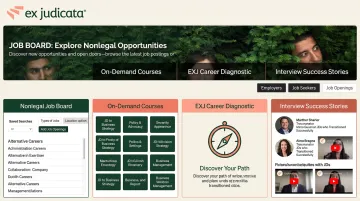
- A Job Board where 100% of listings are nonlegal roles for lawyers — no filtering through thousands of irrelevant positions
- On-demand courses including Financial Fluency for Lawyers (CLE-eligible, taught by Notre Dame Law Professor Matthew J. Barrett) and A Primer on Data Analytics for Lawyers
- The EXJ Career Diagnostic for structured self-assessment
- 44+ EXJ Interview success stories from lawyers who made the leap — across compliance, finance, insurance, nonprofit leadership, entrepreneurship, sales, communications, and more
The range of destinations in those interviews matters. JDs from BigLaw have landed at companies like Lockton, Guidepost Solutions, and Marsh McLennan. The paths are real, and the people who walked them are accessible.
Tip 4: Leave on Good Terms — Don't Burn Bridges
However a lawyer feels about their firm, their colleagues, or the profession itself, leaving professionally is a strategic decision — not just a moral one.
The Practical Case for a Clean Exit
Legal and business communities overlap more than they appear to from the inside. A reputation follows a person across transitions, and the professional world has a long memory.
NYC Bar Opinion 2023-1 spells out that lawyer departures carry ethical obligations tied to client interests and client choice. Philadelphia Bar Ethics Opinion 99-100 requires proper notification to existing clients. Meeting these obligations isn't just about ethics — it's the baseline for an exit that doesn't create complications down the road.
Beyond ethics, consider relationship continuity. Research from MIT on weak ties in LinkedIn networks found that looser professional connections were more likely to lead to new employment than close ones. Former colleagues, partners, and even opposing counsel are exactly the kinds of weak ties that can open doors years later.
What a Professional Exit Actually Looks Like
Those weak ties only stay warm if you leave the right way. In practice, that means:
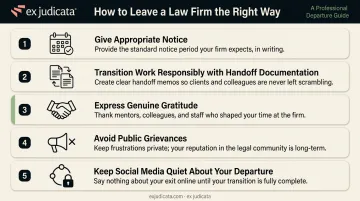
- Give appropriate notice — don't disappear
- Transition outstanding work responsibly, with clear handoff documentation
- Express genuine gratitude where it's warranted — honest, not performative
- Avoid sharing grievances publicly or in farewell messages
- Keep social media quiet about the specifics of your departure
Some lawyers who leave return to practice years later. Others find that former partners become business collaborators, referral sources, or advocates in a new industry. Keeping those relationships intact preserves options that are impossible to predict at the time of exit. The lawyers who navigate this well aren't the ones who pretended everything was fine. They're the ones whose former colleagues actually pick up the phone when they call.
Frequently Asked Questions
What is a good second career for a lawyer?
JDs pursue a wide range of nonlegal paths — compliance, corporate strategy, consulting, policy, nonprofit leadership, wealth management, insurance, communications, entrepreneurship, and education. The right fit depends on your skills, interests, and lifestyle priorities. Ex Judicata's EXJ Interview series documents 44+ real transitions across these fields.
What percent of lawyers quit?
The BLS projects a 3.2% annual occupational separations rate for lawyers in 2024–2034 — roughly 27,900 per year, covering both labor-force exits and occupational transfers. Survey data suggests the impulse runs wider: one study found roughly one-quarter of women and 17% of men had seriously considered leaving due to burnout or mental health concerns.
Do lawyers make $500,000 a year?
Most don't. The BLS reports a median annual wage for lawyers of $151,160 as of May 2024. Partner compensation is a different story — MLA reported average law firm partner compensation of $1,411,000 in 2024. But that figure reflects a small subset of the profession, not the typical lawyer's experience.
What transferable skills do lawyers bring to nonlegal careers?
Nonlegal employers consistently value JDs for analytical reasoning, issue-spotting, risk assessment, negotiation, written and verbal communication, and the ability to synthesize complex information under deadline pressure. These competencies transfer directly across compliance, corporate strategy, nonprofit leadership, and beyond.
How long does it take to transition from law to a nonlegal career?
Timelines vary widely — some lawyers land in a new role within months; others take a year or more. Financial readiness, clarity on direction, personal branding, and network access all shape the pace. Lawyers who invest upfront in self-assessment and positioning consistently move faster than those who improvise.