

You're not alone. Associate attrition at large firms runs nearly 18–20% annually, and 83% of associates who departed in 2025 left within five years of being hired, according to NALP Foundation data. The question most unhappy Big Law attorneys ask isn't "should I leave?" — it's "how do I actually do it without blowing up my finances or my career?"
This guide answers that question. It covers how to recognize when the problem is structural (not just a rough patch), what's really keeping you stuck, how to build a financial runway, what comes next, and how to execute a concrete exit. Whether you want to stay in law with a better environment or leave legal practice entirely, the path forward exists — and it's more navigable than it looks from inside the firm.
Key Takeaways
- Big Law attrition is high — leaving is the norm, not the exception
- The biggest barriers are psychological and financial, not logistical. Both are manageable with the right plan.
- Your JD is a genuine asset outside law practice; employers actively recruit for it
- A successful exit needs a financial runway, a clear timeline, and a target destination
- Purpose-built resources — job boards, peer networks, and JD-specific coaching — exist to support this transition
Signs It's Time to Leave Big Law
The Difference Between a Rough Patch and a Structural Mismatch
Everyone has brutal stretches in Big Law. A nightmare deal, an unreasonable partner, a quarter of impossible hours. That's not a reason to leave — it's a reason to take a vacation.
The real signal is simpler: if rest, time off, or a new practice group doesn't change how you feel, the problem isn't your resilience. It's the environment.
Specific warning signs to take seriously:
- Chronic Sunday dread that doesn't lift after a good weekend
- Emotional detachment from outcomes — wins and losses feel equally meaningless
- A persistent sense that time is being spent rather than invested
- Recurring thoughts of leaving that you keep dismissing as irrational
Bloomberg Law's 2024 Attorney Well-Being Report found attorneys reported feeling burned out 48% of the time, with attorneys aged 25–34 reaching 58%. These numbers aren't just statistics — they describe what a structural mismatch feels like at scale.

The Identity Trap
Many Big Law attorneys stay long after the work has stopped working for them because the job and the self have become the same thing. The firm name on your business card, the Cravath-scale salary, the answer you give at dinner parties — these feel inseparable from who you are.
Recognizing that conflation is itself a sign it's time to reassess. The attorneys who navigate this transition most successfully are the ones who start separating the two before they have to.
The Cost of Staying Too Long
That identity grip is exactly what makes the costs of staying so easy to ignore. But they're real: relationships strained by unavailability, health eroded by chronic stress, and the compounding opportunity cost of years spent in a role that doesn't fit.
If the thought of leaving surfaces regularly, that's data — not irrationality. The next step is figuring out what leaving actually looks like and where your JD skills transfer best.
What's Really Keeping You Stuck in Big Law
Most Big Law attorneys don't stay because they love the work. They stay for reasons that deserve honest examination.
Fear and Prestige
Lawyers are trained to be risk-averse. Big Law rewards prestige-seeking. The social validation of a top-firm title — and the external expectations attached to it, from parents, peers, and law school rankings — can keep attorneys locked in long after the work has stopped being satisfying.
The pressure is real. The harder question is whose expectations you're actually managing.
Golden Handcuffs and Student Loans
Finances are the other side of that same trap. The Cravath scale currently runs from $225,000 to $435,000 for associates, with Milbank recently moving its top end to $455,000. For attorneys carrying six-figure law school debt — NYU's median borrowed amount was $184,952 — leaving can feel financially impossible.
Lifestyle inflation is usually the real culprit, not fixed expenses. Many Big Law attorneys have unconsciously built a life that requires the salary — the apartment, the dinners, the travel — without ever asking what the actual floor of their monthly costs is. That floor is almost always lower than they assume.
Analysis Paralysis
Lawyer brains are built to weigh every risk. That's valuable in practice and paralyzing in career decisions. The result is a planning loop: always preparing to leave "next year," gathering information indefinitely, never acting. Perfect information about a career pivot doesn't exist. Indefinite preparation is still a choice — just one that defaults to staying.
The Peer Bubble
When everyone around you is also a Big Law attorney, leaving feels aberrant — like failure or eccentricity. A homogenous professional environment distorts your sense of what's normal. Outside that bubble, thousands of former Big Law attorneys are building careers in business, compliance, consulting, nonprofits, and government. The bubble makes them invisible.
How to Financially Prepare to Leave Big Law
Financial preparation does more than reduce risk. It turns a shapeless fear into a specific number you can work toward.
Step 1: Audit Your Actual Monthly Expenses
Separate what you genuinely need from what you're currently spending. Many Big Law attorneys discover a significant portion of their spending is stress-driven: takeout, retail therapy, travel that feels earned but isn't budgeted consciously. Use a budgeting tool (YNAB, Monarch, or even a spreadsheet) to identify your actual monthly baseline.
Step 2: Calculate Your Runway Number
Once you know your real monthly costs, calculate how many months of expenses you currently have saved. Decide whether a 6-, 9-, or 12-month cushion fits your risk tolerance and target timeline.
That number matters because it's specific. "I need to save $X more before I can move" is a project. "I can never afford to leave" is just fear with a dollar sign attached.
Step 3: Research What Target Roles Actually Pay
Leaving Big Law often means a near-term salary reduction — Ex Judicata's Money Management hub puts the typical compensation cut at 20–60% in the first role, with a 3–7 year catch-up trajectory when the transition succeeds. Rough benchmarks from BLS data:
| Role | Median Annual Wage | Notes |
|---|---|---|
| Compliance Officer | $78,420 | Occupation-wide; JDs often command more |
| Management Analyst/Consultant | $101,190 | Top 10% earn $174,140+ |
| In-house GC/CLO | $556,794 (avg. total cash) | Senior role; varies significantly by company size |
| Senior In-house Counsel | ~$240,000–$256,000 | Per Major, Lindsey & Africa 2024 data |
| Government attorney (DOJ/SEC) | Varies; SEC tops at $292,300 | Below partner-level Big Law |
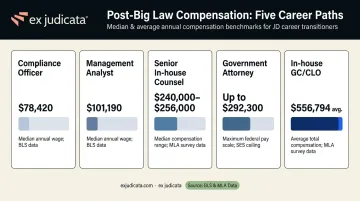
Model the actual gap between your current compensation and your target role — then decide if the gap is a hard constraint or a manageable adjustment.
Step 4: Develop a Student Loan Strategy
Student debt shouldn't be a reason to stay permanently, but it needs a plan. Three primary options:
- Income-driven repayment (IDR): Ties monthly payments to income, which drops after leaving Big Law — often meaningfully reducing monthly obligations
- Public Service Loan Forgiveness (PSLF): Available for government and qualifying nonprofit roles after 10 years of qualifying payments — worth modeling if you're targeting those sectors
- Refinancing: Lowers interest rates but eliminates federal loan protections; only appropriate if PSLF is off the table and income is stable
Ex Judicata's free Money Management content hub addresses these trade-offs specifically in the context of leaving a Big Law salary, and recommends pairing editorial guidance with a Certified Student Loan Professional (CSLP) for personalized planning.
Step 5: Distinguish Real Constraints from Cognitive Ones
If you've completed Steps 1–4 and the numbers still feel impossible, that's worth examining directly. A few diagnostic questions:
- Does your runway calculation assume lifestyle costs you could actually reduce?
- Have you modeled the target salary — or assumed your current comp as the baseline?
- Does "I can't afford to leave" come up before or after you've run the numbers?
Real financial constraints show up in spreadsheets. Cognitive ones tend to appear before you open one.
Career Paths After Big Law: What JDs Do Next
Staying in Law, Leaving Big Law
Not every exit means leaving legal practice. Common paths that change the environment without abandoning the license:
- In-house counsel at a corporation — highly sought by Big Law alumni; often better work-life balance, though compensation varies by company size and stage
- Government attorney — DOJ, SEC, FTC, state AG offices; compensation is lower, but mission-driven work and structured hours are real advantages
- Public interest and nonprofit law — meaningful work, PSLF eligibility, predictable hours
- Boutique or regional firms — smaller platforms, more manageable cultures, sometimes deeper substantive focus
- Academia — law school teaching and administration for those with scholarly inclinations
Leaving Legal Practice Entirely
A growing number of Big Law alumni leave law practice as a deliberate choice, not a last resort. Specific nonlegal roles that actively recruit JDs include:
- Compliance, risk management, and legal operations
- Management consulting and legal technology
- Policy, government affairs, and ESG leadership
- Financial services (wealth management, insurance, investment advisory)
- Corporate strategy, business development, or Chief of Staff roles
- Board service
Ex Judicata's documented placements show the range: Nicolas Dumont moved from a Cooley partnership to VP of Transaction Advisory at Lockton; Alan Kornberg moved from a Paul Weiss partnership to Senior Adviser at Marsh McLennan; Lee Garner moved from Skadden counsel to Managing Director of Compliance & Investigations at Guidepost Solutions. None of these are lateral moves into legal roles. They're genuine pivots into business leadership.
Translating Your JD for Nonlegal Employers
Getting hired for those roles requires one critical shift: language. The skills Big Law builds are valuable outside law, but most attorneys don't know how to describe what they do in terms corporate hiring managers recognize.
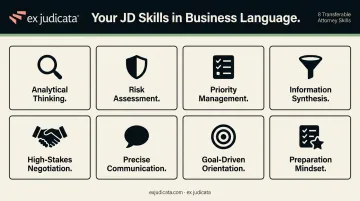
Ex Judicata identifies eight core transferable skills that resonate with nonlegal employers:
- Analytical thinking and issue-spotting
- Risk assessment under pressure
- Managing competing priorities and deadlines
- Synthesizing large volumes of information quickly
- High-stakes negotiation
- Precise written and verbal communication
- Goal-driven orientation
- Preparation mindset and commitment to thoroughness
The key shift is framing these as business outcomes, not legal footnotes. An attorney who led a team negotiating a major real estate acquisition didn't just "handle zoning matters" — they directed large-scale project management across multiple stakeholders under time pressure.
How to Explore Without Triggering a Firm Response
You don't need to commit before you explore. While still employed:
- Conduct informational interviews through law school alumni networks
- Attend industry events in target sectors
- Use LinkedIn to research career paths of former colleagues who've transitioned
- Have coffee conversations — this is research, not a formal job search
Ex Judicata's Job Board lists 100% nonlegal roles for JDs across business, nonprofit, government, and academia. It's useful for understanding what employers are actually hiring and what they require before you make any commitment.
For lawyers assessing fit across 25 business career categories, the EXJ Career Diagnostic ($25.95) maps eight attorney personality traits against those roles and delivers a personalized PDF report with fit percentages. It's built by the same PhD team whose assessments evaluate Fortune 500 board candidates.
Your Step-by-Step Action Plan for Leaving Big Law
Step 1: Clarify What You Actually Want
Before updating a resume or contacting a recruiter, take time to identify what's missing. Is it autonomy? Meaning? Flexibility? Alignment with values? Clarity here prevents trading one bad fit for another.
Tools that help: a personal values inventory, a structured career-change assessment, or the EXJ Career Diagnostic if you're considering nonlegal roles.
Step 2: Build Your Runway and Set a Quit Date
Once you have your runway number, set a concrete savings target and a realistic timeline. Commit to a quit date — even a tentative one. An open-ended plan to leave "eventually" rarely becomes action. Sharing that date with one trusted person creates accountability.
Step 3: Network Quietly While Still Employed
Reach out to law school alumni in roles that interest you. Attend events. Have conversations. This is relationship-building and research — not a formal search — and it can begin immediately without triggering any firm response.
Step 4: Reposition Your Professional Profile
Your Big Law CV and LinkedIn profile are written for law firm audiences. They need to be rewritten for business ones. This means translating legal accomplishments into business outcomes and leading with transferable skills rather than legal credentials.
Ex Judicata's Career Corner is a coaching marketplace built specifically for this: vetted specialists who work with lawyers making the move to business roles. Services include:
- CV rewriting for non-law audiences
- LinkedIn repositioning and personal branding
- Interview preparation for business roles
- ATS keyword optimization and reverse recruiting

Each specialist offers a complimentary discovery consultation. Browse the full roster at exjudicata.com.
Step 5: Execute and Lean on Community
When the offer arrives or the timeline hits, give notice professionally and cleanly. The transition doesn't end on your last day. Connect with others who have made similar moves — especially non-practicing lawyers who understand what this specific shift feels like from the inside.
The EXJ Community at community.exjudicata.com is a free peer-to-peer network for non-practicing lawyers, with a member directory, exclusive content, and connections spanning Fortune 500 companies, consulting firms, legal tech, private equity, and more. No credit card required.
Frequently Asked Questions
How many people quit Big Law?
Associate attrition at large law firms runs 18–20% annually, and 83% of those who departed in 2025 left within five years of being hired, per NALP Foundation data. Departure is the norm, not the exception. The real question is whether you leave on your terms or wait until you're pushed.
What do Big Law lawyers do after they leave?
The range is wide: in-house counsel, government and regulatory roles, boutique firms, and — increasingly — nonlegal careers in compliance, consulting, financial services, legal technology, corporate strategy, and nonprofit leadership. Most transitions leverage the JD skill set in business rather than abandoning it.
Do lawyers make $500,000 a year?
Some do. Senior associates at elite firms can reach $550,000 when base and bonuses combine (the 2025 scale: $435,000 base plus up to $115,000 in year-end bonuses), and the average equity partner earned $1,411,000 in 2024, per Major, Lindsey & Africa. The majority of practicing attorneys earn nowhere near those figures, and nonlegal compensation often closes the gap faster than most expect.
What is the 80/20 rule for lawyers?
In law firm management, the 80/20 rule (Pareto principle) holds that roughly 20% of clients or matter types generate 80% of revenue. This dynamic shapes how Big Law firms prioritize work, how partners manage associate time, and — in practice — which associates get the most demanding assignments, contributing directly to burnout and attrition.
How do I financially prepare to leave Big Law?
Start by auditing real monthly expenses to separate lifestyle spending from fixed costs, then build a 6-to-12-month cash reserve. Research compensation ranges for target roles and nail down a student loan strategy: IDR, PSLF (if targeting government or nonprofit), or refinancing if not. The goal is a concrete plan with a savings target and a timeline — not just a vague intention to leave.