

If you're thinking about leaving, you're in substantial company. Over 500,000 lawyers and law students have visited Ex Judicata's platform seeking exactly that guidance.
The desire to leave isn't weakness — it's data. The question isn't whether to go, but how to do it without blowing up your finances, your reputation, or your sense of self.
These four tips address what actually matters: getting financially stable, rethinking your identity, repositioning your brand, and building real opportunities. No vague encouragement. Just what works.
Key Takeaways
- Build your financial runway first; your exit timeline should follow from that, not from waiting for the perfect job offer
- Your JD is a deployable asset in compliance, risk, consulting, and policy — not a sunk cost
- Nonlegal hiring managers need your resume translated, not just updated
- Warm outreach beats cold applications for career changers, every time
Tip 1: Get Your Financial House in Order Before You Leave
The income gap is real, and most lawyers underestimate it. Ex Judicata's Money Management hub is direct about this: a Big Law associate or senior associate leaving practice typically takes a 20–60% near-term compensation cut moving into a business role, with comp recovery expected over 3–7 years if the transition lands well.
To put numbers to that: NALP reports the median first-year private-sector associate salary hit $200,000 as of January 2025, with large firms paying $215,000+. Compare that to entry-level JD Advantage roles, where the median starting salary is $82,000.
That gap is manageable — but only if you plan for it before you walk out the door.
Build Your Financial Runway First
Before you hand in notice, work through these steps:
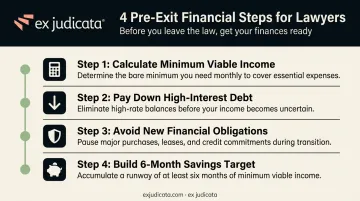
- Calculate your minimum viable income — the floor your household can operate on for 6–12 months, covering fixed expenses, insurance, and loan payments
- Pay down high-interest debt aggressively before you reduce income
- Avoid new financial obligations — hold off on a mortgage or major purchase until you've landed
- Set a savings target that covers 6 months of that minimum figure, even if it delays your exit by a quarter or two
Address the Student Loan Factor Directly
Law school debt keeps many attorneys trapped in practice long after they've checked out mentally. The average law school graduate carries $137,500 in student loan debt, according to the Education Data Initiative.
That debt doesn't require a lawyer's salary to manage. Federal income-driven repayment plans base monthly payments on income and family size — a meaningful lever if your income drops during transition. If you're moving into government or a 501(c)(3) nonprofit, Public Service Loan Forgiveness may eliminate your remaining balance after 120 qualifying payments. Refinancing is another option if federal forgiveness programs don't apply to your situation.
Financial clarity before you leave means your next career decision is driven by direction — not by whatever paycheck keeps the lights on.
Tip 2: Let Go of the Lawyer Label — Own Your JD Skillset
Here's the trap most lawyers fall into: staying in practice not because they love it, but because leaving feels like abandoning seven to nine years of sacrifice. That's the sunk cost fallacy at work — continuing an endeavor because of prior investment, regardless of whether current costs outweigh future benefits. The NIH Office of Intramural Training and Education applies it directly to career decisions.
The law school investment is real. But it's already spent. The only variable you control is what you do next.
Reframe the Transition
Leaving legal practice doesn't mean abandoning your JD. It means deploying it more intentionally. Scott Westfahl, a Harvard Law professor and former non-practicing attorney at McKinsey, puts it clearly in his EXJ Interview: "As a JD you are always building on your past experiences. And this idea that I'm throwing away that JD credential if I'm not applying it currently is wrong. What good is a credential if it's not making me happy and fulfilled?"
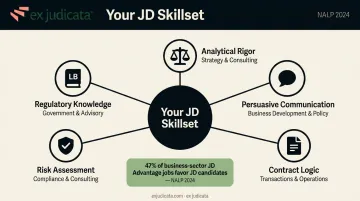
The skills aren't going anywhere. Analytical rigor, persuasive communication, contract logic, risk assessment — these are actively in demand in business, nonprofits, government, and academia. NALP reports that 47% of business-sector JD Advantage jobs taken by the Class of 2024 were in roles where a JD provides a demonstrable advantage.
Start with Self-Assessment
That external demand matters — but only once you know which parts of your skillset to lead with. Ask yourself:
- What tasks in your legal career gave you energy, not just expertise?
- What do colleagues compliment you on that has nothing to do with case outcomes?
- Which parts of your work would you do voluntarily — even unpaid?
If you want structure, the EXJ Career Diagnostic ($25.95, available at exjudicata.com) maps eight core attorney personality traits — including Drive, Initiative, Competitiveness, and Perception — against 25 business career categories, giving you a scored fit percentage for each. It's the first assessment built specifically for JDs navigating this transition.
The identity shift takes time. But lawyers who make it consistently say the same thing: once they stopped defending the label, they started getting hired for what they actually know how to do.
Tip 3: Rebuild Your Professional Brand for Nonlegal Employers
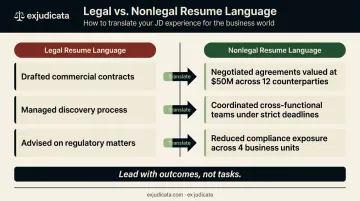
The biggest tactical mistake lawyers make during transition: submitting a legal resume to a nonlegal employer. Hiring managers outside law don't know what "drafted commercial contracts" or "managed a discovery process" means in terms of business value. They do understand outcomes.
Reposition Your Resume Around Results
Think of it as a translation exercise, not a cosmetic refresh:
- "Negotiated agreements valued at $50M across 12 counterparties" lands differently than "Drafted commercial contracts" — lead with the outcome, not the task
- Quantify wherever possible: headcount managed, budget overseen, deals closed, risk avoided, timelines compressed
- List the JD prominently as a differentiator; it signals analytical depth most candidates can't match
- Strip legal jargon from experience descriptions and replace it with language the target industry uses
Optimize LinkedIn Before You Start Outreach
Nonlegal recruiters will check your LinkedIn profile before they read your resume. Your headline, summary, and skills sections must speak the target industry's language, not the legal world's.
A headline like "Corporate Litigation Associate | 6 Years at [Firm]" closes doors. One like "JD | Risk & Compliance Professional | Transactional Background | Open to Senior Business Roles" opens them.
Getting both the resume and LinkedIn right at the same time is where many lawyers benefit from a second set of eyes. Ex Judicata's Career Corner features vetted specialists who understand the JD-to-business translation — including Evgeny Efremkin, PhD, an executive resume writer whose work combines academic rigor with current HR and recruitment trends.
Every specialist offers a complimentary discovery consultation. You book directly, no intermediary fee, complete confidentiality.
Tip 4: Network with Purpose and Create Real Opportunities
Cold applications rarely work for career changers. When a lawyer's resume lands in an ATS for a business development or compliance role, nothing signals why a litigator belongs there. The person reading it needs context that only a warm introduction can provide.
Research on LinkedIn's professional network found that weaker ties — acquaintances rather than close contacts — can be more useful than strong ones when seeking new employment. For career changers, this matters: your strongest network is your legal world, but the most useful connections are often people you know less well who already work where you want to go.
A Practical Networking Framework
- Start with 3–5 targets — roles or industries where your background creates a logical fit: compliance, risk, consulting, policy, corporate strategy
- Map your existing network — law school classmates, clients, opposing counsel, bar association contacts — for people already in those fields
- Request 20-minute informational conversations focused on learning about their world, not asking for a job referral
- Follow up with something useful — an article, an introduction, a thoughtful observation — so the relationship continues
Use Platforms Built for This
The Ex Judicata Job Board (exjudicata.com/job-board/) lists 100% nonlegal roles for JDs across business, nonprofit, government, and academia — no filtering through thousands of irrelevant listings. Employers post there because they want JD candidates, which means your application arrives with context.
The EXJ Community (community.exjudicata.com) is free for non-practicing lawyers and serves the estimated 600,000+ NPLs already working outside law in the US. It's a peer-to-peer network where members connect by industry, career type, and years since leaving practice — which means you can find someone who made the same move and learn how they did it.
Your JD Is a Competitive Advantage, Not a Liability
Organizations across insurance, financial services, compliance, consulting, and policy actively recruit JDs because of how they think — and the roles they're hiring for are well-compensated. Three of the strongest landing spots:
| Role | Why JDs Are Sought | Compensation Range |
|---|---|---|
| Chief Compliance Officer | NALP reports compliance is the #1 JD Advantage business job type; BLS notes employers prefer legal backgrounds | Robert Half: $171,750–$233,000 |
| Management Consultant / Analyst | NALP: consulting = 11.3% of business-sector JD Advantage roles; analytical and communication skills transfer directly | BLS median: $101,190 |
| Financial Services / Risk Management | Banking/finance = 17% of JD Advantage business roles per NALP | BLS financial manager median: $161,700 |

Real JDs are already in these seats. Ex Judicata's EXJ Interview series features first-person accounts from lawyers who made this move — including David Greenberg, who chairs Corporate Governance and Risk Assessment Committees at a publicly traded company, and Perry Ochacher, President of a public affairs firm, who describes the law-to-lobbying shift as "a natural transition."
Stop hiding the JD. Include "JD" in your LinkedIn headline, your email signature, and your networking introductions. It signals analytical depth and credibility that most business candidates cannot match.
Exit the Law Gracefully
How you leave matters nearly as much as where you go. The legal world is smaller than it appears — a poorly handled departure can follow you for years, especially if circumstances ever bring you back.
Practical guidance for a clean exit:
- Give appropriate notice — two to four weeks minimum, more if you're mid-matter or in a senior role
- Thank people specifically — name what you learned from them, not just the firm in general
- Keep your bar license active for at least the first few years — the fees are modest (Texas inactive dues are $55/year; California inactive is $205/year), and it preserves optionality for compliance or regulatory affairs roles
- Stay in contact with former colleagues, clients, and mentors — these are the people who will take calls from hiring managers on your behalf
How you exit shapes how you're remembered — and in a field this networked, being remembered well is an asset you'll use for decades.
Frequently Asked Questions
How do I know if leaving law is the right decision for me?
Reflect on whether your dissatisfaction is with the practice of law itself or with a specific environment — firm size, practice area, culture. If every legal path feels wrong, not just the current one, that's a signal worth taking seriously. A targeted self-assessment like the EXJ Career Diagnostic helps clarify what you're actually moving toward.
What kinds of nonlegal careers are best suited for JDs?
Compliance, risk management, business consulting, policy, financial services, legal operations, and nonprofit leadership are all strong fits. Banking/finance alone accounts for 17% of JD Advantage business roles per NALP data, and government, academia, and corporate America all actively recruit JD talent.
Will leaving law hurt my long-term earning potential?
There's likely a short-term dip — Ex Judicata's Money Management hub puts it at 20–60% for most lawyers leaving Big Law or senior associate roles. Senior nonlegal positions recover quickly, though: Chief Compliance Officers earn $171,750–$233,000 according to Robert Half, and financial managers average $161,700 per BLS data.
Should I keep my bar license active after leaving practice?
Yes, at least for the first few years. It preserves optionality, signals credibility, and may be relevant for compliance or regulatory roles. Inactive status in most states is inexpensive and suspends CLE requirements — a small price for that flexibility.
How long does a law-to-nonlegal career transition typically take?
It varies widely. Lawyers with financial runway, a clear target role, and active outreach often land meaningful nonlegal positions within 6–18 months. Financial preparation and network strength are the two variables most within your control.
How do I explain leaving law to nonlegal employers without it seeming like failure?
Lead with what the JD brings to the new role, not what you're leaving behind. Frame the decision as self-aware career planning: you identified where your skills create the most value, and you pursued it. That's not a retreat — that's strategy.