

The challenge isn't knowing that LinkedIn matters. Most lawyers already know that. The challenge is knowing which optimizations actually move the needle — and avoiding the subtle mistakes that quietly signal the wrong things to the people you most want to impress.
This guide walks through the full optimization process: what to prepare before you start, how to approach each section, and the factors that separate profiles that attract opportunities from those that don't.
Key Takeaways
- A strong photo, keyword-rich headline, and compelling About section have the biggest impact on recruiter visibility
- Keywords placed throughout your profile — not just in the headline — determine whether recruiters find you at all
- Translate your JD skills into business language — non-legal employers won't decode legal jargon for you
- Quarterly profile refreshes and regular posting keep you visible to recruiters between active job searches
- The "Open to Work" feature has a recruiter-only setting that lets you signal availability without alerting your current employer
How to Optimize Your LinkedIn Profile as a Lawyer: Step-by-Step
Step 1: Set Up Your Visual Identity
Your profile photo is the first thing anyone sees — and according to LinkedIn's own guidance, members with a profile photo receive up to 2x more profile views than those without one.
What a strong legal headshot looks like:
- Recent (within 2-3 years), well-lit, and in focus
- Chest-up framing with a neutral or professional background
- Business or business-casual attire appropriate to your practice area or target industry
- Genuine expression — not a stiff passport photo, but not a party photo either
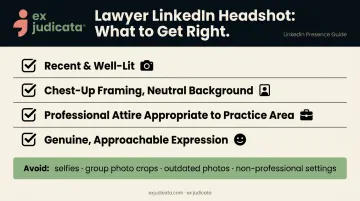
Avoid: selfies, group photo crops, outdated photos from a decade ago, and anything taken in a non-professional setting.
The banner image is where most lawyers leave value on the table. Most profiles still show the default blue gradient — so any intentional banner immediately signals that you've invested in your personal brand.
Lawyers staying in practice can use firm branding, city imagery, or a clean design reflecting their practice area. Lawyers transitioning out of law can use this space to signal their target industry visually before a viewer reads a single word.
Step 2: Craft a Keyword-Optimized Headline
LinkedIn defaults your headline to your current job title. That's a missed opportunity. Per SHRM's guidance on SEO-enhanced LinkedIn profiles, the headline is the single most important place to plant searchable keywords — and the ABA agrees, advising lawyers to include terms that identify their practice type and the clients they serve.
For lawyers staying in legal practice: Lead with your role, then layer in practice area, industry, and the type of client or matter you handle. Example: Corporate M&A Associate | Private Equity & Tech Transactions | Emerging Companies
For lawyers transitioning to non-legal roles: Lead with the business function you're targeting, not your legal title. Example: Risk & Compliance Professional | Former Litigator | Regulatory Strategy for Complex Environments
A headline that reads simply "Attorney" or "Lawyer at [Firm Name]" does almost nothing for discoverability — and actively signals the wrong identity to non-legal employers who are searching for business professionals, not attorneys.
Step 3: Write a Compelling About Section
The About section is where most lawyer profiles fall flat — and where the biggest differentiation opportunities exist. Write in first person (not third, which reads stiff), open with something specific that makes a reader want to continue, and tell a coherent professional story.
Don't restate your resume chronologically. Instead, cover:
- Who you are professionally and what you're known for
- Key accomplishments (quantified where possible)
- What drives your work — not just what you've done, but why it matters
- Where your skills and interests are heading next
If you're targeting non-legal roles, this section carries extra weight. Non-legal hiring managers often don't know how to read a traditional legal background, so the About section is your chance to translate. Skills like negotiation, risk analysis, regulatory navigation, and written communication need to be named in business terms, not legal ones.
Ex Judicata's Career Corner specialists — including LinkedIn profile writers Lisa Carman, Arno Markus, and Evgeny Efremkin PhD — work with lawyers specifically on this translation. A profile that reads well to a legal hiring partner and one that reads well to a corporate HR team are often very different documents.
Step 4: Optimize Your Experience Section
The experience section shouldn't be a copy-paste from your resume. Each role should include 2-4 bullet points that highlight accomplishments and demonstrate specific competencies — using language that mirrors what your target employer or recruiter is actually searching for.
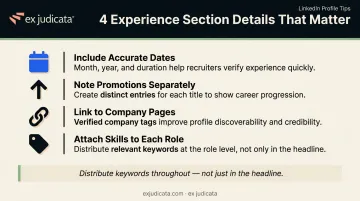
Practical details that matter:
- Include accurate dates — gaps or vague timeframes raise questions
- Note promotions within the same firm rather than lumping everything under one entry
- Link to company pages so your profile surfaces in firm-related searches
- Attach relevant skills to each role to distribute keywords throughout the profile, not concentrated only in the headline
When targeting non-legal roles, reframe accomplishments in outcome language. "Led complex multi-party commercial negotiations" communicates more to a non-legal hiring manager than "litigated commercial disputes." Same competency — different framing.
Step 5: Build Credibility With Skills and Recommendations
The skills section functions as a keyword layer across your entire profile. Recruiters filter candidate searches by skill terms, so your skills list should reflect what your target role requires — not every skill you've ever used.
Keep the list focused and updated. A lawyer targeting compliance roles should surface terms like regulatory compliance, risk management, and legal analysis. A lawyer targeting business development should include stakeholder communication, negotiation, and contract strategy.
One important note for lawyers: the Illinois State Bar Association has flagged ethics considerations around endorsements — specifically, endorsing or accepting endorsements in areas like "best lawyer" or specific practice areas can implicate advertising rules. Stick to skill-based endorsements and review your state bar's guidance.
Recommendations carry more weight than endorsements because they're specific and attributed. A short recommendation from a supervisor, colleague, or client that speaks to a concrete competency — delivered in 3-5 sentences — does more than 50 generic skill endorsements. Ask proactively, and make it easy for the person by suggesting the specific competency you'd like them to address.
Step 6: Complete the Finishing Details
These elements take 15 minutes but make a real difference:
- Custom URL: Change your LinkedIn URL to include your name (linkedin.com/in/yourname). Cleaner for resumes, easier to remember, and slightly better for search.
- Location: Set your location accurately. Recruiters filter by geography, and an incorrect or missing location means you won't surface in regional searches.
- Education: Include your JD, graduation year, and law school. These are searchable and credibility signals.
- Featured section: Use this as a curated portfolio. Pin your best article, a speaking engagement, a publication, or your resume. Keep it to 2-3 high-quality items and update it regularly.
When LinkedIn Optimization Matters Most
LinkedIn optimization isn't only relevant during an active job search — but there are moments when it becomes especially urgent:
- Before starting a job search (not after — your profile should already be polished when you reach out)
- When exploring a lateral move to another firm or in-house opportunity
- When beginning to research non-legal career paths, where an unoptimized profile signals a legal-only identity to employers outside the field
- **When building a client development presence** in private practice
On discretion: Lawyers who are still employed but quietly exploring should use LinkedIn's "Open to Work" feature in recruiter-only mode. According to LinkedIn, this setting makes your job-seeking status visible to recruiters using LinkedIn Recruiter without adding it to your public profile. LinkedIn takes steps to block your current employer's recruiters from seeing it — though they acknowledge they can't guarantee this in every case, so a small risk remains.
For lawyers considering a full exit from legal practice, the stakes are higher still. Non-legal hiring managers often don't know how to evaluate a traditional legal background — so your LinkedIn profile becomes the first chance to frame the JD skillset as a business asset, not a legal one. Resources like Ex Judicata's EXJ Career Diagnostic and its Job Board of 100% nonlegal roles can sharpen that positioning before you start outreach.
What to Prepare Before You Start
Optimization decisions made without a clear target audience tend to produce generic profiles — and generic profiles don't get found. Before editing a single section, get clear on who you want to find you and for what purpose.
With that in mind, gather:
- A current professional headshot
- A list of practice areas or business skills to highlight
- 3-5 job postings or role descriptions for positions you're targeting — these are your keyword sources
- Key accomplishments with numbers attached where possible (deal value, team size, cost savings, cases won)
For lawyers targeting non-legal roles, identifying your transferable skills before writing anything comes first. Ex Judicata's coaching methodology highlights eight core JD competencies that non-legal employers consistently value:
- Analytical thinking and complex problem-solving
- Data synthesis and information management
- Oral and written communication
- Negotiation and persuasion
- Project and deadline management under pressure
- Issue spotting and risk assessment
- Thoroughness and preparation
- Strategic and adaptive thinking
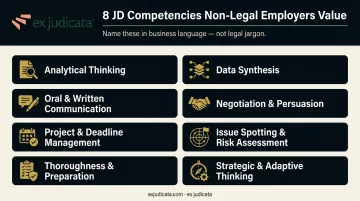
Name these explicitly in your profile — in business language, not legal terminology. Hiring managers outside law won't translate the jargon for you.
Key Factors That Determine Profile Performance
Two lawyers can follow the same optimization checklist and see very different results. Here's why.
Keyword Density and Placement
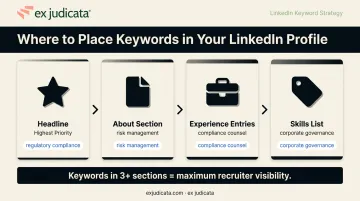
LinkedIn's search algorithm surfaces profiles based on keyword relevance across multiple sections — headline, About, experience, and skills. A company looking for a former litigator to fill a compliance role will search terms like "litigation," "regulatory," "risk," and "compliance." If those terms don't appear in your profile, you're invisible to that search — regardless of how polished everything else looks.
Keywords should appear in at least three sections: your headline, your About section, and distributed across your experience entries and skills list. Keyword placement is necessary, but it's not sufficient on its own.
Profile Completeness
LinkedIn rewards complete profiles with greater visibility in search results. Gaps signal disengagement — to the algorithm and to anyone who lands on your page. A fully built-out profile includes:
- A professional photo
- Full experience history with descriptions
- Education section
- Skills list (at least 10)
- A completed About section
Human visitors use completeness as a proxy for how seriously you take your professional presence.
Activity and Engagement
Consistent activity signals that you're current and engaged — to both the algorithm and anyone who visits your profile. You don't need to publish original articles to benefit from this. Thoughtful comments on relevant posts within your niche, even 10-15 minutes a day, can noticeably expand your reach and keep your profile surfacing in your network's feeds.
Common LinkedIn Profile Mistakes Lawyers Make
Copying and pasting the resume: A resume is a chronological record; a LinkedIn profile is a marketing document. The About section especially needs to speak to what viewers want from you — not just a timeline of what happened.
Using a vague or generic headline: "Attorney at [Firm Name]" does almost nothing for discoverability and signals the wrong identity to non-legal employers. Your headline is searchable real estate — treat it that way.
Neglecting keywords outside the About section: Keyword signals in individual role descriptions and the Skills section carry equal weight in recruiter searches — not just your About section.
Leaving the profile static: A stale profile with no recent activity reads as disengaged to both the algorithm and human visitors. Set a quarterly reminder to audit accomplishments and refresh your Featured section.
Frequently Asked Questions
How do I write a LinkedIn headline as a lawyer who wants to transition out of legal practice?
Move away from title-first headlines. Lead with the skills or function you're targeting — for example: Risk & Compliance Professional | Former Litigator | Helping Organizations Navigate Complex Regulatory Environments. This makes your value proposition clear to non-legal employers while still honoring your legal background.
Should lawyers use LinkedIn's "Open to Work" feature?
Yes, strategically. Use the "Recruiters Only" mode to signal availability without broadcasting to your full network. LinkedIn tries to hide this from your current employer's recruiters, but can't guarantee it — a small risk worth weighing if you're still employed.
What should lawyers include in their LinkedIn About section?
Write in first person and cover: who you are professionally, what drives your work, key accomplishments, and where your skills and interests are heading next. Tell a coherent story — don't just repeat the resume in paragraph form.
How many LinkedIn connections do lawyers need for an effective profile?
Reaching 500+ connections triggers LinkedIn's "500+" display, which signals credibility to visitors. Beyond the number, a well-targeted network — recruiters, former colleagues, industry contacts in your target field — is what turns profile views into actual conversations.
How do I make my legal experience attractive to non-legal employers on LinkedIn?
Reframe accomplishments in business outcome language. "Managed complex multi-party negotiations across 12-party transactions" communicates more to a corporate hiring manager than "litigated commercial disputes." Lead with the outcome and the scale; let the legal context sit in the background.
How often should lawyers post or engage on LinkedIn?
Posting 2-3 times per week works well if you can sustain it consistently. If not, daily thoughtful comments on posts within your niche build visibility without requiring original content. Pick one practice area, industry, or role type to engage around — showing up regularly in that lane does more than sporadic posts across random topics.