

According to Martindale-Avvo's 2023 legal consumer survey, 39% of consumers received an attorney recommendation from friends or family — and nearly half of those referred consumers still researched the lawyer online before making contact. Referrals and digital reputation are one funnel now, not two.
This article covers both dimensions of lawyer networking in 2026: building referral systems that generate clients, and using those same skills to open doors beyond legal practice. If you're growing a practice, pivoting your career, or somewhere in between, the same core principle applies — people hire and refer people they know, trust, and remember.
Key Takeaways
- ~40% of legal consumers find attorneys through referrals — but nearly half check online before making contact
- Niche positioning makes you more referable — specificity is a business development asset
- LinkedIn is non-negotiable: 78% of law firms now use it as their primary professional channel
- In-person networking still outperforms virtual for trust-building — 78% of B2B attendees say so
- Your legal network is a first-degree asset for non-legal career transitions, not just client development
- The EXJ Community gives non-practicing lawyers a free, peer-to-peer network built specifically for the NPL career path
Why Referral Marketing Still Matters for Lawyers in 2026
A warm referral is not a guaranteed client. It's an opportunity with a short shelf life — and the window is closing faster than most lawyers realize.
A Martindale-Avvo survey reveals the conversion risk hiding in plain sight:
- 80% of consumers would contact a different attorney if they didn't hear back within 48 hours
- 40% would only wait 24 hours
- In Clio's 2024 secret-shopper study of 500 US law firms, only 33% responded to emails and only 40% answered phone calls
- Just 12% of prospective clients said they would likely recommend the firms they contacted
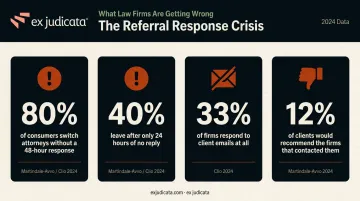
Unresponsiveness doesn't just lose clients — it kills referrals before they convert.
What AI Is Doing to the Referral Equation
Clio's 2025 Legal Trends Report found that 79% of legal professionals now use AI, and 63% of those users report improved client responsiveness. AI tools are helping lawyers respond faster and communicate more clearly — shortening the gap between a referral and a booked consultation.
There's a catch: 78% of clients want disclosure when lawyers use AI, but only a fraction of firms proactively offer it. Speed gains vanish the moment a client feels misled about how their matter is being handled.
In 2026, a referral starts a trust sequence, not a closed sale. Four steps have to hold: personal recommendation, online validation, fast response, and transparent service delivery. Break any one of them and the client walks.
Build Your Foundation: Reputation, Niche, and Online Presence
No referral strategy works without something worth referring. Before you ask anyone for business, give them a clear, confident answer to a silent question every referrer asks: "Will this lawyer make me look good?"
Define Your Niche
Specificity makes you referable. A colleague who knows you handle "general civil litigation" will struggle to recommend you. A colleague who thinks of you as "the dental malpractice lawyer" or "the employment attorney for tech startups" can refer you on the spot.
The narrower your positioning, the more your name surfaces in exactly the right conversations. Narrow positioning isn't limiting — it's precisely how referral networks function. Once your niche is clear, the next step is making sure your online presence backs it up.
Build the Digital Proof
Nearly half of referred consumers research lawyers online before calling. Your online presence needs to validate what the referrer already said about you:
- LinkedIn profile with a clear specialty statement in the headline, not just your job title
- Law firm website with dedicated practice area pages (not just a generic "About" page)
- Google and Avvo reviews — Martindale-Avvo found 50.6% of legal consumers treat reviews as a helpful hiring criterion, and 61% wanted at least 11 reviews before deciding
- Active participation in relevant bar association forums, LinkedIn groups, or niche online communities
Strong digital proof doesn't generate itself — it follows directly from how you treat clients once they hire you.
Make Client Service the Engine
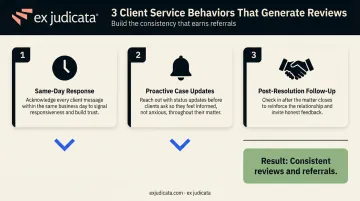
Testimonials and reviews don't appear on their own. Three service behaviors consistently generate them:
- Respond the same day — not eventually, the same day
- Send proactive updates before clients have to ask where their matter stands
- Follow up meaningfully after case resolution — a brief check-in weeks later is memorable and rare
One more piece before you start sharing any of this publicly: get proper permission for client testimonials. If you're a junior attorney, confirm with the lead lawyer that client feedback can be referenced externally. Ethics rules on endorsements vary by state — check yours before posting.
In-Person and Online Networking Strategies That Actually Work
The most effective lawyer networking in 2026 isn't entirely online or entirely in-person. It's both, used deliberately.
Bizzabo research from a 2023 survey of 4,000+ event professionals and attendees found that **78% agreed in-person B2B conferences offer the best networking opportunities**. Face-to-face interaction still builds the kind of trust that generates referrals.
High-value in-person venues for lawyers include:
- Bar association meetings and section committees
- Legal conferences in your practice area
- Chamber of commerce events (especially for small business and real estate attorneys)
- Community fundraisers where clients and referral sources mingle
- Panel discussions and speaking opportunities — being on stage is the highest-leverage in-person move available
Speaking positions you as the expert before you say a word. One well-placed panel appearance can generate more referral relationships than a dozen cocktail parties.
Networking for Introverts
Many lawyers identify as introverts — and traditional "work the room" networking is exhausting for them. The reframe that works: you don't need to meet everyone. You need two genuine conversations.
Two practical approaches:
- Set a micro-goal before you walk in. Decide to meet two new people, exchange cards, and follow up within 48 hours. Leave after that if you need to.
- Prepare one honest answer to "what do you do?" Not a pitch — a real answer that's specific enough to be interesting and brief enough to be memorable.
Online and Community Networking
The ABA's 2024 Websites and Marketing TechReport found 80% of law firms use social media and 78% use LinkedIn specifically. BTI Consulting reported in 2025 that law firms grew LinkedIn followers 54% faster than the platform average.
What works on LinkedIn for lawyers:
- Post consistently — two to three times per week beats irregular bursts
- Comment thoughtfully on others' posts before expecting engagement on yours
- Join practice-area and industry-specific groups where your referral sources spend time
- Keep your headline specific: "Employment Attorney for Healthcare Employers" outperforms "Partner at [Firm]"
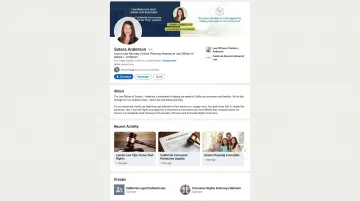
LinkedIn reaches a broad professional audience, but niche communities generate referrals at lower volume and higher relevance. In bar association forums, local Facebook groups, NextDoor, and city- or specialty-specific Reddit threads, one well-answered question can establish you as the go-to resource.
Evaluate the ROI of Networking
All of these channels — events, LinkedIn, niche forums — have real costs in time and money. A simple formula helps separate worthwhile investments from habits:
(Event cost + Time invested at hourly rate) ÷ Clients acquired = Cost per client
Run this calculation quarterly. If certain events consistently produce zero referrals after 12 months, cut them and reallocate that time.
Nurture Your Network: Communication, Reciprocal Referrals, and Formal Agreements
Building a network is the easy part. Maintaining it is where most lawyers fall short.
The Illinois State Bar Association recommends developing at least one new referral source per month and staying in contact with existing sources five to ten times per year. That's a practical benchmark — and it doesn't mean calling to ask for business. It means:
- Sharing an article relevant to their practice or industry
- Congratulating them on a milestone (promotion, case win, anniversary)
- Making an introduction without being asked
- Sending a brief, genuine check-in
The goal is staying top-of-mind without feeling transactional.
Build Reciprocal Referral Relationships
Referrals flow toward people who give them. If you consistently refer estate planning work to a trusted estate attorney, personal injury overflow to a plaintiff's firm, and business formation questions to a CPA or financial advisor — those contacts remember you when the situation reverses.
One standard applies before referring anyone: their client service values need to match yours. Sending a client to someone who doesn't respond promptly reflects on you, not just them.
Get Referral Agreements in Writing
For formal referral arrangements between law firms, signed agreements are not optional — they're protection for everyone involved.
Under ABA Model Rule 1.5(e), fee division between lawyers in different firms is only permissible when:
- The division is proportional to services rendered, or each lawyer assumes joint responsibility
- The client agrees to the arrangement in writing, including each lawyer's share
- The total fee remains reasonable
State rules add further requirements. California's Rule 1.5.1 mandates a written fee-division agreement and written client consent. Illinois imposes its own version of the same requirements. Before any referral fee arrangement, check the applicable jurisdiction's rules. Handshake deals are common; they're also where disputes originate.
Networking Beyond Law: Using Your JD Skills to Open Non-Legal Doors
The networking skills that build a legal practice transfer directly to career transitions. The network you've already built — clients, colleagues, opposing counsel, law school classmates — is a first-degree asset that most people entering non-legal fields don't have.
How to Reframe Your JD Skillset
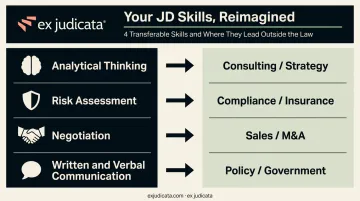
When networking outside of law, the skills that get attention aren't legal in nature — they're transferable:
- Analytical thinking — applied in consulting, corporate strategy, and business development
- Risk assessment — central to compliance, insurance, and executive advisory roles
- Negotiation — valued in sales, partnerships, and M&A-adjacent functions
- Written and verbal communication — a differentiator in policy, communications, and government roles
NALP's data from the Class of 2024 shows JD Advantage jobs represented 7.4% of all graduate placements, with 47% of those roles in business. Employers like Deloitte and McKinsey explicitly recruit JD holders for tax advisory and consulting roles, respectively — validation that the analytical framework lawyers develop has real market demand outside courtrooms.
Roles where this translates most directly:
- Compliance and risk management
- Corporate strategy and business development
- Chief of Staff and board secretary positions
- Policy and regulatory affairs
- Legal technology and legal operations
- ESG and sustainability leadership
Expand Beyond Legal Circles
Staying only within your legal network during a transition limits you to people who primarily know you as a lawyer. To break into a new field, build relationships with people already in it.
Practical steps:
- Attend industry conferences in your target sector, not just legal ones
- Join LinkedIn groups where your target professionals gather
- Follow and engage with thought leaders in your target industry
- Ask for informational interviews — not job inquiries, but genuine curiosity about career paths
The Harvard Law School informational interview guide frames these conversations accurately: they build contacts, surface the hidden job market, and help you translate legal language into the terms an industry actually uses. Thirty minutes with the right person moves a transition forward faster than months of passive job searching.
The NPL Network Advantage
One resource that most transitioning lawyers overlook: other lawyers who have already made the move.
Non-practicing lawyers (NPLs) can tell you what the first 90 days in a compliance role actually look like, which companies genuinely value JD credentials, and who the right contacts are in a specific sector. They can also make warm introductions that skip the cold-outreach phase entirely.
Until recently, there was no central place to find them. Ex Judicata's EXJ Community — launched in January 2026 at community.exjudicata.com — is the first peer-to-peer network built specifically for this group. Membership is free for non-practicing lawyers, with no credit card required.
The platform's member directory lets you filter by industry, company, career type, and years since leaving practice — so you can find and contact NPLs in exactly the fields you're targeting.
For still-practicing lawyers exploring a transition, access is available through an Ex Judicata subscription at $9.29 per month.
A Practical Framework for Transition Networking
Four steps, applied consistently over 90 days:
- Audit your existing network : identify contacts in target industries, former clients in non-legal sectors, and law school classmates who've transitioned
- Pick two or three target industries based on your skills and interests (the $25.95 EXJ Career Diagnostic maps your attorney personality traits against 25 business career paths if you're unsure where to focus)
- Reach out to five people per month with a clear, authentic ask : not "I want a job," but "I'd love to hear about your career path"
- Follow up with value : share a relevant article, make an introduction, express genuine gratitude without immediately asking for something else
Five conversations per month, sustained over a quarter, builds a real web of relationships in a new field — and those relationships are what actually surface roles before they're posted.
Frequently Asked Questions
How do lawyers build a referral network from scratch?
Start with your existing circle: law school classmates, bar association contacts, former colleagues, and clients you've served well. The key is offering value before expecting referrals — make introductions, share resources, show up consistently. Reciprocity builds over time, not in a single transaction.
Is in-person networking still worth it for lawyers in 2026?
Yes. Bizzabo research found 78% of B2B event attendees say in-person conferences offer the best networking opportunities. Virtual and hybrid events have expanded the menu of options, but face-to-face interaction still builds the trust density that referral relationships require. Attend fewer events, but attend the right ones.
How can introverted lawyers succeed at networking?
Reframe the goal: instead of working the room, aim for two real conversations. Set a specific micro-goal before each event and prepare a genuine answer to "what do you do?" LinkedIn and online communities offer lower-pressure alternatives where introverts can build relationships at their own pace.
What platforms work best for online lawyer networking in 2026?
LinkedIn is the primary channel — 78% of law firms use it and engagement is growing. Supplement with bar association forums, niche Facebook and Reddit groups, and JD-focused communities like the EXJ Community for transition-specific networking among non-practicing lawyers.
How can lawyers use their network to transition into a non-legal career?
Your legal contacts often know decision-makers in non-legal industries — reach out for informational interviews and frame the conversation around learning, not job-seeking. The EXJ Community's member directory lets you search for NPLs already working in your target field who can make warm introductions.
Do lawyers need a formal referral agreement with other attorneys?
A written agreement is strongly recommended and often required. ABA Model Rule 1.5(e) mandates client consent in writing, proportional fee division or joint responsibility, and a reasonable total fee — and state rules add further requirements. Handshake deals are common and a frequent source of disputes that a one-page agreement would have prevented.