

This blog is written for managing partners, firm leaders, and HR directors who want to stop the revolving door. It covers the research-backed reasons associates leave (beyond salary), the behavioral warning signs to watch for, and practical retention strategies that work.
One important distinction up front: some associates leave because law practice itself isn't the right fit for them — no firm policy will change that. But most departures are preventable. This article addresses both scenarios honestly.
Key Takeaways
- Replacing a single mid-level associate costs $400,000 to over $1 million, according to Thomson Reuters and BigHand research
- Associates who plan to stay rank culture and colleagues above compensation; salary typically lands 4th or 5th on the list of reasons they remain
- The leading non-compensation departure drivers include feeling undervalued, lack of career clarity, inequitable workloads, and burnout
- Only 31% of firms hold regular career development conversations with associates
- Firms with the strongest retention combine culture, career development, workload equity, and pay — no single lever is enough on its own
Why Associates Really Leave Law Firms
Compensation is almost always the first reason departing associates cite. It's rarely the real one.
Thomson Reuters Institute's 2022 research surveyed more than 1,500 associates and found that associates likely to leave ranked feeling underappreciated 3rd and lack of career progression 4th. Associates who planned to stay ranked compensation 5th — behind colleagues and firm culture. The same pattern held across underrepresented associate groups, where people consistently ranked as the number one reason for staying.
Compensation Is the Floor, Not the Ceiling
Matching market compensation prevents immediate attrition. It doesn't create loyalty.
The deeper problem is opacity. Associates who can't connect their performance to a clear, predictable financial outcome lose trust in the system. Opaque bonus structures, moving targets, and year-end surprises erode confidence in firm leadership faster than compensation level alone.
Quality and Variety of Work
Associates enter the profession to practice law — depositions, deal strategy, client contact. Many find themselves doing routine document review and research with little exposure to substantive decisions.
NALP Foundation data shows that for lateral associates, the leading departure reason was work quality standards not being met (22%), followed by unmet productivity expectations (15%) and pursuit of specific practice interests (11%). Entry-level associates cited the same top three.
The pigeonhole problem compounds this. A narrow practice focus limits future mobility, partnership prospects, and lateral marketability. Firms that allow cross-practice exposure or practice area transfers hold a measurable retention advantage.
Burnout, Unsustainable Hours, and Inequitable Workloads
Bloomberg Law's 2025 Attorney Workload Survey found attorneys averaging 48 hours per week, with 36 billable. Associates entering the profession expect long hours. What creates resentment is the perception that the burden isn't shared fairly.
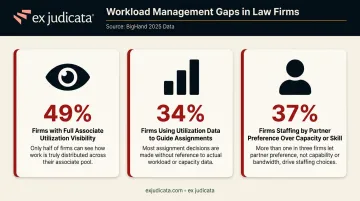
BigHand's 2025 data reveals a structural problem: only 49% of firms have full visibility into associate utilization, only 34% use that data to guide assignments, and 37% base staffing on partner preference rather than capacity or skill. Firms without utilization data cannot correct inequitable distribution even when they want to.
Feeling Invisible: No Recognition, No Path, No Belonging
Associates need to feel their contributions matter and that a future at the firm is genuinely attainable. Vague advancement criteria, inconsistent feedback, and absent recognition erode commitment faster than almost anything else.
Firms with high associate satisfaction share identifiable traits:
- Partners know individual associates' career goals — and actively help them pursue those goals
- Advancement criteria are specific and applied consistently, not shifted at year-end
- Recognition is tied to contribution, not just billable hours
- Associates receive regular, substantive feedback rather than annual performance reviews alone
The Hidden Cost of Associate Attrition
The replacement cost figures alone make the business case.
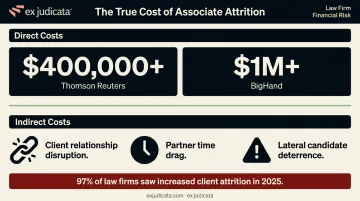
- $400,000+ per associate, per Thomson Reuters Institute (2022)
- Over $1 million per departure in lost revenue, recruiting, and training costs, per BigHand (2025)
- 44% of firms report that high associate turnover is actively affecting client satisfaction and matter delivery
Those direct costs only tell part of the story. The indirect costs rarely appear in any calculation:
- Client relationship disruption when a familiar face disappears from an active matter
- Partner time drag spent re-training replacements instead of generating revenue
- Lateral candidate deterrence — senior associates and partners evaluate firm culture before accepting offers, and public turnover signals spread fast
These indirect costs compound the damage. BigHand reported that 97% of law firms saw increased client attrition in 2025, with high associate turnover cited as a contributing factor. Talent retention and revenue stability are the same problem.
The investment required to build a structured mentorship program, implement utilization tracking, and run quarterly career development conversations is a fraction of what a single departure costs. One lost associate can erase an entire year of retention spending — and then some.
Warning Signs an Associate Is About to Leave
Behavioral shifts typically appear 3–6 months before a resignation. The signs are recognizable if leaders are looking for them.
Engagement changes:
- Pulls back from firm-wide initiatives and committees
- Decline in work quality or self-initiated contributions
- Withdraws from informal social interactions with colleagues
- Visible apathy toward feedback or growth opportunities
Scheduling red flags:
- Increased use of sick and personal days
- Requests for large blocks of time off without explanation
- Distracted or unavailable during work hours — often a sign of active interviewing
Both categories of signals point toward the same response: proactive conversation, not surveillance. When a manager reaches out before a situation deteriorates, most associates will engage honestly.
The most dangerous departures are the quiet ones. The high-performing associate who has mentally checked out but shows no dramatic behavior change is invisible to firms that rely on annual reviews as their only diagnostic. Regular one-on-one check-ins — held monthly, not annually — give managers a real read on engagement before the associate has already accepted another offer.
How to Retain Associates: Strategies That Go Beyond Salary
Retention is not a single initiative. Firms with the strongest rates excel across multiple dimensions simultaneously.
Invest in Meaningful Work and Equitable Distribution
Work allocation based on partner preference is one of the most fixable retention problems — and one of the least fixed. With 37% of firms still staffing based on preference rather than capacity or skill, the opportunity to differentiate is significant.
Structured allocation systems that distribute assignments based on capacity, development goals, and skillset serve two purposes: they prevent the overloaded/underutilized dynamic that breeds resentment, and they ensure associates are getting the variety of work that keeps them engaged.
Associates should have access to substantive, career-building work early — including client contact, strategic discussions, and opportunities to lead portions of matters under supervision. This signals investment in their development in a way that no benefits package can replicate.
Build Mentorship Programs That Actually Develop Careers
Effective mentorship means senior attorneys actively know each associate's career goals, create aligned opportunities, and provide feedback outside of formal review cycles — not just at annual reviews.
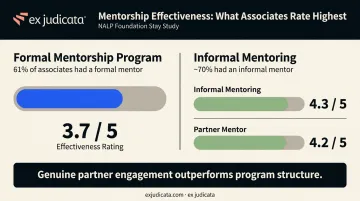
MLA's 2023 BigLaw associate survey found that 61% of associates had a formal mentor and nearly 70% had an informal mentor. Yet the NALP Foundation's Stay Study found that informal mentoring (rated 4.3) and partner mentors (rated 4.2) consistently outperformed formal programs (rated 3.7) in associate importance rankings.
The implication: program structure matters less than genuine partner engagement. Associates can tell the difference between a partner who knows their goals and one who signed up for a mentorship checkbox.
Communicate Career Paths Transparently
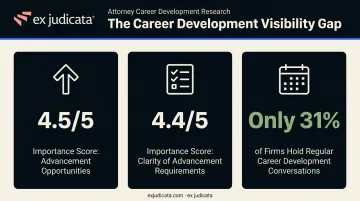
The NALP Foundation's 2024 Stay Study found that opportunities for advancement scored 4.5 in importance, and clarity about advancement requirements scored 4.4 — both ranking higher than many firms realize.
Yet only 31% of firms hold regular career development conversations, and more than half of North American firms lack visibility into available development opportunities for their associates.
Clear, written criteria for advancement — including counsel tracks for those not on a partnership path — give associates something to measure themselves against. Without that, even high performers start looking for clearer horizons elsewhere.
Create a Culture of Belonging and Recognition
Acknowledging excellent work when it happens — not only at year-end review — has an outsized impact on how associates experience the firm. Recognition that is timely and specific lands differently than generic praise delivered months later.
Belonging requires intentional design from day one:
- Structured introductions that connect new associates across practices
- Cross-practice collaboration opportunities built into matter staffing
- Firm traditions and social touchpoints that connect attorneys as people
Associates who feel they belong are far less likely to look for that elsewhere.
Address Well-Being Honestly
Work-life balance ranked as the primary reason associates leave in BigHand's 2025 analysis, cited by 20% of departing associates. Firms should ask themselves directly: does the culture treat burnout as a badge of honor, or as a problem to solve?
Younger attorney cohorts have different expectations — and they have more options than previous generations did. Firms that adapt their cultures accordingly tend to retain the associates most likely to become strong next-generation partners. Those that don't are accelerating the exit decisions their associates are already quietly considering.

When It's Not the Firm — Associates Leaving Law Entirely
Some attrition cannot be retained away. BigHand's 2025 research found associates leaving the legal industry entirely rose from 9% in 2024 to 16% in 2025 — with junior and senior associates leaving at nearly identical rates (16% and 17%, respectively).
That's a qualitatively different challenge. No mentorship program or work allocation system helps an associate who has concluded that practicing law simply isn't right for them.
The signs of professional misalignment — as distinct from firm dissatisfaction — are specific:
- Consistent disillusionment with the nature of legal work, not specific tasks or partners
- Expressed curiosity about roles in business, policy, compliance, or other sectors
- A sense that their skills and values don't align with private practice regardless of environment
Co-founder Neil Handwerker of Ex Judicata came to understand this distinction firsthand: he left practice three months after starting and discovered there were no resources to help him navigate a transition. When he later reached out to law firms with the Ex Judicata platform concept, firm leaders told him: "We're looking for other platforms to help our JDs who told us they don't want to stay with us and practice law."
When an associate has reached that conclusion, the most supportive — and strategically sound — thing a firm can do is acknowledge it. Happy exits become alumni relationships, outside counsel referrals, and business development pipelines.
Ex Judicata exists specifically for this moment: connecting JDs who want to use their legal training in nonlegal careers with organizations actively seeking that expertise.
Frequently Asked Questions
What is the average cost of losing a law firm associate?
Industry figures range from $400,000 (Thomson Reuters, 2022) to over $1 million per departure (BigHand, 2025), depending on seniority. These figures include recruiting fees, training, lost productivity, and client relationship disruption — most of which never appear in a single line item.
What are the top reasons associates leave law firms?
Compensation is a threshold factor, not the primary driver. The leading non-compensation reasons include:
Compensation is a threshold factor, not the primary driver. Associates who plan to stay consistently rank culture and colleagues above salary. The leading non-compensation reasons are:
- Lack of meaningful work
- Feeling undervalued or invisible
- Unclear advancement criteria
- Burnout from inequitable workloads
- Poor cultural fit
How can law firms retain associates without just raising salaries?
The most evidence-backed retention levers are:
- Structured mentorship programs
- Transparent, written advancement criteria
- Equitable work distribution tied to capacity and development goals
- Regular career development conversations (not just annual reviews)
- Timely, specific recognition culture
What percentage of associates leave law firms each year?
The NALP Foundation reported an overall associate attrition rate of 19% in 2025, down slightly from 20% in 2024. The percentage leaving the legal industry entirely — not just switching firms — rose sharply from 9% to 16% in the same period.
How can law firm leaders spot an associate who is thinking about leaving?
Warning signs typically appear 3–6 months before a resignation. Watch for:
- Disengagement from firm initiatives
- Decline in self-initiated work
- Social withdrawal from colleagues
- Unexplained time-off requests or scheduling changes
Proactive one-on-one check-ins are the most effective early intervention.
What should a firm do when an associate wants to leave the legal profession entirely?
Approach the conversation supportively rather than defensively. Some JDs are better suited to nonlegal careers — and associates who leave well become ambassadors, not detractors. Resources like Ex Judicata connect departing attorneys with nonlegal roles that value their JD training, providing structured transition support that benefits both the associate and the firm's long-term alumni relationships.