

Introduction: The Big Law Promise Nobody Told You the Full Truth About
You leave before sunrise. You return after dark. You miss the school play, the anniversary dinner, the friend's birthday—again. And when you finally sit down at 11 p.m. to answer the email you've been dreading, you still feel behind.
This is what "making it" looks like in Big Law.
The prestige, compensation, and intellectual challenge are all real. According to NALP's 2025 salary survey, median first-year associate salaries at firms with 700+ lawyers hit $215,000—with senior associates at elite firms earning up to $445,000. Nobody disputes that this is exceptional money.
But more lawyers than ever are asking whether the tradeoff still makes sense. The NALP Foundation reported 20% associate attrition in 2024, with 74% of departing associates leaving within four years of hire. That's not a few unhappy outliers. That's a structural pattern.
This article isn't an argument against Big Law. It's an honest look at what life after it can look like—and why the goal shouldn't be "work-life balance" but work-life integration and career alignment.
Key Takeaways
- Leaving Big Law is a deliberate redirection thousands of JDs make each year—not failure
- "Work-life balance" is the wrong frame; integration and alignment are more sustainable goals
- The biggest barriers to leaving are psychological, not financial
- JD skills translate powerfully into nonlegal roles across business, compliance, consulting, and policy
- A planned exit — financial runway, professional positioning, emotional readiness — beats a reactive one every time
The Big Law Bargain: Prestige, Pay, and the Hidden Price Tag
Big Law offers something genuinely valuable: elite clients, complex high-stakes work, colleagues at the top of their fields, and compensation that few professional environments can match. Dismissing this doesn't serve anyone. The bargain is real, and for many lawyers, it makes sense—for a while.
But the structural demands behind that bargain are worth naming clearly.
What the Billable Hour Doesn't Capture
Many firms set billable targets of 2,000+ hours annually. Bloomberg Law reported that King & Spalding used 1,950 billable hours as the threshold for bonus eligibility—paired with a broader 2,400 productive-hours expectation that includes recruiting, business development, and firm citizenship. The relevant number is never just the billable hours. It's the total availability load.
The data on time off is equally stark. Bloomberg Law's 2025 workload survey found that 97% of legal professionals worked while out of office, with 73% doing so on at least half their days off. Burnout averaged 42% of the time overall—and 51% for midlevel and senior associates.

The Golden Handcuffs Problem
The financial case for staying is easy to make. Senior associate salaries at elite firms reached $445,000 in 2025, with firms like Milbank raising pay further in 2026. At those numbers, leaving feels financially reckless.
But the handcuffs aren't just the salary. They're the lifestyle that gets built incrementally around a job that demands everything:
- Nightly takeout because there's no time to cook
- Convenience services that offset the time Big Law consumes
- Retail comfort spending that compensates for chronic stress
- A fixed-cost structure calibrated to a Big Law paycheck
Each of those spending patterns makes the income gap look more terrifying than it is. Ex Judicata's Money Management content hub calls the compensation delta "the single most under-discussed obstacle to leaving law." A Big Law associate or senior associate typically takes a 20–60% near-term comp cut when moving into a business role—but a meaningful share of current spending exists to offset the costs of staying in an unsustainable one.
Why "Work-Life Balance" Is the Wrong Goal
The balance metaphor fails because it implies a zero-sum trade: every hour given to work is an hour taken from life. But the real problem isn't the number of hours—it's the mental occupation that persists even when the hours technically stop.
That Bloomberg Law finding bears repeating: 97% of legal professionals worked while out of office. A midlevel associate answering emails on a Saturday morning isn't just working too many hours. She's operating inside a professional norm where the boundary has already been crossed, and recovery happens afterward—if at all.
Law360 Pulse's 2025 survey of 1,184 U.S. attorneys found job satisfaction at a five-year low of 61%, with 51% of respondents stressed most or all of the time—up from 38% just a year earlier. Work-life balance worsened for 35% and improved for only 19%.
Integration as an Alternative Frame
Integration rejects the separation model entirely. Instead of carving off protected hours and defending them against work's encroachment, it asks a harder question: does the work itself align with who you are?
What integration actually looks like in practice:
- Colleagues who know your family exists and factor that into expectations
- Clients who respect that you have a life outside their matters
- Work that reflects your values, not just your credentials
- The ability to be fully present—at work and at home—without constant mental context-switching
The critical distinction: integration is not about working less. Some lawyers who leave Big Law work just as hard in their next role. The difference is that the work no longer requires them to splinter their identity to do it.
Prestige and Identity
That identity question sits at the center of the integration challenge. For many Big Law attorneys, the job isn't just a job. It's the answer to "What do you do?"—a question that carries serious weight in legal circles and family conversations alike.
The Vault Law 100 and Am Law 100 are explicitly prestige rankings, and being part of that ecosystem becomes part of how attorneys see themselves. Letting go of it is genuinely hard.
Ex Judicata's Wellbeing content hub addresses this directly in a piece called "Overcoming Pride and Ego Concerns," featuring Scott Westfahl, Professor of Practice at Harvard Law School. His framing cuts to the core: "Throwing away that JD credential if I'm not applying it currently is wrong. What good is a credential if it's not making me happy and fulfilled?"
Identity doesn't disappear when you leave Big Law. Attorneys who transition successfully find that new sources of meaning replace the status identity — not by erasing it, but by giving it somewhere better to go.
What's Really Keeping You Stuck in Big Law
The barriers to leaving are rarely what they appear on the surface.
The Psychological Stack
Most attorneys who stay past the point of wanting to leave are held by a combination of factors:
- The firm name is social capital — and leaving means giving it up before you've built something to replace it.
- Judgment — from peers, family, and yourself — feels louder than it actually is. The internal critic tends to impersonate the most intimidating partner in the room.
- "I don't know how to do anything else": This belief is nearly universal. It's also nearly always wrong.
- The echo chamber: When your entire social world is other Big Law attorneys, staying seems rational and leaving seems radical. It isn't. The NALP attrition data makes that clear.
The Sunk Cost Trap
Law school debt averaged approximately $165,000 at graduation according to ABA reporting — and that number weighs on every exit calculation. Combined with years of training, late nights, and professional identity investment, leaving can feel like abandoning the return on everything you've sacrificed.
Reframe it this way: the skills are not stuck in a law firm. Analytical rigor, high-stakes communication, negotiation, risk assessment, attention to detail — these are portable. They were earned inside Big Law, but they don't belong to it.
That reframe matters even more when you look at the actual math of leaving.
Financial Paralysis
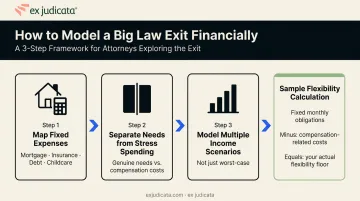
Many attorneys don't leave because they've never modeled what life at a different income level actually looks like. They're running on fear, not numbers. Three steps change that:
- Map your actual fixed expenses (not a rough guess)
- Separate genuine needs from compensation-for-unhappiness spending
- Model multiple income scenarios — not just the worst case
A lawyer earning $350,000 who spends $180,000 on genuine needs and $60,000 on stress-compensation has $110,000 in annual flexibility. Run the actual numbers. They often surprise people — and they should be driving the decision, not the anxiety.
What Life After Big Law Actually Looks Like
The transition period is rarely immediate relief. There's an adjustment phase—sometimes lasting months—where the absence of structure, status, and peer community feels disorienting. This is normal. It doesn't mean the decision was wrong.
Where Attorneys Go
The paths after Big Law are more varied than most current associates realize:
- Boutique and regional firms: smaller, more defined practice areas, distinct culture
- In-house legal: one client, closer to the business, different pace
- Government and public sector: mission-driven work with real tradeoffs
- Nonlegal business roles: the fastest-growing destination for departing Big Law attorneys
The American Bar Foundation's After the JD III longitudinal study found that 19.2% of lawyers were no longer practicing law 12 years into their careers, with 20% working in the business sector. The most frequent destination for lawyers leaving private firms was a business organization—not another law firm.
What Former Big Law Attorneys Consistently Report Gaining
- Autonomy over their time and attention
- Alignment between their work and their values
- The ability to be present for relationships and family
- Often, renewed energy and engagement with their work
Those personal gains are real. They're also backed by a harder-nosed argument: JD skills are in demand in business.
How JD Skills Translate
The transition isn't reinvention. It's translation. Harvard Business Review has reported that CEOs with legal training are associated with higher firm value in certain contexts, particularly in high-growth and high-litigation industries. That's not a coincidence. Legal training builds judgment under pressure — the kind that risk-sensitive organizations pay for.
NALP's 2025 JD Advantage Career Guide identifies specific nonlegal roles where JD skills map directly:
| Role | Core JD Skill Applied |
|---|---|
| Compliance & ethics | Regulatory analysis, risk controls |
| Contracts & procurement | Negotiation, drafting, issue spotting |
| Data privacy & risk | Risk assessment, governance |
| Consulting & operations | Structured problem solving, client communication |
| Policy & government affairs | Statutory interpretation, advocacy |

Companies like Lockton, Marsh McLennan, and Guidepost Solutions have hired former Big Law attorneys into senior nonlegal roles through Ex Judicata's retained search practice. Nicolas Dumont moved from Cooley to Lockton. Alan Kornberg moved from Paul Weiss to Marsh McLennan. Lee Garner moved from Skadden to Guidepost Solutions. These aren't flukes—they're a category.
For attorneys exploring nonlegal paths, Ex Judicata is the first and only platform built specifically for this transition. It combines a nonlegal job board, the $25.95 EXJ Career Diagnostic (a PhD-validated assessment mapping eight attorney traits against 25 business careers), and a Career Corner coaching marketplace with vetted specialists.
One of those specialists is Margaret Enloe — a former Skadden litigation associate and PricewaterhouseCoopers partner who now coaches attorneys through exactly this kind of move.
Practical Steps to Engineer Your Exit
Don't wait until you're burned out to start this process. The attorneys who transition most successfully are the ones who built their exit deliberately.
Step 1: Run the Financial Math
Before any other decision:
- List your actual fixed expenses—mortgage, insurance, debt payments, childcare
- Separate genuine needs from spending that compensates for unhappiness
- Model income at multiple salary levels (not just worst-case)
- Calculate how much runway you'd have with current savings at a reduced income
The 20–60% near-term comp cut that typically accompanies a Big Law exit is more manageable when it's modeled honestly rather than imagined as catastrophe.
Step 2: Build Your Exit Identity Before You Leave
- Connect with professionals outside Big Law now, not after you've already left
- Explore what genuinely excites you beyond your current practice area
- Identify how your specific skills translate to roles you'd actually want
- Take the EXJ Career Diagnostic to get a structured map of where your traits align with business careers
Step 3: Find Community with People Who've Made the Move
The mental transition is as hard as the practical one. It's easier when you're talking to people who've already navigated it, not theorists with frameworks.
The EXJ Community, launched by Ex Judicata in January 2026, is a free peer-to-peer network for non-practicing lawyers — the first of its kind, built around the 600,000+ JDs already working in nonlegal careers in the US. No credit card required. Real conversations with people who've been exactly where you are tend to move the needle faster than any course or checklist.

Frequently Asked Questions
How prestigious is Big Law?
Big Law—typically defined as the AmLaw 100, the largest US firms by revenue—is considered among the most elite employers in the legal profession. Vault's Law 100 ranks firms by prestige based on peer-lawyer assessments. That prestige is real, but it's one dimension of a career, not a guarantee of fulfillment.
How stressful is Big Law?
Very. Law360 Pulse's 2025 survey found 51% of attorneys stressed most or all of the time, up from 38% in 2024. Bloomberg Law's workload data shows burnout averaging 51% for midlevel and senior associates, with 97% of legal professionals working during time off.
Can you go back to Big Law after leaving?
It's possible, particularly for those who move to in-house roles or boutique firms. Law360 reported in 2025 that Big Law firms are increasingly pursuing "boomerang" lateral hires. Re-entry gets harder the further you move from traditional practice, and for most who leave, that's not the destination anyway.
What nonlegal careers are best for former Big Law attorneys?
Compliance and risk, consulting, business operations, policy, legal technology, financial services, and entrepreneurship are the most common paths. The key is matching your specific JD skills to your interests—not just chasing available roles. The EXJ Career Diagnostic is built to make exactly that mapping.
How do I financially prepare to leave Big Law?
Map your true baseline expenses, model multiple income scenarios, and separate real needs from lifestyle costs inflated by job dissatisfaction. Reduce debt and build savings before departing if you can—runway matters. Ex Judicata's free Money Management content hub covers the comp-delta reality in detail.
Is work-life balance actually achievable after leaving Big Law?
"Balance" is the wrong frame. Integration—work that aligns with your values without requiring you to fragment your identity—is more realistic and more sustainable. Most former Big Law attorneys report significantly greater autonomy and presence after leaving, though the specific form varies widely by path.