

Introduction
According to the NALP Foundation, 83% of associates who departed law firms in 2025 had been there fewer than five years — a record high. If you're a Big Law attorney thinking about leaving, you're not an outlier. You're the norm.
The tension is real. Big Law offers genuine prestige, elite compensation, and a professional identity that's hard to separate from your sense of self. But it also delivers chronic billable pressure and a partnership track that narrows with each passing year — alongside a daily reality that looks nothing like what drew you to law.
This guide maps every realistic exit path — from in-house counsel to compliance leadership to fully nonlegal careers where your JD becomes a competitive edge. It also covers the honest trade-offs, the timing question, and a practical framework for planning a move.
Whether you want to stay close to law or leave it behind entirely, you'll finish with a clear picture of what's actually available and what it takes to get there.
Key Takeaways
- 83% of departing associates in 2025 left within five years of hire — leaving Big Law is common, not a failure
- Exit paths split into two tracks: legal-adjacent moves (in-house, government, boutique, lateral) and fully nonlegal roles that use your JD
- Every path trades off differently on comp, hours, autonomy, and long-term upside
- The first question isn't "which job?" — it's "am I leaving the profession, or just this firm?"
- Compliance, finance, legal tech, consulting, and policy roles all actively recruit JD holders — your degree opens more doors than most lawyers realize
Why So Many Big Law Attorneys Are Considering the Exit
The Push Factors
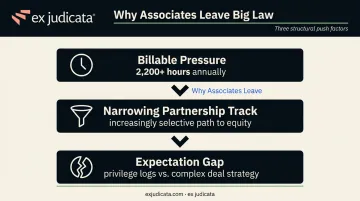
Big Law attrition doesn't happen in a vacuum. The drivers are structural and well-documented:
- Billable pressure: Historical NALP data shows firms with 700+ lawyers averaged over 2,200 total hours worked annually — and that was over a decade ago. Current expectations at many firms run higher
- Narrowing partnership tracks: The path from first-year to equity partner has become increasingly selective, and most associates recognize early that they're running a race with long odds
- The expectation gap: Many attorneys arrive expecting courtroom drama or complex deal strategy and find themselves on privilege logs, document review, or supporting senior partners on matters where their contribution feels invisible
A 2023 wellbeing survey of large law firms found that 17% of Big Law lawyers and employees felt emotionally depleted — and that figure covers all staff, not associates specifically, suggesting associate-level burnout runs higher.
The Pull Factors
The exit decision is also about moving toward something concrete:
- Greater ownership of a real business problem
- More predictable hours and a clearer boundary between work and life
- Higher effective hourly earnings in many nonlegal roles, even when base salary is lower
- The chance to be a decision-maker, not just a service provider
The Golden Handcuffs Problem
This deserves an honest acknowledgment: Big Law compensation, prestige, and professional identity create powerful inertia. Lifestyle inflation catches up quickly. Student debt feels more manageable with a Big Law paycheck.
And the "I'm a Big Law attorney" identity is real — it's what your family brags about, what's on your LinkedIn, what defines you at dinner parties.
Ex Judicata's wellbeing resources identify this as a barrier that rarely gets named directly. The binding constraint for most dissatisfied attorneys isn't the job market — it's the psychological weight of sunk costs, parental expectations, peer-group identity, and the prestige of bar admission. Recognizing that weight for what it is — not a reason to stay, but a reason the decision feels harder than it should — is where the real work begins.
Legal-Adjacent Exit Paths: Staying in Law, Changing the Context
Before choosing an exit path, answer one diagnostic question: Is the problem the legal profession itself, or is it this firm, this practice group, or this culture? Your answer determines which category applies.
In-House Counsel
In-house is the most common non-firm destination for departing Big Law attorneys — and for good reason. The trade-offs are meaningful but manageable:
What you gain:
- More predictable hours and work-life balance
- Proximity to real business decisions
- Ownership of a company's legal function over time
What you give up (at least initially):
- Work breadth — in-house roles tend to narrow your practice scope
- Compensation, especially early in the transition
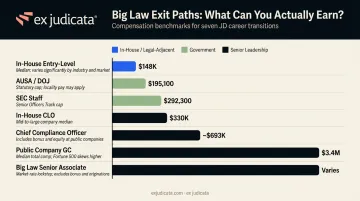
ACC's 2025 Law Department Compensation Survey reported a median base salary of $148,000 for entry-level in-house attorneys — a meaningful step down from Big Law all-in compensation for mid-level associates. The gap narrows significantly at senior levels, with Chief Legal Officers reporting median base salaries of $330,000, and General Counsel compensation at the largest public companies reaching a median of $3.4 million in 2024 according to Equilar.
The in-house path rewards patience. The early pay cut is real — but so is the senior upside.
Government and Public Service
DOJ, SEC, U.S. Attorney offices, and federal regulatory agencies are strategically underrated exits. The compensation reality is straightforward:
- AUSAs are capped at $195,100 in total pay with locality under the 2025 AD pay plan
- SEC staff face a salary cap of $292,300 including locality
That's a significant cut from Big Law. But the credential compounds. Government experience — particularly in enforcement, regulatory, or appellate work — reopens private-sector doors at a senior level, often with better leverage than if you'd stayed at a firm the entire time.
Attorneys who join the DOJ at 30 and return to Big Law or move in-house at 38 frequently access positions and compensation that a pure firm track wouldn't have made available.
Boutique and Mid-Size Firms
Smaller platforms offer something Big Law rarely can: faster matter ownership, closer client relationships, and a clearer line of sight to partnership. For litigators especially, the autonomy trade-off often outweighs the income delta.
The compensation gap is real — NALP's 2025 Associate Salary Survey shows the largest firms (700+ lawyers) carry a median first-year salary of $215,000, compared to $200,000 across all private-sector firms. At the senior level, that gap typically widens.
For attorneys who want to actually run matters — not just staff them — that income delta is often worth it. The question isn't whether you'll earn less; it's whether the work itself is worth more.
Lateral to Another Firm
The most overlooked option is usually the most practical first step. If the problem is a specific culture, a difficult partner, or a practice mix that doesn't fit — not Big Law itself — switching firms preserves your compensation, your title, and your platform while solving the actual problem.
Before networking for in-house roles or drafting a plan to leave the profession, ask honestly: would this problem go away at a different firm? Sometimes the answer is yes.
The Nonlegal Exit: Where Your JD Becomes a Competitive Advantage
A JD is not a limitation outside law. It signals analytical rigor, comfort with complexity, and the ability to make high-stakes judgments under pressure. Those qualities are genuinely rare, and businesses know it.
NALP's JD Advantage framework formalizes this — it defines roles where legal education provides a competitive edge even when bar passage or active law practice isn't required.
Legal Tech and Legal Operations
Legal tech companies and corporate legal operations teams actively recruit attorneys for product, implementation, compliance, and strategy roles. The value proposition is specific: legal judgment combined with business context is a combination that non-JD hires can rarely replicate.
Ex Judicata has placed attorneys in legal tech and legal ops roles through EXJ Search and features these transitions prominently in its EXJ Interview series — including Nicole Clark, who left law firm litigation to co-found Trellis Research, and Alexander Su, who became Chief Revenue Officer at Latitude Legal after leaving Sullivan & Cromwell.
Compliance, Risk, and Financial Services
Big Law attorneys — especially those from regulatory, securities, or finance practices — are natural fits for compliance leadership and risk advisory roles. The analytical and regulatory fluency that firms train you to have is exactly what banks, insurers, and consulting firms need in people who aren't practicing law.
This is also one of the most documented exit categories in terms of real placements. Through EXJ Search, Ex Judicata has placed:
- Nicolas Dumont (formerly Cooley) as VP, Transaction Advisory Leader at Lockton
- Alan Kornberg (formerly Paul Weiss) as Senior Adviser at Marsh McLennan
- Lee Garner (formerly Skadden) as Managing Director, Compliance & Investigations at Guidepost Solutions

These are senior, high-responsibility roles at major organizations — not consolation prizes. They're the kinds of positions that require exactly what Big Law builds.
Consulting, Policy, Nonprofit, and Entrepreneurship
The range of viable paths here is broader than most Big Law attorneys expect:
- Management consulting firms hire JDs to structure complex problems and present findings to senior stakeholders
- Legislative, regulatory, and agency roles value legal training without requiring bar admission
- Nonprofit executive director and advocacy positions reward analytical credibility and policy fluency
- Entrepreneurship is a real option — EXJ Interview subject Helene Godin founded By the Way Bakery after 22 years of practice, building on the discipline and credibility her JD provided
For attorneys exploring this terrain, Ex Judicata has built the only platform designed specifically for this transition:
- Job Board: 100% nonlegal roles for JDs — no filtering required
- EXJ Community: A peer network for non-practicing lawyers, free to join
- EXJ Career Diagnostic: $25.95 PhD-validated assessment mapping eight attorney traits against 25 business careers
- EXJ Search: Retained executive search for attorneys targeting senior nonlegal placements
The Honest Trade-Off Ledger
The Honest Trade-Off Ledger
Compensation by Exit Path
| Exit Path | Compensation Benchmark | Key Caveat |
|---|---|---|
| Big Law senior associate | Significant base + bonus (varies by class year) | All-in figures vary; bonuses are variable |
| In-house entry-level | $148,000 median base (ACC 2025) | Base only; early-career gap is real |
| In-house CLO | $330,000 median base (ACC 2025) | Senior role; not entry-level trajectory |
| Public company GC | $3.4M median (Equilar 2024) | Top-of-market; not typical in-house comp |
| Chief Compliance Officer | ~$693,000 base + bonus target (ACC/MLA 2024) | CCO-level; compliance leadership specifically |
| AUSA / DOJ | Capped at $195,100 with locality (2025) | Agency-specific; real pay cut |
| SEC staff | Capped at $292,300 with locality (2025) | SEC-specific |
The Hours-Per-Dollar Reality
Total compensation is only one dimension. Big Law's effective hourly rate, calculated by dividing all-in pay by actual hours worked, often looks less impressive than the headline number.
An attorney earning $400,000 and working 2,400 hours clears roughly $167 per hour before tax. An in-house attorney earning $250,000 and working 1,800 hours lands at approximately $139 per hour. Factor in benefits, job security, and quality of life, and that gap narrows considerably. The takeaway: hourly economics matter as much as the offer letter when evaluating a move.
The Identity Cost Nobody Puts in a Salary Guide
Leaving Big Law means giving up the institutional name, the structured ladder, and the professional identity that comes with a firm. For many attorneys, this is harder than the income adjustment.
Ex Judicata's EXJ Interview series addresses this directly. Geoffrey Stein, a former litigator who became an artist, put it plainly: "When you say you're a lawyer, there's a status attached. Even if they don't know what you do day-to-day, people know what law is." Keita Young, now Senior Director of DEI at FanDuel, heard from her JPMorgan division head: "You will always be a lawyer. You can always come back to it."
What both stories point to:
- The JD credential is permanent — no exit strips it away
- Status anxiety tends to peak in the first year, then recede
- Professional identity expands over time; it doesn't simply disappear
The credential doesn't disappear — and the identity evolves with it.
Planning Your Big Law Exit: A Practical Framework
Step 1: Get Financially Honest
Before anything else, understand your actual financial position:
- What is your outstanding student debt, and how does your current paycheck affect your repayment strategy?
- How much has your lifestyle inflated around a Big Law salary?
- Can you build a savings runway for 6-12 months of lower or interrupted income?
Ex Judicata's free Money Management content hub (exjudicata.com) covers this ground in detail: comp-comparison frameworks, bridge-income strategy, and the 20-60% near-term pay cut most attorneys face when moving to business roles.
Step 2: Explore Before You Decide
Start gathering real information before you make any decisions:
- Talk to attorneys who have already transitioned — your Big Law client relationships and opposing counsel are an underused window into other careers, and most are willing to share their experience
- Run the EXJ Career Diagnostic ($25.95, 20-30 minutes) to get PhD-validated fit scores across 25 business careers before committing to a direction
- Connect with JDs already working in roles you're considering through the EXJ Community (free for non-practicing lawyers; $9.29/month for still-practicing attorneys)
Step 3: Time Your Exit Well
Recruiter guidance from Chambers Associate and Major, Lindsey & Africa consistently points to 3 to 7 years of experience as the window when Big Law associates are most marketable for in-house and nonlegal transitions. The reasoning:
Leave too soon and your credential isn't fully built yet — no defined practice area, no real matter history, no story that holds up in an interview. Wait too long and inertia compounds: leaving gets harder psychologically, financially, and practically with every year that passes.
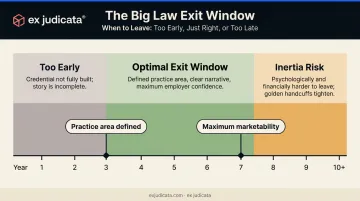
The goal is to leave with a clear story: what you did, why it matters outside law, and where you're going next. Employers hiring JDs for nonlegal roles aren't just buying your degree — they're buying a coherent professional arc.
Frequently Asked Questions
What are realistic Big Law exit options at the Big 4?
PwC, Deloitte, and EY all hire JDs for tax, compliance, advisory, and strategy roles — PwC even maintains a dedicated Tax JD/LLM hiring page. This path works particularly well for attorneys with transactional, tax, or regulatory backgrounds who want a business context without leaving professional services.
What is the 80/20 rule for lawyers?
Applied to career strategy, it means identifying the 20% of your Big Law skills that generate the most transferable value — analytical reasoning, complex drafting, high-stakes judgment — and leading with those when positioning for exits. Anchoring on your highest-leverage capabilities works. Trying to replicate the entire Big Law job description in a new context rarely does.
How can a lawyer make $500,000 a year outside Big Law?
It's possible, but the route matters. Senior in-house roles at large public companies, Chief Compliance Officer positions, private equity or finance roles with carry, and equity partnership at high-revenue boutiques are the most realistic routes. Staying in Big Law as a senior associate or junior partner remains one of the fastest paths to that level.
When is the right time to leave Big Law?
The strongest exits happen after you've built enough substantive experience to speak credibly about a defined practice area and specific matters. Leaving too early means exiting before the credential is fully built; staying out of inertia has its own growing cost.
Can you return to Big Law after leaving?
Yes, particularly if your departure was for a prestigious in-house role, government service, or a well-regarded boutique. It isn't guaranteed — but protecting relationships and your professional reputation on the way out significantly improves the odds if you later want to return.