

The good news: tax law expertise is unusually portable. The combination of legal precision and financial fluency that tax lawyers develop — reading deal structures, navigating cross-border regulatory risk, managing IRS controversy — is exactly what CFOs, private equity deal teams, and multinational corporations need. And they'll pay accordingly.
This post maps the top high-paying non-Big Law career paths for tax lawyers, identifies which roles can realistically reach $500K–$1M+, and offers a practical framework for evaluating your transition.
Key Takeaways
- Tax law is one of the most transferable legal specializations, with premium pay available well beyond Big Law.
- Top non-Big Law earners land as Corporate Head of Tax, PE tax principal, Big 4 tax partner, family office tax director, or international tax consultant.
- Corporate and finance roles can match or exceed Big Law total comp once equity, carried interest, and bonuses factor in.
- Hitting $500K+ requires 10+ years of seniority, a specialized niche, and variable pay on top of base salary.
- Ex Judicata connects tax lawyers with organizations actively seeking JD talent for senior nonlegal roles.
What Makes Tax Lawyers Uniquely Valuable Outside Big Law
Tax lawyers carry three distinct skill layers that most professionals never combine: legal reasoning, subject-matter depth, and financial fluency. They can read a balance sheet, translate regulatory risk into business terms, and advise executives when the answer isn't in the code. That's a profile most finance or compliance hires can't replicate.
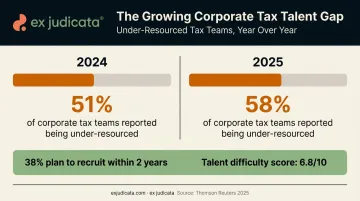
The market reflects this. Thomson Reuters' 2025 State of the Corporate Tax Department report found 58% of corporate tax departments were under-resourced — up from 51% in 2024 — and 38% planned to recruit qualified tax professionals within two years. Tax leaders rated the difficulty of finding qualified talent at 6.8 out of 10.
That talent gap creates real leverage for JD and LLM holders. No public benchmark precisely quantifies the pay premium over a CPA in corporate roles, but the distinction shows up in practice: when a role requires IRS controversy judgment, M&A structuring, or board-level risk communication, a CPA credential alone doesn't get you there.
One practical distinction matters for how you position yourself:
- Bar admission still relevant: In-house roles involving IRS controversy, formal legal opinions, or direct representation
- Bar admission less relevant: VP of Tax Strategy, PE tax principal, Big 4 advisory — business-facing roles focused on outcomes, not legal practice
Knowing which side of that line your target role sits on shapes how you present your credentials.
Top High-Paying Non-Big Law Career Paths for Tax Lawyers
These five paths were selected based on realistic compensation ceiling, direct use of tax law expertise, and accessibility to attorneys with 3–15 years of Big Law or government experience.
Corporate Head of Tax / VP of Tax (In-House)
Fortune 500 and large private companies hire senior tax attorneys to own global tax strategy — covering ASC 740 (tax accounting), M&A tax due diligence, transfer pricing policy, and IRS controversy management. The role is the internal equivalent of outside counsel, but with P&L ownership, cross-functional leadership, and equity-based pay that Big Law doesn't offer.
| Details | |
|---|---|
| Typical Compensation | Base: $225K–$600K depending on market and seniority; total comp (base + bonus + LTI) can reach $400K–$700K+ at the VP/Head level in major markets |
| Core Tax Skills Applied | Transactional tax, ASC 740/GAAP tax provision, international tax, tax controversy, M&A structuring |
| Path In | Typically 7–12 years of Big Law or Big 4 tax experience; M&A or international tax background especially valued |
Per Brewer Morris' 2024–25 U.S. in-house tax salary guide, Northeast Tier 1 VP/Head of Tax roles show base salaries of $225K–$325K with bonus targets of 25–40% and LTI of 15–20%. Midwest and Southeast Head of Tax roles show base ranges of $300K–$600K. Houston and Dallas are competitive with coastal markets.
Private Equity / Investment Management Tax Principal
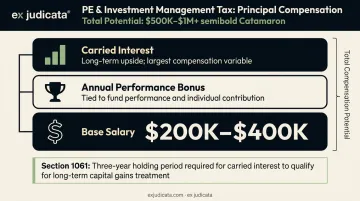
This is one of the highest-ceiling roles available to tax attorneys outside Big Law — and the structure of compensation explains why. PE firms, hedge funds, and asset managers bring tax lawyers in as in-house principals or senior advisors to handle fund structuring, deal tax due diligence, portfolio company strategy, and investor-level pass-through issues.
What sets this path apart is carried interest and performance bonuses on top of base salary — compensation mechanics that Big Law simply doesn't offer.
| Details | |
|---|---|
| Typical Compensation | Senior carry-eligible tax principals can realistically reach $500K–$1M+; base salary alone is lower, but carry tied to fund performance drives total economics |
| Core Tax Skills Applied | Partnership tax, fund structuring, deal tax diligence, carried interest mechanics, blocker structures |
| Path In | Typically 5–10 years of Big Law tax with a focus on fund formation, M&A, or partnership tax; CPA or LLM is a strong differentiator |
Carried interest is generally taxed as capital gain, and under Section 1061 of the IRC, a three-year holding period applies for certain partnership interests to receive long-term capital gain treatment. The upside is real — but vesting schedules, fund performance, allocation size, and whether the tax role specifically receives carry all determine realized pay.
Big 4 Tax Partner / Principal (Deloitte, PwC, KPMG, EY)
Big 4 firms run large, high-volume tax advisory practices and actively recruit experienced Big Law tax attorneys for partner and principal-track positions — particularly in M&A tax, international tax, transfer pricing, and tax controversy. PwC's U.S. recruiting specifically lists Tax JD and LLM opportunities, and Harvard Law School's Center on the Legal Profession documents the Big Four as established career destinations for lawyers.
| Details | |
|---|---|
| Typical Compensation | U.S. Big 4 tax partner/principal compensation isn't publicly disclosed in detail, but typically ranges, based on available industry benchmarks, from $300K–$700K+ depending on equity status, book of business, geography, and firm profitability |
| Core Tax Skills Applied | Tax planning, M&A tax structuring, transfer pricing, tax controversy, client advisory |
| Path In | Direct lateral from Big Law tax practice; LLM in taxation is highly valued; Managing Director or Principal title is common entry point before partner election |
Big 4 tax partners often match or exceed Big Law partner economics with broader client exposure and no billable-hour model. The main variable: whether you reach equity partner status and how large your book of business becomes.
Family Office / Wealth Management Tax Director
For tax lawyers burned out on transaction volume and billable-hour pressure, family office roles offer a different calculus. Senior tax directors and Chief Tax Officers at large family offices manage estate and gift tax planning, trust structures, charitable giving strategies, international tax compliance, and investment tax planning — with deep client relationships and no timesheet.
| Details | |
|---|---|
| Typical Compensation | Varies widely by AUM; using CFO/CLO benchmarks as proxies, senior tax leadership at large family offices can range from $250K–$600K+; offices with $1B+ AUM and carry structures can push higher |
| Core Tax Skills Applied | Estate and gift tax, trust planning, international tax compliance, charitable structures, investment tax |
| Path In | Private client/wealth planning background at a Big Law firm or estate planning boutique; CPA/LLM combination is a strong differentiator |
Botoff Consulting's 2025 family office report (prepared for Morgan Stanley Private Wealth Management) shows that 43% of investment-focused family offices offer carried interest or phantom carry, and New York/San Francisco roles command 15–25% geographic premiums. For attorneys targeting the $500K+ range, AUM size and carry eligibility matter as much as title.
International Tax / Transfer Pricing Consultant at a Global Advisory Firm
Demand for international tax expertise isn't cyclical — it's being written into law. Global consulting firms, including Big 4, Alvarez & Marsal, NERA, and boutique transfer pricing shops, hire tax lawyers with international backgrounds to advise multinationals on OECD/BEPS compliance, transfer pricing documentation, APAs, and cross-border deal structures.
| Details | |
|---|---|
| Typical Compensation | Senior managers and directors typically earn $200K–$400K+; partner/MD-level roles can reach $500K+ |
| Core Tax Skills Applied | International tax law, OECD/BEPS frameworks, transfer pricing documentation, APA negotiations, cross-border M&A |
| Path In | Big Law or Big 4 international tax background; LLM with an international focus is particularly valuable; language skills are a differentiator |
OECD Pillar Two establishes a 15% global minimum tax applying to multinationals above €750M in consolidated revenue. Approximately 40 countries implemented the rules in 2024, with up to 60 jurisdictions expected by end-2025. That rollout is generating a sustained wave of compliance and advisory work — the kind that requires lawyers who can operate at the intersection of tax law and cross-border operations, not just one or the other.
Which of These Roles Can Realistically Reach $500K–$1M+?
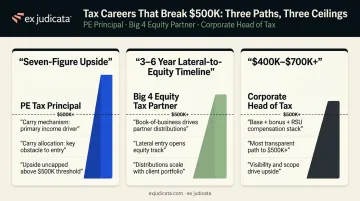
Roles that cross the $500K threshold share one trait: variable compensation tied to business performance, not just a high base salary.
The three highest-ceiling paths:
- PE/Investment Management Tax Principal — Carry is the mechanism. A senior tax attorney at carry-eligible status in a strong-performing fund can see total economics well into seven figures. Getting carry allocated to a tax role (rather than an investment role) is the real obstacle to clear.
- Big 4 Tax Partner (Equity) — At equity partner status, distributions depend on your book of business and firm profitability rather than a fixed salary. Most Big Law laterals reach equity partner in 3–6 years.
- Corporate Head of Tax at a Large Public Company — RSUs plus annual bonus on top of a strong base salary make this the most accessible and transparent path to $400K–$700K+. The $1M ceiling exists but requires exceptional company size, equity grants, and market timing.
Credentials and Geography
An LLM in taxation from NYU (#1 in U.S. News' 2026 Tax Law rankings) or Georgetown (#2) gives you a measurable edge on the Big 4 partnership track and with PE firms that weight technical credentialing. In family office and in-house roles, deep transactional experience tends to matter more than the degree itself.
Geography shapes your ceiling more than most candidates expect. The cities where variable pay is highest:
- New York — PE, finance, and hedge fund tax roles
- Houston — Energy sector tax, including midstream and E&P
- Chicago — Private equity and derivatives tax
- San Francisco / San Jose — Tech company in-house tax; Brewer Morris' guide adds a 10% premium over other West Coast markets
If you're targeting the $500K–$1M+ range, your location strategy is as important as your credential stack.
How to Evaluate and Pursue Your Transition
Before targeting a specific path, three questions help clarify fit:
- Do you want to stay close to legal work, or move toward a business/advisory role? In-house Head of Tax keeps you in a legal-adjacent function. Big 4 and PE move you toward client service and deal economics.
- Do you prefer a structured organization or a lean team? Fortune 500 in-house roles come with hierarchy and process. Family offices are often 2–5 person operations where you own everything.
- Is compensation ceiling or work-life balance the higher priority? PE and Big 4 partner track offer the highest upside but aren't low-pressure environments. Family offices and some in-house roles offer better quality of life with a lower — but still strong — compensation ceiling.

Once you know which direction fits, the next step is making sure your resume speaks to hiring managers who've never read a legal CV.
Repositioning Your Resume for Non-Law Employers
Most hiring managers outside law firms don't know how to read a traditional legal CV. What to emphasize:
- Deal volume and deal complexity (transaction sizes, cross-border dimensions)
- Industries served and types of clients advised
- Quantifiable outcomes where possible (tax savings identified, controversy amounts resolved, structure complexity)
- Cross-functional collaboration with CFOs, boards, and deal teams
What to de-emphasize: billing rates, billable hour totals, firm hierarchy titles, and legal citation-style descriptions of work.
Where Ex Judicata Fits
Ex Judicata is the only platform built specifically for JD career transitions. Four resources are directly relevant to tax lawyers making this move:
- Job Board with 100% nonlegal roles for JDs, spanning business, finance, and advisory positions
- EXJ Search, a retained executive search service operating at partner and senior counsel level — the right tier for a 7–15 year Big Law tax attorney
- EXJ Community, free for non-practicing lawyers (no credit card required), with the first-ever NPL member directory to connect with lawyers already working in finance, wealth management, and advisory roles
- Financial Fluency for Lawyers, an on-demand course for tax attorneys who need to demonstrate broader financial literacy in corporate or PE interviews
EXJ Community membership is determined by role, not bar status. A tax lawyer who has moved in-house or joined a Big 4 advisory team qualifies for free membership regardless of whether they still hold bar admission.
Frequently Asked Questions
What are the highest-paying non-Big Law jobs for tax lawyers (JD/LLM) that can earn $500,000–$1,000,000 a year?
Private equity in-house tax principals with carry eligibility, Big 4 equity tax partners, and Corporate Head of Tax roles at large public companies with meaningful equity grants are the most realistic paths. Reaching this range typically requires 10+ years of specialized experience and variable pay — carry, RSUs, or partnership distributions — not base salary alone.
Which LLM program is best for tax law?
NYU School of Law (#1) and Georgetown Law (#2) top U.S. News' 2026 Tax Law rankings. Choose based on your target path: NYU for Big Law or Big 4 credentialing, Georgetown for government or policy roles. NYU reported 97.1% full-time employment for its 2025 Tax LLM class by March 2026.
Do tax lawyers need to maintain bar admission to work in non-Big Law roles?
Bar admission is not required for most corporate, finance, or consulting roles described here. It can remain an asset for in-house positions involving IRS controversy or formal legal opinions. Many non-practicing lawyers maintain inactive status — in California, inactive attorneys represent approximately 18% of the bar population.
Can a tax lawyer with no finance background transition into private equity?
Pure M&A tax advisory work — deal diligence, structuring memos — is a strong bridge to PE roles. Candidates without financial modeling experience may benefit from a transitional role at a Big 4 M&A tax group before targeting PE firms directly — or from supplemental coursework such as Ex Judicata's Financial Fluency for Lawyers, a 3-hour CLE-eligible course designed for lawyers building business-side fluency.
What skills from Big Law tax practice translate best to corporate and finance roles?
Deal structuring analysis, tax risk assessment, cross-border regulatory fluency, and advising under uncertainty are the most transferable. The ability to synthesize complex tax issues into executive-level recommendations — in plain language, under time pressure — is particularly valued in corporate and PE settings where lawyers typically aren't in the room.
How long does a typical transition from Big Law tax to a non-Big Law role take?
Lateral moves to Big 4 or in-house roles often happen within 3–6 months for candidates who are actively networking and searching. Pivots to PE or family office roles can take 6–18 months — those hiring processes are relationship-driven and rarely run through traditional job boards.