

Introduction
Promoting a strong individual contributor into a leadership role is one of the most common — and costly — mistakes organizations make without adequate support. The assumption that high performance translates automatically into effective leadership is wrong more often than it's right. McKinsey research shows that between 27% and 46% of executive transitions are regarded as failures or disappointments within two years.
Two development tools directly address this gap: executive coaching and leadership mentoring. They're frequently treated as interchangeable — they're not. Each serves a distinct purpose, and deploying them strategically is what determines whether your leadership investment pays off.
This article covers:
- The core difference between coaching and mentoring
- The business case for investing in both
- The specific skills each approach builds
- When to use which tool
- Why JDs stepping into leadership roles are uniquely positioned to benefit from structured development support
Key Takeaways
- Executive coaching targets specific performance gaps over 3–12 months; mentoring builds whole-leader capability over a longer arc
- Gallup data shows managers account for at least 70% of the variance in employee engagement scores
- Coaching and mentoring work best as complementary investments, not either/or choices
- JDs bring strong analytical and communication skills to leadership roles; structured coaching addresses common gaps in organizational dynamics and people management
- Ex Judicata's Career Corner connects JDs with vetted specialists in leadership development and executive coaching
Executive Coaching vs. Leadership Mentoring: What's the Difference?
Coaching and mentoring serve different purposes — and using the wrong one is an expensive mistake. Mentoring can't fix an urgent performance gap in six weeks. Coaching can't replicate the institutional wisdom that a seasoned guide builds over years. Knowing which to deploy, and when, is where most organizations go wrong.
Executive Coaching
Executive coaching is a structured, time-bound engagement — typically 3 to 12 months — focused on closing a specific performance gap or driving a defined behavioral change. It's goal-oriented, measurable, and conducted by a credentialed professional who provides objective feedback and accountability without the organizational politics that can compromise internal feedback.
According to the Association for Talent Development, coaching is task-oriented and performance-driven. Coaches frequently use structured assessment tools — 360-degree feedback, leadership style inventories — to establish a baseline before work begins.
Leadership Mentoring
Mentoring is a longer-term advisory relationship between a seasoned leader and a developing one. The EMCC defines mentoring as a learning relationship involving the sharing of skills, knowledge, and expertise through developmental conversations, experience sharing, and role modeling. It's not about fixing a single gap — it's about developing the whole leader over time.
The value comes from institutional wisdom, honest sounding-board conversations, and the kind of network access that only a trusted senior guide can open. That depth takes time — which is why mentoring relationships typically span nine months to several years.
Side-by-Side Comparison
| Dimension | Executive Coaching | Leadership Mentoring |
|---|---|---|
| Duration | 3–12 months | 9 months to several years |
| Focus | Specific skill gap or behavior | Career trajectory, whole-leader growth |
| Structure | Formal, goal-driven, measured | Relationship-driven, advisory |
| Best for | Performance gaps, role transitions | Pipeline development, cultural integration |
| Primary outcome | Measurable behavioral change | Wisdom transfer, career confidence |
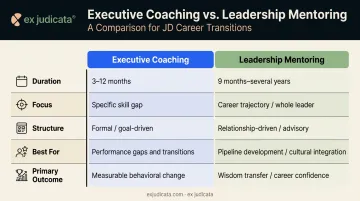
Coaching sharpens a specific skill for near-term impact. Mentoring builds the judgment to deploy those skills across an entire career. Most high-performing organizations use both — at different stages and for different people.
The Business Case: Why Investing in Leader Development Pays Off
Poor leadership is expensive. Gallup reports that one in two employees has left a job specifically to get away from a manager. Multiply that voluntary attrition across a workforce and the cost compounds quickly — recruiting, onboarding, and productivity loss stack up with every departure.
Those departures don't happen in a vacuum. Gallup's research shows managers account for at least 70% of the variance in employee engagement scores across business units — meaning leadership quality directly drives output, retention, and team morale at every level of the organization.
The Succession Planning Gap
DDI's research indicates that 80% of organizations lack confidence in their leadership pipeline, and half of external executive hires fail. McKinsey's data reinforces this: only 32% of organizations in their sample provided tailored executive coaching during leadership transitions — and tailored coaching more than doubled the likelihood of transition success.
External executive hires are expensive and high-risk. Building internal pipelines through structured mentoring reduces both the frequency and cost of external searches — and lowers the odds of a costly mis-hire at the senior level.
How Coaching and Mentoring Complement Each Other Financially
Coaching and mentoring aren't competing budget items. They address different time horizons:
- Coaching delivers concentrated, measurable returns over a short window. One MetrixGlobal case study for a Fortune 500 company reported a 529% ROI from executive coaching, rising to 788% when employee retention benefits were included.
- Mentoring scales development broadly across leadership populations at lower per-person cost. ATD surveys show that 50% of organizations running formal mentoring programs cite higher employee engagement and retention as the top benefit.
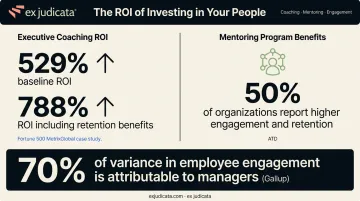
Used together, they cover the full arc — from immediate performance gains to sustained leadership growth over time.
Key Leadership Skills Developed Through Coaching and Mentoring
Coaching Builds These Critical Capabilities
Executive coaching typically targets skills with immediate performance implications:
- Executive presence and communication — how a leader shows up in high-stakes conversations, board presentations, and cross-functional negotiations
- Decision-making under pressure — moving from analysis paralysis to confident, timely calls
- Conflict resolution — navigating team friction and competing stakeholder interests without escalation
- Delegation — letting go of individual contributor habits and trusting a team to execute
- Managing up and across — influencing without direct authority in matrixed organizations
Coaches establish a baseline using structured assessment tools. SHRM describes 360-degree feedback as collecting anonymous input from peers, managers, and direct reports to reveal the gap between a leader's intentions and their actual impact. This data-driven start makes coaching outcomes trackable rather than impressionistic.
A 2023 meta-analysis of executive coaching randomized controlled trials found coaching effects were strongest for behavioral outcomes — precisely the domain these tools target.
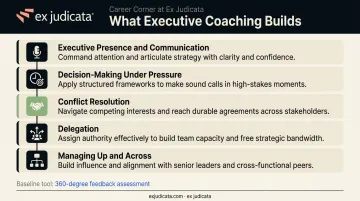
Coaching sharpens behaviors quickly. Mentoring builds something different — the kind of judgment and self-awareness that only comes with time.
Mentoring Develops These Long-Range Strengths
Mentoring builds qualities that take time and experience to cultivate. A trusted senior mentor provides access to:
- Strategic thinking — seeing beyond quarterly results to longer organizational trajectories
- Organizational navigation — understanding informal power structures, unwritten rules, and how decisions actually get made
- Network development — introductions and relationships that cannot be manufactured through LinkedIn alone
- Career confidence — the conviction to pursue senior roles and advocate for yourself effectively
- Leading through ambiguity — resilience when the path isn't clear
The emotional intelligence data is striking. A 2024 Frontiers in Education study found mentored leaders showed significantly lower empathy difficulty than non-mentored peers. Peer-group mentoring produced the highest EQ scores across the sample — a result no performance review process is designed to achieve.
When to Use Executive Coaching vs. Mentoring
Use Executive Coaching When:
- A leader is preparing for a significant role transition — new function, new level, new organization
- A performance review or 360 has identified a specific behavioral gap requiring attention
- A senior external hire needs rapid onboarding and cultural acceleration
- A defined outcome must be achieved within a defined timeframe
Research from McKinsey found that tailored executive coaching during leadership transitions more than doubles the likelihood of success — yet only 32% of organizations actually provide it. For those that do, that gap is a straightforward competitive advantage. For JDs stepping into senior nonlegal roles (Chief Compliance Officer, Chief Risk Officer, General Counsel), structured coaching during the first 90 days can be particularly decisive.
Use Mentoring When:
- A high-potential employee is being groomed for a senior role over the next 1–3 years
- A new leader needs cultural integration, network-building, and institutional wisdom transfer
- Your organization is building a succession pipeline and needs deeper bench strength
- The development need is long-range — not a skill deficit, but a career trajectory question
The Case for Running Both Simultaneously
Many high-performing organizations don't choose between them. A common hybrid structure pairs a 6–12 month coaching engagement targeting specific capabilities with a concurrent mentoring relationship for broader development and cultural integration. In practice, it looks like this:
- Coaching: Targets a specific gap — executive presence, stakeholder influence, decision-making under ambiguity
- Mentoring: Builds the longer arc — judgment, institutional relationships, cultural fluency
- Combined: The leader closes the immediate capability gap while building the foundation for sustained performance
Neither replaces the other. Together, they cover both the near-term and the horizon.
Building a Coaching and Mentoring Culture
Coaching culture is built through sustained behavior, not a single program. The ICF identifies three markers of real infrastructure: organization-wide access to coaching, leaders who apply coaching skills in daily interactions, and visible resource commitment that signals development is a strategic priority.
What a Coaching Culture Looks Like in Practice
- Leaders at every level hold regular development conversations with their teams
- Feedback is given in real time, not saved for annual reviews
- Asking powerful questions is valued as much as giving direct answers
- Psychological safety exists for leaders to acknowledge gaps without career risk
These behaviors don't emerge on their own — they require program structure to take hold.
Designing a Formal Mentoring Program That Works
ATD recommends these core design elements for programs that produce measurable outcomes:
- Clear goals tied to business strategy — not just career development for its own sake
- Deliberate mentor-mentee pairing — based on development needs, not convenience
- Signed learning agreements with defined timelines and milestones
- Confidentiality norms — mentees need to speak candidly without political risk
- Training for both parties — mentors need guidance too; good leadership doesn't automatically produce good mentoring
- A measurement framework established before launch — tracking promotions, retention, and tenure against the general employee population
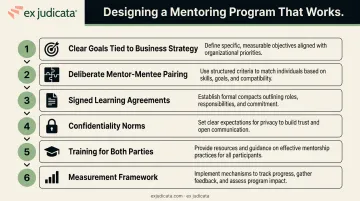
Executive buy-in is the variable most often underestimated. Programs succeed when senior leaders participate as active mentors — not just as sponsors who approve the budget. Linking development metrics to leadership performance reviews is what converts good intentions into consistent practice.
Why JDs Make Exceptional Leadership Candidates Worth Developing
Lawyers entering business leadership bring a foundation that most MBA programs spend years trying to build: rigorous analytical thinking, meticulous attention to detail, strong written and verbal communication, high ethical standards, and the ability to synthesize complex information under time pressure. U.S. News identified 15 Fortune 500 CEOs who earned law degrees — the skills transfer at the highest organizational levels.
The Gap That Coaching and Mentoring Fill
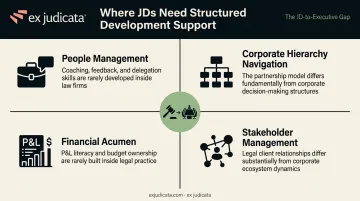
Where JDs most commonly need support is organizational dynamics, corporate culture, and people leadership. Ex Judicata's founders — with 75+ years of combined experience in legal recruiting and JD career transitions — observe these gaps consistently:
- People management — law firm environments rarely develop the coaching, feedback, and delegation skills that corporate leadership requires
- Corporate hierarchy navigation — the law firm partnership model differs fundamentally from how corporate organizations make decisions
- Financial acumen — P&L literacy and budget ownership are rarely developed in legal practice
- Stakeholder management — legal client relationships operate under different incentive structures than corporate stakeholder ecosystems
These gaps aren't reflections of JD capability. They're artifacts of law school and law firm training's narrow focus. Structured coaching and mentoring can compress that learning curve — often by years — turning an already strong analytical foundation into effective organizational leadership. That's exactly where Ex Judicata's resources come in.
How Ex Judicata Supports This Transition
Ex Judicata's Career Corner connects JDs with vetted specialists who understand this transition firsthand. A few examples:
- Tracy Tyler, MBA (Strategies for Success International) — coaching, leadership development, onboarding support, and self-discovery, specializing in organizational design and team development
- Margaret Enloe, JD, PCC — Professional Certified Coach with 30+ years of legal experience, including partnership at PricewaterhouseCoopers; focuses on leadership development and career transition
- John Costango — former Chief of Staff/COO for JPMorgan's Global Legal Team, with 20 years of executive experience in complex international organizations
All Career Corner engagements begin with a complimentary discovery consultation. Typical coaching engagements run approximately six months with up to 12 sessions. Access the Career Corner at exjudicata.com.
For organizations seeking to hire experienced JD talent for senior nonlegal roles — Chief Compliance Officer, Chief of Staff, ESG leadership, Transaction Advisory — EXJ Search provides retained executive search at the intersection of legal search and executive search, with documented placements at Marsh McLennan, Lockton, Guidepost Solutions, and MSIG USA.
Frequently Asked Questions
What is executive coaching and mentoring?
Executive coaching is a structured, time-limited process (typically 3 to 12 months) targeting specific leadership performance gaps through goal-setting, assessment, and accountability. Mentoring is a longer-term advisory relationship focused on career growth, wisdom transfer, and whole-leader development. Both are personalized and confidential.
What are the 4 C's of executive presence?
The 4 C's of executive presence are Confidence, Credibility, Communication, and Composure. Executive coaching targets all four directly — from sharpening high-stakes communication to building the emotional regulation that composure demands.
What are the 5 C's of coaching and mentoring?
The 5 C's are Commitment, Communication, Clarity, Consistency, and Compassion. These are the relational qualities that separate engagements that produce real growth from ones that stall out.
What is the 70/30 rule in coaching?
The 70/30 rule holds that the person being coached should do approximately 70% of the talking during sessions, with the coach speaking only 30% of the time. This reflects a core principle of effective coaching: the coachee's own reflection and insight drive lasting behavioral change, not the coach's advice.
How long does executive coaching typically last?
Executive coaching engagements typically run 3 to 12 months, depending on the complexity of the development goal. Shorter engagements (3-6 months) address specific skill gaps; longer ones (6-12 months) support broader leadership transitions, role changes, or complex behavioral shifts.