
This post compiles the most current lawyer mental health statistics across depression, anxiety, substance abuse, burnout, and career impact. Whether you're a practicing attorney, a firm leader, or someone already questioning whether to stay, these numbers tell a clear story about the state of mental health in law.
Key Takeaways
- 66% of lawyers say the legal profession has been detrimental to their mental health
- Lawyer anxiety jumped from 64% to 71% between 2019 and 2020, compared to just 19.1% in the general population
- Lawyers contemplate suicide at approximately twice the rate of the general adult population
- Stigma is a primary barrier: 50.6% of attorneys avoid seeking treatment because they don't want others to find out
- ~50% of lawyers are considering leaving the profession due to stress or burnout
The Scale of the Problem: Overall Lawyer Mental Health Statistics
The legal profession's mental health crisis is not new, and the data shows no sign of improving.
A 2023 study published in Healthcare of 1,962 practicing lawyers found that 66% of respondents said their time in the legal profession had been detrimental to their mental health. That same study found 46% were considering leaving the profession due to stress or burnout.
The Krill Study: The Peer-Reviewed Baseline
Those 2023 figures echo a pattern documented years earlier. The landmark reference point for lawyer mental health research is the 2016 Krill, Johnson, and Albert study published in the Journal of Addiction Medicine — the largest study of its kind, covering 12,825 licensed, employed attorneys.
Core findings:
- 28% reported depression
- 19% reported anxiety
- 23% reported stress
- 20.6% screened positive for hazardous or potentially alcohol-dependent drinking
- 11.5% reported suicidal thoughts over their career
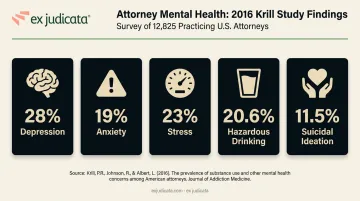
The authors noted that stigma and reluctance to self-report likely push real figures higher — what the data shows is already alarming, and it's probably an undercount.
The Stigma Barrier
Stigma doesn't just cause suffering — it prevents recovery. The Krill study found that among attorneys who didn't seek substance use treatment:
- 50.6% didn't want others to find out
- 44.2% cited privacy or confidentiality concerns
Bloomberg Law's 2024 Attorney Well-Being Report adds another layer: 43% of attorneys delayed or didn't seek mental health treatment at all. The cited reasons: lack of time (72%), belief they could handle it themselves (52%), societal stigma (16%), and fear of threat to job status (15%).
How Lawyers Compare to Other Professions
The legal profession's substance use rates stand out even against other high-stress fields. Two comparisons from Krill's 2016 data make the gap concrete:
- Problematic drinking: Attorneys at 20.6% vs. a broad highly educated workforce at 11.8%
- AUDIT-C positive screening: Attorneys at 36.4% — more than double the physician and surgeon rate of roughly 15%
The COVID-19 Effect
The pandemic accelerated trends already in motion. A California Lawyers Association summary of ALM Intelligence survey data from 2022 — drawing on approximately 3,400 legal-profession respondents — found:
- 67% experienced anxiety
- 44% reported isolation
- 35% reported depression
- 19% reported suicidal ideation
Bloomberg Law data from the same period found attorneys felt burned out nearly half the time. For lawyers ages 25 to 34, that figure climbed to 58%.
Depression and Anxiety Among Lawyers: By the Numbers
The trajectory of depression and anxiety in the legal profession over the past several years is not encouraging.
Depression Rates
- Krill 2016 baseline: 28% of attorneys reported depression
- Bloomberg Law 2024: 25% of attorneys experienced depression since the start of 2024
- ALM survey data (legal profession, 2019–2020): Depression rose from approximately 31% to 37% among legal-industry respondents
For context, these figures reflect people actively employed in the profession. Attorneys who left due to mental health reasons are not captured in most surveys — which means the data likely understates the crisis.
Anxiety Rates
The anxiety numbers are even more striking:
- Bloomberg Law 2024: 44% of attorneys experienced anxiety
- ALM survey data (2019–2020): Anxiety among legal professionals rose from approximately 64% to 71%
- General population benchmark (NIMH): 19.1% past-year prevalence for any anxiety disorder
Attorneys experience anxiety at more than double the rate of the general adult population.
What Stress Looks Like Physically
The ABA Commission on Lawyer Assistance Programs identifies the following as documented stress symptoms in attorneys:
- Headaches, muscle tension, and chest pain
- Fatigue and sleep problems
- Stomach upset and digestive issues
- Restlessness and lack of focus
- Irritability, anger, and sadness
- Depression and anxiety
For many attorneys, this list isn't clinical — it's a daily experience.
The Professional Consequences
Mental health conditions in the legal profession don't stay private — they affect clients and the profession broadly. The numbers across multiple sources tell the same story:
- Bloomberg Law 2024: 62% of attorneys had encountered legal professionals whose well-being or substance use might interfere with work responsibilities
- Missouri Bar: Studies estimate 50% of discipline prosecutions and 60% of malpractice claims involve alcoholism
- Missouri Bar: 40% to 70% of attorney discipline proceedings are linked to alcohol abuse or mental illness
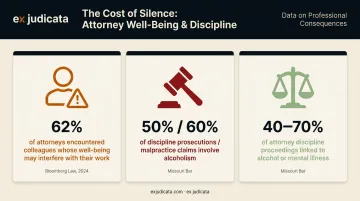
Each of these outcomes becomes more likely when stigma keeps struggling attorneys from seeking help before problems escalate.
Substance Abuse and Suicide Risk in the Legal Profession
Alcohol Use
The 2016 Krill study remains the most rigorous peer-reviewed baseline: 20.6% of attorneys screened positive for hazardous or potentially alcohol-dependent drinking.
Bloomberg Law's 2024 data adds current context:
- 87% of attorneys were current drinkers or had consumed alcohol
- 25% drank above moderate-use limits
- 14% reported increased alcohol use since the start of 2024
Suicidal Ideation
The 2023 Healthcare study of 1,962 practicing lawyers found 8.5% endorsed suicidal ideation — compared to 4.2% in the general adult population. Lawyers with high perceived stress had 22.39 times the odds of suicidal ideation versus lawyers with low stress.
Law.com/ALM's 2024 Mental Health Survey of the Legal Profession, tracking nearly 2,500 legal professionals, found:
- 15.3% had contemplated suicide during their legal career
- 14.6% knew a colleague who had died by suicide in the past two years
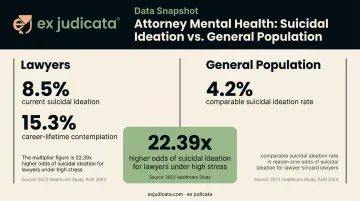
For a profession that prizes stoicism and self-sufficiency, these numbers reflect something more than personal struggle — they point to a culture that routinely leaves lawyers without support at their most vulnerable.
Gender Disparities
A 2021 peer-reviewed study by Anker and Krill of 2,863 licensed attorneys found women attorneys reported higher rates of mental health distress and risky drinking than men:
- Moderate depression: 13.7% of women vs. 10.6% of men
- Moderately severe depression: 5.2% of women vs. 3.2% of men
- Moderate anxiety: 14.1% of women vs. 10.0% of men
- Severe anxiety: higher in women across all categories measured
Root Causes: Why Lawyers Have High Rates of Mental Health Issues
Structural Stressors
Bloomberg Law's 2024 report identifies the top well-being challenges attorneys face:
- Inability to disconnect from work (45%)
- Unmanageable workload (32%)
- Average weekly hours around 50, with more than 75% of attorneys working on half or more of their days off
Bloomberg Law's 2025 data found only 3% of lawyers completely disconnected from work while on vacation. This chronic inability to decompress is a structural condition — one that accelerates burnout and compounds mental health decline over time.
Stigma as Multiplier
Stigma doesn't just delay treatment; it converts manageable problems into crises. The same attorneys who know the statistics about mental health in law are reluctant to apply them to themselves.
Disclosing mental health struggles risks reputation damage, client perception shifts, and — in some states — complications with bar standing. The result: lawyers wait until problems become severe before seeking help, if they seek help at all.
Billable Hours and Adversarial Culture
The ABA Journal has documented lawyers reporting that billable-hour pressures directly affect their mental health. State bar reports have gone further, recommending billable-hour caps as a formal wellbeing intervention.
The adversarial nature of legal work compounds this: winning and losing are explicit and constant, rewarding aggression while punishing vulnerability. Psychological safety is genuinely scarce in that environment.
The Career Toll: When Mental Health Pushes Lawyers Out
The 2023 Healthcare study found **46% of lawyers were considering leaving the profession** due to stress or burnout. Bloomberg Law's 2024 data adds another angle: **48% of attorneys were actively seeking or open to other employment**, with 57% citing reduced work stress and 54% citing better work-life balance as their primary motivations.
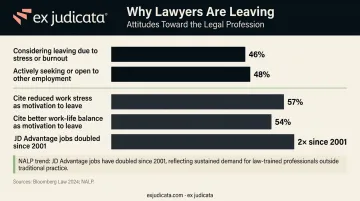
Many aren't just considering the exit — they're taking it. NALP data shows that JD Advantage jobs — roles where bar passage isn't required but a law degree provides a real edge — have more than doubled as a share of graduate employment since 2001. Demand spans business, compliance, risk management, government, nonprofit leadership, and academia.
Ex Judicata was built for lawyers at exactly this crossroads — the end-to-end career-transition platform for JDs moving out of practice. Key resources include:
- 100% nonlegal Job Board — roles spanning business, government, nonprofit, and academia
- EXJ Career Diagnostic — a PhD-validated assessment mapping eight attorney personality traits against 25 business career paths
- Career Corner coaching marketplace — specialists in identity transition, personal branding, and resume strategy
- Free Wellbeing content hub — editorial resources on burnout, mental health, and the psychological dimensions of leaving law
Those who have already left practice have their own resource: the EXJ Community, the first peer-to-peer network for the 600,000+ non-practicing lawyers in the U.S. It provides connection, mentorship, and peer support from people who've navigated the same transition. Membership is free — no credit card required.
Frequently Asked Questions
What percentage of lawyers have mental health issues?
The most current data shows 66% of lawyers say the profession has been detrimental to their mental health, 44% report anxiety, and 25% report depression (Bloomberg Law, 2024). Given documented reluctance to self-report, true figures are likely higher.
What is the 3-month rule in mental health?
The DSM-5 specifies that for adjustment disorders, symptoms must develop within 3 months of an identifiable stressor to meet diagnostic criteria. This threshold distinguishes a stress response from a diagnosable condition — relevant context for any lawyer assessing whether their symptoms warrant clinical attention.
What are the most common mental health issues among lawyers?
Anxiety, depression, and problematic alcohol use are the three most consistently documented conditions in peer-reviewed attorney research. Burnout overlaps significantly with all three and is reported at extremely high rates across attorney surveys.
Why do lawyers have such high rates of depression and anxiety?
The structural causes are well-documented: extreme and largely uncontrollable workloads, adversarial professional culture, billable-hour pressure, limited work-life separation, and strong institutional stigma against help-seeking.
Do lawyers have higher rates of substance abuse than other professions?
Yes. The Krill 2016 study found lawyers' hazardous drinking rate of 20.6% far exceeded comparable educated professional populations at 11.8%, and their positive alcohol screening rate was more than double that of physicians. More recent Bloomberg Law data shows the pattern has not meaningfully improved.