

Introduction: Why Patent Attorneys Are Rethinking Their Careers
Most professionals pick a lane — science or law. Patent attorneys picked both. A STEM degree, a JD, and the analytical precision to operate in either world is an unusually powerful combination. Yet many find it feels wasted inside a traditional patent practice.
The fears are predictable: Did I waste a decade on credentials I'm abandoning? Will anyone outside law take me seriously? Can I afford to make a move? These concerns are legitimate, but they also dissolve once attorneys see how the broader market values them.
A JD plus a technical background is one of the most versatile credential combinations available today. The question isn't whether you can transition — it's which of the many available paths actually fits.
This guide covers why patent attorneys leave, what transferable skills they bring, the strongest career paths across business, academia, and government, and concrete steps to make the move successfully.
Key Takeaways:
- Patent attorneys hold rare dual expertise — genuinely scarce and more valuable outside law than many realize
- Law-firm associate attrition hit 20% in 2024 — this is a widespread movement, not an individual failing
- Strong nonlegal paths include IP strategy, technology licensing, VC due diligence, consulting, and product management
- Repositioning your resume and building targeted networks matters more than starting over
- Platforms like Ex Judicata exist specifically to bridge this gap for JDs
Why Patent Attorneys Look for Career Alternatives
The structural pressures in patent law are specific and persistent. They don't resolve with seniority — for many attorneys, they intensify.
The Day-to-Day Reality
Private-firm IP attorneys logged a median of 1,387 billable hours in 2022, with partner-track associates reaching 1,646, according to the AIPLA 2023 Economic Survey. The work itself is narrow: drafting claims, prosecuting applications, managing prosecution timelines, occasionally litigating. There's little variation, limited client strategy involvement, and almost no connection to business outcomes.
That last point matters more than people expect. Patent attorneys often entered the field because they love science or technology. But legal practice keeps them at arm's length from the actual innovation. They protect the invention — they don't build it, commercialize it, or share in what it becomes.
The Identity Mismatch
Many patent attorneys describe a disconnect that deepens over time: they became attorneys to use their technical knowledge, but the job rewards procedural precision more than scientific curiosity. The creativity is in the claims — and even that becomes formulaic over years of prosecution work.
This isn't a personal failing. Bloomberg Law found that legal professionals reported feeling burned out 42% of the time in 2024, with mid-level and senior associates reporting 51%. NALP data shows that of departing associates, only 18% moved in-house — meaning the vast majority were pursuing something meaningfully different.
For patent attorneys specifically, that "something different" tends to mean roles where their technical depth actually drives decisions — not just defends them.
The Transferable Skills That Make Patent Attorneys Uniquely Valuable
Patent attorneys are more marketable outside law than most attorneys in other specialties — and the reason is the combination. Deep technical knowledge — in engineering, biology, chemistry, or software — paired with legal analytical rigor is genuinely scarce. Hiring managers in tech, pharma, consulting, and finance encounter this profile infrequently. When they do, it often solves a problem they didn't know how to fill.
The Core Skill Translation
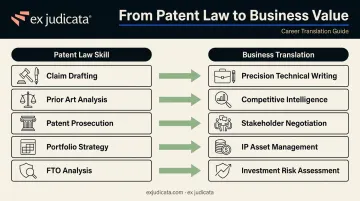
| Patent Law Skill | Business Translation |
|---|---|
| Claim drafting | Precision technical writing, specification design |
| Prior art analysis | Competitive intelligence, landscape mapping |
| Patent prosecution | Negotiation, examiner/stakeholder management |
| Portfolio strategy | Business planning, IP asset management |
| FTO analysis | Risk assessment, investment due diligence |
The Hidden Superpower: Communication
Patent attorneys explain complex technical systems to non-technical audiences constantly — USPTO examiners, judges, juries, and executives. That translation skill is exactly what consultants, product managers, and policy professionals need — and it's far harder to teach than patent law fundamentals.
The trained mindset also matters. Patent attorneys are conditioned to ask: What is novel? What is defensible? Where is the risk? That analytical frame maps directly onto product development decisions, investment analysis, and innovation strategy — roles where these questions are asked every day without anyone trained to answer them rigorously.
The USPTO's active roster lists approximately 38,327 registered patent attorneys in the US. That supply is finite. In nonlegal roles where this skillset is relevant, the competition is thinner — which means a well-prepared patent attorney often enters the room as the only candidate who can genuinely do both.
High-Value Business and Industry Career Paths
Patent attorneys who move into business roles typically find they can apply their expertise directly to outcomes — building products, closing deals, shaping strategy — while maintaining competitive compensation.
IP Strategy and In-House Counsel Roles
Moving in-house as a Director of IP, VP of Intellectual Property, or IP Strategy Lead is the most natural first transition. It trades billable hours for a seat at the business table. Corporate IP department heads reported a median gross income of $292,250 in 2022, with projected 2023 income of $322,821, per the AIPLA survey.
The work shifts from execution to strategy: portfolio building, licensing negotiations, competitive positioning, and advising product and executive teams. It still uses legal expertise but applies it to outcomes you're invested in.
Technology Licensing and Commercialization
Technology transfer offices — at universities, research hospitals, and large corporations — broker agreements that move inventions from lab to market. This is part deal-making, part relationship management, and part strategic analysis.
The scale of this sector is significant. AUTM's 2023 Licensing Survey reported:
- $104 billion in US research expenditures
- 25,000+ invention disclosures
- About 3,000 patent licenses executed
- $3.6 billion in US license income
Someone who can evaluate a patent portfolio, assess commercial potential, and negotiate licensing terms is exactly who fills these roles. Patent attorneys bring a combination of technical and legal fluency that most licensing professionals simply don't have.
Venture Capital and Startup Advising
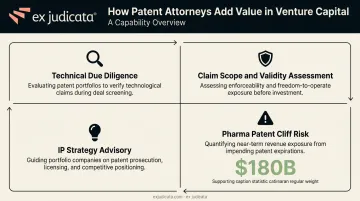
VC firms and growth-stage startups actively recruit former patent attorneys for IP-intensive deal work. The capability set transfers directly:
- Conducting technical due diligence on patent portfolios
- Assessing validity, claim scope, and freedom-to-operate risk
- Advising portfolio companies on IP strategy post-investment
- Evaluating patent exposure in pharma — where analysts have flagged roughly $180 billion in big-pharma revenue at risk from patent cliffs by 2030
These skills are genuinely rare in investment circles. Most VC analysts have finance or MBA backgrounds; few can assess a biotech patent landscape independently.
Management and IP Consulting
Boutique IP consultancies like Ocean Tomo and ipCapital Group, along with major strategy firms, hire former patent attorneys to advise on competitive analysis, IP monetization, freedom-to-operate assessments, and innovation strategy. The work is applied, project-based, and client-facing — closer to strategy consulting than legal services.
Intangible assets now represent roughly 90% of business value for S&P 500 companies, per Ocean Tomo's analysis. That concentration has made sophisticated IP advisory work one of the faster-growing niches in management consulting — and former patent attorneys are among the few professionals who can do it credibly.
Product Management in Tech or Pharma
Patent attorneys with software, biotech, or pharmaceutical backgrounds are natural product management candidates. They understand the technology deeply, can navigate regulatory and IP considerations without hand-holding, and translate technical requirements into business language fluently.
BLS data puts marketing and product managers at a $159,660 median annual wage — a useful floor benchmark, though roles requiring IP expertise in pharma or deep tech typically skew higher.
Career Paths in Academia, Government, and Nonprofits
Not every transition needs to point toward a corporate role. For attorneys drawn to intellectual depth, public mission, or policy impact, several paths offer strong fits.
University technology transfer offices (TTOs) are a natural landing spot. These roles combine patent evaluation, licensing negotiation, and commercialization strategy — work that maps directly onto what patent attorneys already do, applied to an institutional mission. Teaching IP law at a law school is another avenue, especially for attorneys who found satisfaction in breaking down complex systems for others.
Government roles span a wider range than most attorneys expect:
- USPTO roles in patent policy, quality management, and senior examiner leadership (USPTO examiners reported a $155,192 median gross income in 2022, per AIPLA)
- Federal agencies — NIH, DOE, DARPA — that manage IP in government-funded research
- Legislative and regulatory policy positions where IP expertise directly shapes outcomes
Nonprofits and think tanks are worth considering for attorneys motivated by public interest work. Organizations focused on innovation policy, access to medicines, open-source advocacy, and technology regulation actively seek people who understand IP from both sides of a debate — a skill set patent attorneys build throughout their careers.
The Ex Judicata Job Board includes government policy roles and academic administration positions across these categories, so it's a practical first stop for attorneys exploring this direction.
How to Successfully Transition Out of Patent Law
Start With Self-Assessment
Before updating a resume, identify what you actually want to stop doing versus what you genuinely enjoy. Some patent attorneys love the technical analysis; others prefer client relationships or strategic planning. The distinction matters — it determines whether the right move is in-house IP strategy, product management, or consulting.
This is exactly the gap the EXJ Career Diagnostic ($25.95) is designed to fill. It's a PhD-validated assessment that maps eight attorney personality traits against 25 business career paths, producing fit scores for each. It was built specifically for lawyers in transition — not a repurposed corporate assessment.
Reposition Your Resume
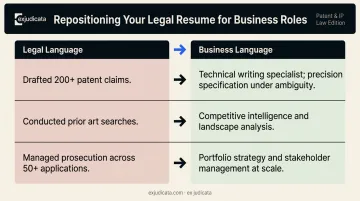
A resume built around legal practice won't communicate value to a business hiring manager. The translation work is real:
- "Drafted 200+ patent claims" → Technical writing specialist; precision specification under ambiguity
- "Conducted prior art searches" → Competitive intelligence and landscape analysis
- "Managed prosecution across 50+ applications" → Portfolio strategy and stakeholder management at scale
The Career Corner coaching specialists at Ex Judicata — including Margaret Enloe (former PwC Associate General Counsel) and John Costango (former JPMorgan executive) — focus on this kind of repositioning work: CV rewriting, LinkedIn optimization, and ATS keyword tailoring.
Build Targeted Networks
Most nonlegal roles for former attorneys are filled through professional relationships, not job boards. That means:
- Connecting with in-house IP teams at target companies
- Attending industry conferences (not just IP law events)
- Engaging with former attorneys who've already made the move
The EXJ Community exists for this purpose — a free peer-to-peer network for the 600,000+ non-practicing lawyers already working outside law in the US. It's searchable by industry, career type, and years since leaving practice. For someone weighing a move from patent law, talking to an attorney who's already navigated this transition is the single most useful step you can take.
Understand the Timeline and Compensation Bridge
Done the work above? Most patent attorneys land nonlegal roles within 6–18 months. The compensation picture is more favorable than many expect:
- In-house IP department heads: $292,250–$322,821 median (AIPLA)
- Life sciences in-house roles broadly: $474,000 median total compensation (BarkerGilmore, 2025)
- Management consulting broadly: $101,190 median (BLS — entry-level for IP specialists, not a cap)
For attorneys concerned about the financial bridge, Ex Judicata's Money Management content hub covers compensation trade-offs, savings runway, and managing law school debt during transition — all free editorial content at exjudicata.com.
Frequently Asked Questions
What should I do if I don't want to be a lawyer anymore?
Start with a skills and interests audit before targeting any specific field — knowing what you want to move toward matters as much as knowing what you're leaving. A JD retains real value in dozens of nonlegal roles. Platforms like Ex Judicata offer career diagnostics and job boards built specifically for this situation, so you're not navigating it alone.
What is the career progression of a patent attorney?
The traditional track runs from associate to senior associate to partner or in-house counsel. Many patent attorneys now view lateral moves into IP strategy, technology licensing, venture capital, or consulting as equally viable progressions — and often more financially and intellectually rewarding than the partnership track.
Is there high demand for patent attorneys?
Demand exists, particularly in pharma and tech, but the registered patent attorney pool is specialized and competitive (roughly 38,327 active attorneys per USPTO data). The nonlegal market — where the JD plus STEM combination is rarer — often offers stronger career leverage and less direct competition.
Can a patent attorney work in business without practicing law?
Yes. Roles in IP strategy, product management, technology licensing, venture capital, and consulting all draw heavily on a patent attorney's background without requiring active bar membership or legal practice. The expertise transfers directly — the license is optional.
What industries hire former patent attorneys for nonlegal roles?
Primary industries include biotechnology, pharmaceuticals, software and tech, medical devices, financial services (VC and PE), management consulting, and government/regulatory agencies. Where patents matter to the business model, former patent attorneys are in demand.
How long does it take to transition from patent law to a new career?
Most attorneys land nonlegal roles within 6–18 months when they actively reposition their experience, build targeted networks, and use tools designed for the transition. Attorneys who start with a vague target or a resume written for legal roles consistently take longer — clarifying direction early is the single biggest time-saver.