
Introduction
The Chief Compliance Officer job has changed almost beyond recognition. What once looked like an internal audit function — checklists, policy manuals, penalty avoidance — now looks like one of the most consequential roles in the C-suite.
The stakes are not abstract. In 2024, TD Bank pleaded guilty to Bank Secrecy Act and money-laundering conspiracy violations, resulting in a total penalty exceeding $1.88 billion — and FinCEN separately assessed what it described as the largest penalty against a depository institution in Treasury history. The DOJ found that 92% of TD Bank's transaction volume — $18.3 trillion — went unmonitored.
That is a compliance failure at organizational scale. Boards everywhere took notice.
That scrutiny is reshaping what CCOs are expected to do. Regulatory environments are fragmenting, AI governance obligations are arriving in waves, ESG disclosure requirements are shifting by jurisdiction, and personal accountability for compliance failures is squarely on the DOJ's radar.
What follows is a clear-eyed look at what the modern CCO role actually demands — how it evolved, what's driving its expansion in 2026, and why JDs are among the most competitive candidates for the position.
Key Takeaways
- The CCO has moved from rules enforcer to board-level strategic partner — with reporting lines increasingly going directly to the CEO.
- Core 2026 priorities include AI governance, ESG compliance, cybersecurity oversight, and third-party risk management.
- A JD background provides a natural foundation for compliance leadership — and historically correlates with higher CCO compensation.
- Regulatory complexity continues to grow, with 20 U.S. states now carrying comprehensive privacy laws and EU obligations expanding globally.
- CCO-track roles for JDs are increasingly filled through specialized executive search — Ex Judicata's Job Board and EXJ Search both focus exclusively on this market.
What Is a Chief Compliance Officer and Why Does the Role Matter in 2026?
The Chief Compliance Officer is the executive accountable for ensuring the organization operates within applicable laws, regulations, and ethical standards — while enabling sustainable growth, not just blocking risk.
That second part is relatively new. Today's CCO has moved well past the gatekeeper role — operating as a strategic partner to the CEO, board, and business units.
A Perfect Storm of Regulatory Complexity
Several forces have converged to make compliance leadership more consequential than at any prior point:
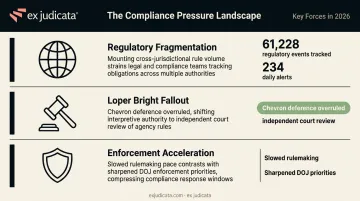
- Regulatory fragmentation: Thomson Reuters Regulatory Intelligence tracked 61,228 regulatory events in 2022 across 1,374 regulators in 190 countries — approximately 234 daily alerts — and the volume has only grown.
- Loper Bright fallout: The Supreme Court's 2024 decision overruling Chevron deference removed a key interpretive anchor, making proactive compliance planning harder as courts now independently assess whether agencies acted within statutory authority.
- Deceleration in rulemaking, acceleration in enforcement: Deloitte reports U.S. federal market regulators slowed new rulemaking in 2025 and into 2026. At the same time, DOJ enforcement priorities sharpened, with a department-wide corporate enforcement policy announced in March 2026.
An Organizational Role That Varies Widely
CCO is not a monolithic role. It differs meaningfully by:
- Industry: Financial services, healthcare, life sciences, and technology each carry distinct regulatory regimes and compliance cultures
- Reporting line: Some CCOs report to the General Counsel; others report directly to the CEO or board — a structural choice that reshapes scope and board access
- Organizational maturity: Early-stage companies may fold compliance into Legal; large multinationals often maintain independent, well-resourced compliance functions
From Gatekeeper to Strategic Partner: How the CCO Role Has Evolved
The Old Model
The compliance function spent decades as an internal monitor — focused on checklists, internal controls, and keeping the organization out of regulatory trouble. The CCO was often perceived as the organizational "cop," with limited influence over strategic decisions and a mandate that rarely extended beyond penalty avoidance.
That model had limits. When enforcement actions hit, boards discovered that a compliance function optimized for checkboxes rather than cultural change offered little protection.
The Inflection Point: Individual Accountability
The DOJ's Evaluation of Corporate Compliance Programs (ECCP) reshaped how organizations approach compliance programs. The ECCP specifically evaluates whether compliance personnel have the seniority, autonomy, resources, data access, and direct board access to function effectively. It asks three core questions:
- Is the program well designed?
- Is it adequately resourced and empowered?
- Is it actually working in practice?
The implicit message: a compliance program that exists on paper is not a defense. This pushed boards to demand genuinely empowered CCOs — not figureheads.
Reporting Line Shifts
That shift in expectations shows up in reporting structures. According to BarkerGilmore's research, CCOs most often reported to the Chief Legal Officer or General Counsel (44%), with CEO reporting a close second (42%). The trend toward direct CEO or board reporting reflects expanded scope and institutional recognition that compliance is a strategic function, not a legal subfunction.
The Structural Tension That Persists
Separating compliance from legal doesn't automatically produce better outcomes. Harvard Law School Forum analysis makes the point plainly: structural changes only matter if the CCO has the influence, relationships, and organizational culture to drive real change. Technical qualifications matter — but CCOs who succeed long-term build trust across the enterprise and know when to escalate concerns without burning the relationships that make escalation possible.

Core Responsibilities of a Modern Chief Compliance Officer
The CCO's responsibilities in 2026 span well beyond regulatory tracking. The role now owns multiple functions simultaneously:
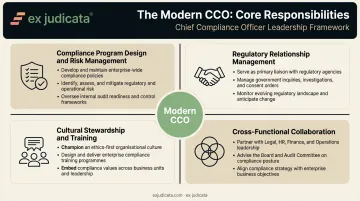
Compliance Program Design and Risk Management
- Building proactive frameworks aligned with current regulations (SOX, Basel III, GDPR, and sector-specific requirements)
- Conducting ongoing risk assessments that prioritize vulnerabilities by business impact
- Testing controls before regulators do — and fixing gaps before they become enforcement actions
- Updating policies rapidly as regulatory environments shift
Regulatory Relationship Management
The CCO serves as the organization's primary interface with regulators. That means:
- Managing audits and examination cycles from start to finish
- Proactively disclosing issues before they surface through regulatory review
- Responding to examination findings with documented remediation plans
- Maintaining constructive relationships that reduce enforcement risk over time
Boards increasingly recognize this as a high-value function. A CCO who has earned regulator trust is a genuine organizational asset — one that pays dividends when inquiries arise.
Cultural Stewardship and Training
A policy that employees don't understand — or don't follow — offers no real protection. The modern CCO:
- Sets ethical tone at the organizational level
- Designs tailored training programs that connect regulatory requirements to daily decisions
- Creates safe, accessible channels for employees to raise concerns
- Treats compliance as a value to be lived, not a procedure to be completed
Cross-Functional Collaboration
That cultural reach extends outward. The CCO in 2026 works alongside Legal, HR, IT, Finance, and Operations to embed compliance into new product development, vendor onboarding, M&A due diligence, and strategic planning. The role serves as a bridge between regulatory requirements and business objectives. In practice, that means a CCO who can't build internal alliances will struggle — regardless of formal authority.
Emerging Priorities Reshaping the CCO Role in 2026
AI Governance and Algorithmic Accountability
The EU AI Act entered into force in August 2024 and applies broadly from August 2, 2026. High-risk AI providers face obligations covering risk mitigation, data quality, transparency, human oversight, and cybersecurity robustness.
In the U.S., the regulatory picture shifted when Executive Order 14179 revoked the prior AI safety framework. The result is a less prescriptive but also less predictable federal environment for compliance teams.
Enforcement precedents are accumulating regardless. The SEC charged two investment advisers for false AI-related marketing claims, resulting in $400,000 in civil penalties. The FTC's Operation AI Comply brought five actions targeting deceptive AI claims. CCOs who don't own AI governance are leaving their organizations exposed.
ESG Compliance and Sustainability Reporting
The SEC's climate disclosure rules — adopted in March 2024, stayed in April 2024, and proposed for full rescission in May 2026 — illustrate how rapidly the U.S. ESG regulatory landscape can shift. Meanwhile, the EU's Corporate Sustainability Reporting Directive (CSRD) applies to non-EU companies with more than €150M in EU net turnover, with rules applying for financial years starting January 1, 2028.
For multinationals, ESG compliance is not a single jurisdiction question. It's a patchwork. And according to a NAVEX survey, compliance functions hold primary ESG reporting accountability at 43% of organizations surveyed — more than any other function.
Navigating Regulatory Fragmentation
CCOs in 2026 face simultaneous pressures: rollbacks in some federal areas, intensification in state-level privacy enforcement, and growing divergence between U.S., EU, and U.K. frameworks. The IAPP reports 19 enacted comprehensive state privacy laws as of early 2026, with new ones taking effect continuously.
Leading compliance teams are responding with:
- Systematic horizon scanning across multiple jurisdictions
- Scenario planning that accounts for regulatory reversal
- Closer ongoing dialogue with regulators rather than reactive engagement
Technology Fluency as a Core Competency
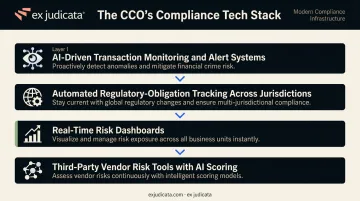
CCOs are now expected to evaluate and govern the compliance technologies their organizations deploy. Technology fluency is no longer optional. CCOs who cannot assess the compliance implications of their own tech stack are operating with a meaningful blind spot.
That stack increasingly includes:
- AI-driven transaction monitoring and alert systems
- Automated regulatory-obligation tracking across jurisdictions
- Real-time risk dashboards surfacing emerging issues
- Third-party vendor risk tools with embedded AI scoring
The Skills That Define Today's Strategic CCO
The skills separating effective 2026 CCOs from compliance administrators are largely behavioral and strategic — and for JDs considering this path, many translate directly from legal practice:
- Business acumen: Reading P&L dynamics, commercial trade-offs, and strategic priorities well enough to position compliance as a growth enabler rather than an obstacle
- Executive presence and communication: Translating regulatory complexity into clear guidance for boards, executives, and employees; building trust with regulators through credible, consistent engagement
- Emotional intelligence: Building a speak-up culture through influence rather than authority — and navigating the political dynamics of a C-suite where compliance is rarely the most popular voice
- Change leadership: Revising compliance frameworks quickly, leading teams through regulatory uncertainty, and maintaining organizational resolve when the instinct is to wait and see
Why JDs Are Well-Positioned for the CCO Role
Legal training builds exactly the capabilities the CCO role requires: regulatory interpretation, analytical reasoning, risk assessment, ethics, and comfort with ambiguity. These are not adjacent skills — they are core to both law practice and compliance leadership.
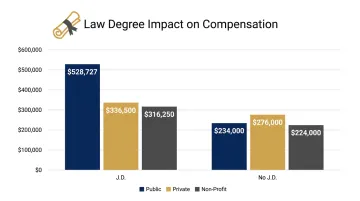
BarkerGilmore's data shows that CCOs with a JD historically earned 26% more in total compensation than CCOs without one, reflecting how the market values legal training in compliance leadership.
The "Can" vs. "Should" Shift
One useful lens for lawyers considering this path: the General Counsel focuses on what the organization can do under applicable law. The CCO focuses on what it should do — operating at the intersection of legal requirements, ethical standards, and organizational culture. For many lawyers, that shift represents a broader and more professionally fulfilling mandate.
Lawyers who move into compliance are not abandoning their legal training. They're deploying it in a context where the work is more operational, more cross-functional, and more directly tied to organizational culture and outcomes.
Resources for JDs Exploring This Path
Four resources support JDs at different stages of this exploration:
- "If I Leave the Law" Compliance Webinar — Ex Judicata's dedicated compliance episode, Business Ethics & Legal Ethics: A Comparison for the JD Seeking a Pivot to Business – Compliance Career Paths, features speakers from the Society of Corporate Compliance and Ethics, Guidepost Solutions, International Seaways, and Fordham Law School. It maps how legal ethics training translates to corporate compliance — and where the frameworks diverge.
- EXJ Career Diagnostic — A PhD-validated assessment that maps eight attorney personality traits against 25 business careers, including compliance, and produces personalized fit percentages. A practical first step before making any larger commitment.
- Ex Judicata Job Board — Nonlegal roles curated specifically for JD-credentialed candidates, including compliance positions across industries.
- EXJ Search — Retained executive search placing lawyers into senior compliance and risk leadership roles. Documented placements include a former Skadden counsel placed as Managing Director, Compliance & Investigations at Guidepost Solutions.
Frequently Asked Questions
What are the 5 C's of compliance?
The "5 C's" is an informal framework referencing Culture, Conduct, Controls, Compliance Management, and Continuous Improvement. While no single body formally defines it, the elements track closely with DOJ evaluation criteria covering program design, resourcing, and real-world effectiveness.
What is another name for Chief Compliance Officer?
CCOs may also carry titles like Chief Ethics and Compliance Officer (CECO), Chief Risk and Compliance Officer (CRCO), or Head of Compliance. These variations typically reflect differences in scope — a CECO title often signals explicit ethics program ownership, while CRCO suggests a broader risk mandate combined with compliance.
Do you need a law degree to become a Chief Compliance Officer?
A JD is not universally required, but legal training is consistently valued at the senior compliance level. Many CCOs hold JDs, and BarkerGilmore data shows JD-credentialed compliance leaders earn substantially more in total compensation — a clear sign of how employers price the credential in the market.
How is the CCO role different from the General Counsel?
The General Counsel advises on legal permissibility within an attorney-client privileged relationship. The CCO owns ethics programs, compliance culture, and regulatory adherence — the behavioral dimensions of risk that sit outside privileged counsel's remit.
What is a typical salary range for a Chief Compliance Officer in 2026?
According to BarkerGilmore's 2025 CCO Compensation Report, median CCO salaries grew 2.7% in 2025. Total compensation varies by industry: Technology CCOs averaged $770,000, Life Sciences $665,000, and Energy $578,000. Average bonuses ran approximately $125,551 (roughly 88% of target), with company size, reporting structure, and jurisdiction each affecting the final number.