

For JDs who have spent years building legal expertise and now want broader organizational influence, the CLAO trajectory represents one of the most compelling paths available. Understanding what the role entails, how it evolved, and what it takes to get there is increasingly relevant as more companies elevate their top legal executives into genuinely hybrid positions.
This article covers the CLAO's full definition and scope, core responsibilities, how the title evolved from General Counsel to CLO to CLAO, how it compares to similar C-suite titles, and what lawyers need to know about pursuing this path.
Key Takeaways
- The CLAO combines legal leadership with authority over administrative functions — compliance, HR, facilities, and procurement — in a single C-suite role
- The career arc typically runs General Counsel → Chief Legal Officer → Chief Legal and Administrative Officer
- CLAOs almost always report directly to the CEO and hold board-level visibility, unlike GCs who may report to the CFO
- Legal training's core competencies — analytical rigor, risk management, and stakeholder communication — translate directly into the operational demands of the CLAO role
What Is a Chief Legal and Administrative Officer?
The CLAO is a senior C-suite executive with dual authority: leading the organization's legal function (strategy, compliance, governance, risk) while also owning key administrative or operational functions. That second domain — HR, facilities, corporate real estate, procurement, government affairs, sustainability — is what separates the CLAO from a traditional Chief Legal Officer.
The title is not yet universal. It appears most frequently in large corporations, regulated industries, and organizations undergoing significant transformation. Some companies use CLO or GC titles even when the actual scope of the role is comparable to a CLAO. What matters is not the title itself but scope and reporting structure — where the role sits and how far its authority actually runs.
Those dimensions of scope also determine which of two configurations the role takes in practice.
Two Common CLAO Configurations
- Active legal + administrative leadership — the CLAO personally runs the legal department while also owning administrative functions directly
- Strategic oversight model — a General Counsel beneath the CLAO handles day-to-day legal operations, while the CLAO focuses on strategic legal oversight and administrative leadership; this model is more common in large organizations
Real-World Examples
Three companies illustrate what verified CLAO scope actually looks like:
- CBRE: Chad Doellinger serves as Chief Legal & Administrative Officer and Corporate Secretary, overseeing legal, risk, ethics, compliance, global insurance, corporate real estate, HR, and procurement
- Newell Brands: Bradford Turner holds the CLAO title with responsibility for Legal, Ethics and Compliance, Corporate Development, and Sustainability
- Community Health Systems: Justin Pitt carries the title President and Chief Legal and Administrative Officer, with a remit spanning legal, strategy, government relations, risk management, HR, and governance
Reporting Structure
The CLAO almost always reports directly to the CEO. This reporting line is a meaningful signal: legal and administrative leadership has been elevated from a support function to a genuine strategic function with board-level visibility.
Core Responsibilities of the CLAO
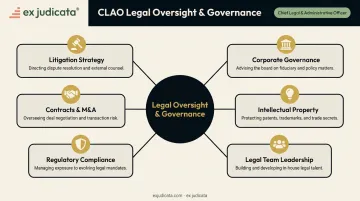
Legal Oversight and Governance
The legal side of the CLAO role covers the full spectrum of corporate legal matters:
- Litigation strategy — setting overall approach and managing outside counsel relationships
- Contracts and M&A — overseeing transaction documentation and deal risk
- Regulatory compliance — ensuring business activities align with applicable law across all jurisdictions
- Corporate governance — advising the board on governance requirements, drafting resolutions and minutes, managing securities compliance in public companies
- Intellectual property — protecting the organization's key assets
- Legal team leadership — managing the in-house team, the legal budget, and external counsel relationships
The board advisory function deserves particular emphasis. According to ACC's 2025 Chief Legal Officers Survey, 57% of CLOs were considered a trusted advisor to the board and 54% had a direct board reporting line. At the CLAO level, board interaction is standard, not exceptional.
Administrative and Operational Functions
The "A" in CLAO is what distinguishes the role. Verified administrative functions held by CLAOs include:
- Human resources strategy and people operations
- Facilities and corporate real estate management
- Procurement and vendor management
- Government relations and regulatory affairs
- Sustainability and ESG programs
- Corporate communications
- Shared administrative services
The exact portfolio varies by organization. The CLAO's job is not to run each of these functions in isolation — it's to spot where legal risk lives inside operational decisions before those decisions are made. That means advising the CEO when a procurement shift creates regulatory exposure, or when an HR policy carries litigation risk that isn't obvious from inside the people team. Seeing those connections across departments is what the role is actually built for.
The Evolution: From General Counsel to CLO to CLAO
The General Counsel's Traditional Starting Point
The GC was historically the most senior in-house lawyer: managing legal risk, compliance, contracts, and litigation, often reporting to the CFO. That reporting line reflected how legal was perceived: a support function, not a strategic driver.
The Rise of the CLO
The Chief Legal Officer title emerged as organizations began treating legal as a genuine C-suite function. The CLO reports directly to the CEO, holds board visibility, and operates as a strategic business partner rather than a reactive legal reviewer. The shift is from "review the decision after it's made" to "shape the initiative from inception."
ACC survey data shows this trend accelerating: the CLO title grew from 21% of respondents in 2022 to 28% in 2024, while the GC title fell from 66% to 57% over the same period. The title shift tracks a genuine change in how boards and CEOs think about legal leadership.
How Hybrid Roles Built the Bridge to CLAO
The next evolution came when organizations realized that legal executives' skill sets extended well beyond legal matters. Analytical rigor, risk intelligence, and stakeholder management are operational leadership skills as much as legal ones. Hybrid CLO roles emerged (CLO + CAO, CLO + CPO), and these became the bridge to the full CLAO model.
What's Driving the CLAO Today
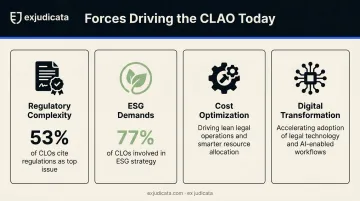
Several forces are accelerating the CLAO's emergence:
- Regulatory complexity — ACC's 2024 survey found 53% of CLOs cite regulations and enforcement as a top issue, with privacy, data security, and cybersecurity close behind
- ESG demands — 77% of CLOs in the same survey were involved in ESG strategy
- Cost optimization — organizations want one executive who can integrate legal risk management with operational efficiency, not two separate executives
- Digital transformation — building governance frameworks that keep pace with technology requires someone who understands both regulatory exposure and operational execution
Two well-documented careers show how this plays out in practice. Richard Verma served as Mastercard's CLO and head of global public policy, then returned as Chief Administrative Officer, overseeing Law, Government Affairs and Policy, Franchise, Corporate Security, and Community and Belonging.
Beth O'Callahan was appointed CLO and General Counsel at NetApp in January 2022, then transitioned in March 2025 to a newly defined CAO role — adding HR, Workplace Experience, and Corporate Communications to her existing legal portfolio. The pattern in both cases is the same: legal leadership as the entry point, expanded administrative authority as the outcome.
CLAO vs. CLO vs. CAO: Understanding the Differences
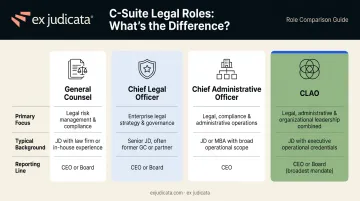
| Title | Primary Focus | Typical Background | Reporting Line |
|---|---|---|---|
| General Counsel | Day-to-day legal operations | JD, bar-admitted | Often CFO |
| Chief Legal Officer | Legal strategy, governance, C-suite partnership | JD, bar-admitted | CEO |
| Chief Administrative Officer | Administrative and operational functions | Varies; often MBA or operational background | CEO |
| CLAO | Legal strategy + administrative authority combined | JD, bar-admitted, operational experience | CEO |
Is a CLO Higher Than a GC?
In most organizations, the CLO is the more senior title. In larger companies, the GC may report to the CLO. In many organizations, however, the two titles are used interchangeably for the top legal executive — what matters more than the label is scope, reporting structure, and compensation.
ACC describes the CLO title as signaling a C-suite, business-solutions orientation, while GC is the more traditional lawyering designation. The CLO may also fit organizations where divisional or subsidiary GCs report to a parent-company legal leader.
Is a CAO Higher Than a COO?
Neither is universally higher. The COO typically oversees business and revenue-generating operations; the CAO owns internal administrative and support functions. They are peers at the same C-suite level. Which carries more influence depends entirely on the organization's structure and strategic priorities, not on any universal hierarchy.
When Does the CLAO Structure Make Sense?
The CLAO is most appropriate in larger, complex organizations where:
- Separating legal strategy from day-to-day legal operations is practical
- A single executive overseeing both legal and administrative functions creates genuine efficiency
- The board wants one executive accountable for both governance and operational risk
Small to mid-sized companies typically need only one senior legal executive: a GC or CLO. At that scale, the added complexity of a combined CLAO role rarely justifies the overhead.
Skills and Qualifications for the CLAO Role
Legal Credentials
The baseline is non-negotiable: a JD, bar admission, and substantial in-house experience. Most CLAOs have previously served as GC or CLO and have led organizations through high-stakes events — IPOs, M&A transactions, major regulatory investigations, or significant litigation.
Business and Operational Skills
What separates CLO candidates from CLAO candidates is demonstrated operational capability:
- Financial acumen — comfort with budgets, P&L accountability, and resource allocation decisions
- People leadership — ability to lead multiple non-legal functions (HR, facilities, procurement) staffed by professionals who don't report through legal
- Systems thinking — seeing how legal, HR, and corporate real estate decisions interconnect and affect each other
- Technology fluency — understanding cybersecurity governance, AI adoption risk, and the legal exposure embedded in technology vendor contracts and data decisions
ACC's surveys consistently show CLOs most want their lawyers to develop business acumen (63%), communication (51%), and executive presence (45%) — the same competencies that define CLAO effectiveness.
Those findings point to something structural: legal training already builds the capabilities that operational leadership demands. Here's why.
Why Legal Training Is the Right Foundation
Legal training produces capabilities that are genuinely rare at the executive level:
- Pattern recognition across large volumes of complex information
- Risk calibration — distinguishing serious exposure from manageable risk
- Stakeholder communication to audiences ranging from frontline staff to board directors
- Crisis management under ambiguity and time pressure
- Persuasion and negotiation across competing interests
Lawyers build these capabilities through daily client work — under deadline, under scrutiny, and with real consequences. That pressure-tested foundation is exactly what the CLAO role requires.
Pursuing the CLAO Role: What JDs Need to Know
The Typical Career Path
Most CLAOs follow a layered progression: build deep legal expertise as an associate and senior counsel, reach GC or CLO level, then gradually expand their portfolio by taking on additional administrative functions. That expansion typically happens through formal role restructuring or by actively volunteering to lead cross-functional initiatives — governance projects, M&A integration teams, enterprise risk programs — that build operational credibility alongside legal credentials.
What the CLAO Role Means for JDs Leaving Practice
The CLAO is one of the strongest examples of how a JD can become a launchpad for broad business leadership. For lawyers who feel constrained by traditional practice but don't want to abandon their expertise, this trajectory offers something rare: a path that is authentically non-legal in its day-to-day demands while remaining rooted in legal training.
Ex Judicata Search works at this intersection, placing legally trained professionals into senior executive and hybrid roles where JD credentials are a genuine operational advantage — and offering the career development resources to help lawyers build toward that level.
Concrete Development Steps
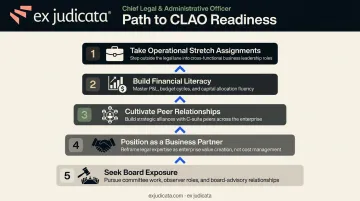
The path to CLAO-level readiness is deliberate, not accidental. Here's where to focus:
- Take operational stretch assignments : volunteer to lead projects that span HR, finance, or facilities, even informally
- Build financial literacy : Ex Judicata's Financial Fluency for Lawyers course is designed specifically for lawyers navigating this gap in operational roles
- Cultivate peer relationships : build real working relationships with HR, IT, and finance leaders, not just service them as a legal advisor
- Position as a business partner : in every interaction with the CEO and board, lead with business impact, not legal technicality
- Seek board exposure : whether through advisory board service, board committee work, or formal board membership, board-level experience at the CLAO level is expected, not optional
Frequently Asked Questions
What is a Chief Administrative Officer?
A CAO is a senior C-suite executive responsible for the organization's internal administrative functions — typically HR, facilities, procurement, and shared services. Reporting directly to the CEO, the CAO owns operational efficiency and cross-functional integration — distinct from the COO, whose focus is revenue-generating business operations.
Is a CAO higher than a COO?
Neither is universally higher than the other. The two roles are typically peers at the same C-suite level — the COO owns business and revenue operations while the CAO owns internal administrative and support functions. Organizational influence depends on company structure and strategic priorities, not a fixed hierarchy.
Is a CLO higher than a GC?
In most organizations, yes — the CLO is the more senior title, with the GC sometimes reporting to the CLO in larger companies. However, many organizations use the two titles interchangeably for the top legal executive. In practice, reporting structure and compensation tell you more about seniority than the title does.
What is the difference between a CLO and a Chief Legal and Administrative Officer?
A CLO focuses on legal strategy, compliance, and governance. A CLAO holds all of those responsibilities plus formal authority over administrative functions such as HR, facilities, corporate real estate, or corporate affairs. The CLAO is effectively a CLO whose portfolio has been expanded to encompass broader operational leadership.
What qualifications do you need to become a Chief Legal and Administrative Officer?
CLAOs typically hold a JD, are bar-admitted, and have extensive legal experience including prior service as GC or CLO. Beyond legal credentials, the role demands leadership across multiple business functions, financial acumen, and a track record of strategic partnership with CEOs and boards.
Can a JD who no longer wants to practice law pursue a CLAO-type role?
Yes — many CLAOs reach the role precisely because they outgrew traditional legal practice and expanded into operational leadership. JDs with strong business instincts and broad leadership ambitions are well-positioned for this trajectory. Ex Judicata helps JDs identify and pursue senior executive paths where their legal training is a competitive advantage, not a liability.