

Introduction
Making a lateral move as a law firm partner is categorically different from any other career decision in law. You're moving a book of business, renegotiating ownership economics, managing client relationships that may have taken a decade to build, and navigating ethical obligations that associates simply don't face.
The stakes reflect that complexity. According to Thomson Reuters Institute, nearly 50% of lateral partners leave within five years, and the cost of a failed lateral hire can reach $4 million. Yet the 2023 MLA Lateral Partner Satisfaction Survey found that 83% of partners who made a move would still choose the same firm — suggesting that well-executed moves tend to stick.
The gap between those outcomes comes down to preparation. Partners who move with clarity about their motivations, their book, their financial picture, and cultural fit succeed at far higher rates than those who move reactively.
This guide covers every critical factor — from assessing your motivations before the first conversation, to evaluating financial terms, protecting client relationships ethically, and determining whether a new firm is genuinely the right answer.
Key Takeaways
- Diagnose the real source of dissatisfaction before you do anything else — moving for the wrong reasons rarely fixes the underlying problem
- Self-reported client portability has dropped from 75% to 57% since 2018 — far less reliable than most partners assume
- First-year guarantees matter far less than what your compensation looks like in year three
- Ethical guardrails govern every stage of departure — engage outside ethics counsel before taking any visible steps
- Some partners who work through this self-assessment realize the problem runs deeper than any firm can fix
Know Why You're Really Moving — and Be Honest With Yourself
The most consequential thing you can do before contacting a recruiter is diagnose whether your dissatisfaction is with your firm specifically or with something broader. Partners who skip this step often recreate the same problems somewhere else.
Common Misidentified Motivations
These frustrations feel like firm-level problems but usually aren't:
- A slow year — Cyclical practice downturns happen everywhere. One bad year doesn't signal a structural problem at your firm.
- A difficult colleague — Interpersonal friction with one partner is not a firm-wide cultural indictment.
- Compensation that feels low — If your origination is genuinely strong, the issue may be how your firm credits and weighs it, which is worth surfacing internally first.
Reasons That Actually Warrant a Move
These signal a genuine mismatch that a new platform could resolve:
- Your firm lacks the complementary practice groups your clients increasingly need
- Your origination is outpacing what your current firm can service — you're leaving revenue on the table
- The firm's strategic direction has drifted away from your practice area's growth trajectory
- A competing firm has a specific gap you can fill, creating structural opportunity rather than just a comparable seat
The MLA survey found that lack of confidence in firm management and strategy was the leading factor driving partner departures — not compensation. That distinction matters because compensation can sometimes be negotiated; strategic misalignment usually can't.
The Momentum Trap
Many partners spend one to two years on the fence, delaying the decision month after month. The cost is real: you're neither fully committed to your current firm nor positioned to move cleanly.
Clarity on your "why" also makes you a stronger candidate. Prospective firms can tell the difference between a partner who knows what they need and one who's simply running away from something.
Some partners work through this exercise and realize the issue isn't their firm at all — it's the practice of law itself. For attorneys at that crossroads, Ex Judicata's career-transition platform offers a structured pathway out of practice, including assessments and connections with JDs who've already made the move.
Assess Practice Fit at the Prospective Firm
Practice fit is the most important operational factor in a lateral move, outweighing compensation, firm prestige, and even existing client relationships. Thomson Reuters reported that 67% of firms have had a lateral partner leave for failing to deliver the expected book, and 29% for cultural fit issues. Both often trace back to inadequate practice-fit diligence.
Evaluate Your Current Clients in the New Context
Before you get deep into any process, assess your clients one by one against the prospective firm:
- Do conflicts of interest block any key client relationships? They don't automatically disqualify a firm, but they shift the financial picture and must surface early.
- Are the new firm's billing rates compatible with what your clients will accept?
- Does the new firm's platform, reputation, or practice capabilities make your clients more likely to stay — or create unnecessary friction?
Cross-selling is also worth pressure-testing. If the prospective firm has practice areas or industry depth your clients genuinely need, a move could expand your originations — not just protect them. That client-level picture then feeds directly into which practice group structure makes sense for you.
Consider Your Practice Group Dynamics
The size of the practice group you're joining involves real tradeoffs:
| Larger, Established Group | Smaller or Newer Group |
|---|---|
| Higher-complexity work, premium brand | Greater visibility within the firm |
| Deep associate and staff support | Less internal competition for client opportunities |
| More internal competition for credit | More influence over group direction |
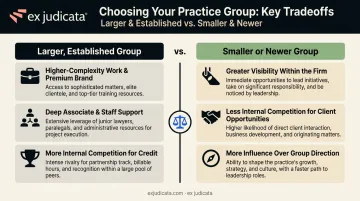
The right answer depends on your practice stage. A partner in the first decade of building a book often benefits from the platform a well-resourced group provides. A more established partner with a loyal client base may prefer the autonomy of a smaller group.
Investigate the specific office you'd be joining, too. Firm culture is never perfectly uniform across geography. Ask about the office's local leadership, size, growth trajectory, and which practice groups are co-located there.
Dig Into the Full Financial Picture Before You Commit
Compensation drives culture. How a firm pays — and who controls those decisions — tells you more about its values than any recruiting pitch will.
Understand How Compensation Is Actually Calculated
Ask these questions directly, early in the process:
- Is the system open (all compensation visible), closed (individual number only), or semi-closed?
- Is compensation formula-driven or committee-determined?
- How are origination, billing, and working attorney credits allocated?
- What happens to my compensation in year three — not just year one under the guarantee?
Year three is where the real math happens. Major, Lindsey & Africa (MLA) reports that most firms pay laterals on a fixed guarantee for 18-24 months before moving them into the standard compensation array. Model out your best-case, likely, and worst-case scenarios for that transition based on what the firm's system actually rewards.
Equity vs. Non-Equity: Know What You're Walking Into
Reuters reported in 2024 that 86% of the 100 largest firms by revenue have non-equity partner positions — meaning most laterals will enter as non-equity partners first.
Key things to clarify upfront:
- What are the specific metrics and timeline for equity eligibility?
- What does buy-in look like? MLA data shows the norm is 25-35% of current-year compensation, with some firms requiring up to 65%.
- Are non-equity partners eligible for firm profits, or purely salaried?

On bonus timing: many partners delay a move specifically to collect year-end compensation. That's often the wrong calculation. A 2025 analysis from The Practical Lawyer notes that delayed departures can trigger departure provisions or result in loss of pro-rata compensation — eroding the very bonus you were waiting for.
If the new firm's compensation structure is meaningfully better, months of delay at your current firm rarely justify the foregone upside.
Develop a Client Portability Plan
Client portability concerns stop more lateral moves than almost any other factor — and the reality is more complicated than most partners anticipate.
Relationship-Loyal vs. Institution-Loyal Clients
Be honest about this distinction before any conversation starts. Some clients follow partners because the relationship is genuinely personal. Others stay with a firm because of institutional relationships, brand trust, or procurement rules that restrict outside counsel changes. The mix in your book determines your realistic portable revenue.
Decipher's 2024 data found that lateral partner candidates self-reported 57% client portability — down from 75% in 2018 — with estimated actual transfer rates around 35%. That gap between claimed and actual portability is real, and shifts considerably by practice area and geography.
Ethical Obligations in Client Notification
Under ABA Model Rules 1.4 and 1.16, clients have the right to know about a lawyer's departure and to choose their counsel. Key obligations:
- Notify clients with active matters as soon as reasonably practicable
- ABA Formal Opinion 489 recommends joint notification from both the departing partner and the firm
- Do not solicit clients prior to departure — the line between notification and solicitation matters
- Consult your state bar's guidance and, ideally, outside ethics counsel before taking any steps
Meeting these obligations is the floor, not the ceiling. Once you've handled notification correctly, the new firm's platform can work in your favor: clients sometimes move not just out of loyalty but because the new firm offers something better — alternative fee arrangements, a wider geographic footprint, or stronger industry capabilities.
Navigate the Timing, Ethics, and Onboarding Logistics
Timing Is More Complex Than the Bonus Calendar
A well-executed lateral transition typically takes four to six months from first serious conversation to start date — sometimes longer. Partners who compress this timeline often shortchange the conflicts check process, rush client transition planning, or leave active matters in disarray.
Plan around:
- Active matter deadlines and pending trials
- The new firm's conflicts clearance timeline
- Notice requirements in your partnership agreement
- The firm's fiscal year and how that interacts with compensation timing
Ethical Guardrails You Cannot Ignore
Before taking any visible step toward departure, review your partnership agreement with outside ethics counsel. Your core obligations cover:
- Confidentiality — ABA Rule 1.6 governs what information you can share during the job-search process, including in conflicts disclosures
- Non-solicitation clauses — Review what your agreement restricts, and note that ABA Model Rule 5.6 prohibits agreements that unreasonably restrict your right to practice
- Firm materials — Client files and firm proprietary data must be handled according to Rule 1.16(d); do not take anything that belongs to the firm
- Notice requirements — Violating notice provisions can create financial exposure and damage client relationships
Ask Pointed Questions About Onboarding
Once you've cleared ethics obligations, shift focus to integration. The first 90–120 days at a new firm are the critical window — and how well a firm has thought through that period tells you a lot. Ask prospective firms:
- How quickly can conflicts be cleared and matters opened?
- What systems will I use, and how is training handled?
- Who is responsible for my integration, and how will success be measured in year one?
Vague or unprepared answers here are worth taking seriously. If a firm hasn't built a real onboarding structure, you'll be left to figure it out alone during the period when first impressions with new colleagues — and new clients — matter most.
Evaluate Cultural Fit and Long-Term Opportunity
Cultural fit is the hardest factor to assess because firms present their best selves during recruitment. The formal interview process will not tell you what you need to know.
Go beyond the formal process:
- Request informal conversations with peer partners — not just management
- Ask how the firm has handled partners whose practices went through a down year
- Ask how compensation decisions were made for recent laterals after their guarantee expired
- Understand whether the firm has a sponsor-based integration model or leaves laterals to sink or swim
Industry research consistently identifies lateral integration as the single greatest predictor of lateral partner satisfaction — more than compensation, more than firm prestige. A firm with a structured onboarding process and assigned internal sponsors produces better outcomes than one that assumes a senior partner will figure it out independently.
That integration advantage is also easier to secure when you join to fill a real gap — not just to add headcount.
Define the Specific Role You're Walking Into
The clearest indicator of long-term trajectory is whether the firm has a genuine, defined need that only you can fill. Partners who move into those roles tend to earn more autonomy, stronger internal support, and less competition for origination credit than those who land in an already well-populated practice group.
The Citi-Hildebrandt 2026 Client Advisory reported 63% success for lateral equity partners and 56% success for lateral income partners — compared to 75% and 66% for internally promoted partners. Closing that gap requires moving with purpose into a role where the firm genuinely needs what you bring.

Frequently Asked Questions
How long does a typical law firm partner lateral transition take?
Most lateral search professionals estimate the full process takes four to six months, sometimes longer — from initial conversations through conflicts checks, partnership agreement review, client transition planning, and notice periods. Partners who plan for 60-90 days typically underestimate what's involved.
Can I legally take my clients with me when I change firms?
Clients have the right to choose their counsel regardless of which firm holds their matters. Your obligation is proper, timely notification — ideally joint notice from both you and your departing firm — so clients can make an informed decision. Soliciting clients before formal departure creates ethical exposure.
What ethical rules govern a partner's departure from a law firm?
Key obligations include confidentiality of client information (Rule 1.6), protection of client interests on termination (Rule 1.16), notice requirements in your partnership agreement, and a prohibition on taking firm proprietary materials. Engage outside ethics counsel before taking any substantive steps toward departure.
Should I wait for my year-end bonus before making a lateral move?
Run the actual numbers. Bonus timing delays can trigger departure provisions or reduce pro-rata compensation, reducing what you set out to collect. If the new firm's compensation structure is materially better, the months of delay often cost more than the bonus is worth.
What is the difference between equity and non-equity partnership at a new firm?
Non-equity partners are typically salaried without a capital contribution or ownership stake. Equity partners share in firm profits and liabilities — usually requiring a buy-in of 25-35% of current-year compensation — and laterals entering as non-equity should pin down the specific metrics and timeline for equity eligibility before signing.
What questions should I ask a prospective firm during the interview process?
Cover at least five areas:
- How compensation is structured and evolves post-guarantee
- How conflicts will be handled for your key clients
- What associate and administrative support looks like
- The firm's five-year strategic direction
- How the firm has supported recent lateral partners through their first two years