

According to the ABA's 2024 Artificial Intelligence TechReport, 30.2% of attorneys' offices now use AI-based technology tools, with adoption reaching nearly 48% at firms with 500 or more lawyers. The shift isn't coming — it's already here.
This guide covers what legal analytics actually is, its core applications in legal practice, how firms can start building an analytics capability, and the ethical landmines to avoid. Whether you're a litigator evaluating settlement odds, a managing partner tracking firm profitability, or a lawyer wondering how data fluency opens doors beyond the courtroom — this is your starting point.
Key Takeaways
- Legal analytics applies data analysis, AI, and statistical tools to improve case strategy, research, and firm operations
- Core applications include predictive case analysis, AI-powered research, e-discovery, and firm business intelligence
- Legal data spans three categories: client data, internal firm data, and external industry data
- Start by identifying 2–3 specific decisions you want data to inform before evaluating any platform
- Ethical obligations around data quality, bias, and client confidentiality apply regardless of what any tool outputs
What Is Legal Analytics?
Legal analytics is the practice of using data analysis, machine learning, and AI-powered tools to surface patterns, inform decisions, and reveal risks hidden inside legal data. That covers a wide range: court records, case filings, judicial behavior, billing patterns, motion outcomes, and more.
Three Types of Legal Data
Before choosing any tool, it helps to understand what kind of data you're actually working with:
- Individual/client data — website behavior, intake sources, client demographics, matter history
- Internal firm data — billing records, time tracking, matter outcomes, utilization rates, realization rates
- External industry data — litigation trends, jurisdiction benchmarks, judge analytics, verdict databases
Each category requires different tools. A platform optimized for judge analytics won't tell you why your collection rate dropped last quarter — and vice versa.
The Analytics Spectrum
Most firms enter at the descriptive level and work toward predictive:
- Descriptive analytics — What happened? (Motion success rates by judge, billable hour trends)
- Predictive analytics — What's likely to happen? (Case outcome probabilities, settlement timing)
- Prescriptive analytics — What should we do? (Optimal litigation strategy given available data)
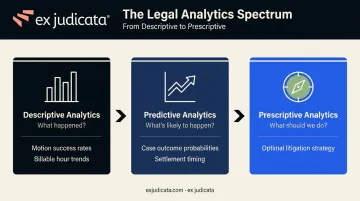
Most firms start at the descriptive level — understanding what your data actually says before you try to predict or optimize anything. That foundation matters more than jumping straight to AI-driven recommendations.
Why Legal Analytics Matters for Lawyers Today
The LexisNexis and ALM 2020 Legal Analytics Study found that 70% of large law firms were already using legal analytics — and among those users, 98% reported improved firm performance.
More recent data shows the trend continues. A 2025 Thomson Reuters report projects AI will save professionals roughly 240 hours per year — valued at approximately $19,000 per professional annually.
Direct Benefits for Legal Practice
For practicing lawyers, analytics translates into concrete advantages:
- Stronger litigation strategy — analyze a judge's ruling tendencies, opposing counsel win rates, and jurisdiction-specific patterns before filing
- Better client communication — replace "we think you have a good case" with data-backed probability assessments
- Reduced research time — AI tools surface relevant precedent faster than manual review
- Improved profitability — dashboards that surface realization gaps and underperforming practice areas in real time
Beyond the Courtroom
Legal analytics skills don't stop at the courthouse door. Compliance, legal operations, risk management, and corporate strategy roles increasingly seek professionals who can pair legal reasoning with data fluency — and that combination opens doors well beyond traditional practice.
For lawyers exploring those paths, Ex Judicata connects JDs with employers in compliance, risk, and legal operations who specifically value this skill set. Ex Judicata also offers "A Primer on Data Analytics for Lawyers," an on-demand course taught by Andrew Banasiewicz, Ph.D., built to develop exactly these quantitative capabilities.
Key Applications of Legal Analytics
Legal analytics covers a range of distinct capabilities. Each application addresses a different problem within practice — from predicting outcomes to managing firm profitability.
Predictive Case Analytics
Predictive tools use historical case data to estimate the likelihood of success. Variables include:
- Judge history and tendencies on specific motion types
- Jurisdiction-level outcome patterns
- Opposing counsel win rates
- Case type and procedural stage
The research on accuracy is instructive. A PLOS One study analyzing 28,000 SCOTUS case outcomes achieved 70.2% accuracy for case outcomes and 71.9% accuracy for individual justice votes. A separate study predicting European Court of Human Rights decisions across 584 cases reached 79% average accuracy using NLP models.
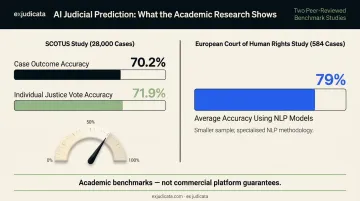
These figures represent academic benchmarks, not guarantees from commercial platforms. Treat predictions as probabilistic guidance — useful input to your judgment, not a substitute for it.
Legal Research and Precedent Analysis
AI-powered research tools scan vast legal databases to surface relevant case law far faster than manual review. The value isn't only speed — the better platforms identify pattern-based arguments most likely to resonate with a specific judge or court, something keyword searches never could.
The vendor landscape reflects how seriously firms are investing here. Thomson Reuters completed its acquisition of Casetext in August 2023, integrating CoCounsel's AI assistant into its research ecosystem. LexisNexis' platform (now rebranded as Lexis+ with Protégé) reported 344% ROI and over 20,000 attorney hours saved by year three in a commissioned Forrester study.
E-Discovery and Document Review
Document review is the biggest cost driver in litigation. RAND research found it accounts for roughly 73% of total e-discovery production costs, historically running around $18,000 per gigabyte.
Automated e-discovery tools use natural language processing to filter, tag, and summarize large document sets. Common functions lawyers use daily:
- Keyword filtering — scope documents to relevant terms and date ranges
- Concept clustering — group thematically related documents without pre-defined search terms
- Predictive coding / TAR — train the system on reviewed documents to prioritize the rest
The ABA's 2024 data shows keyword search remains dominant at 85.3% usage, with AI-assisted search at 27.6% — firms that move early on AI-assisted review gain a measurable cost and speed advantage over those still relying on keyword search alone.
Law Firm Business Intelligence
Analytics isn't only for cases. Managing partners and firm administrators use dashboards to track operational KPIs that directly affect profitability:
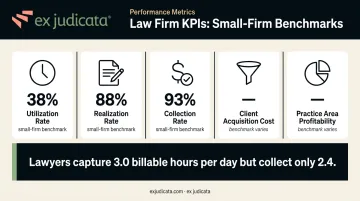
- Utilization rate — billable hours as a percentage of total available hours (small-firm average: 38%, per Clio's 2025 benchmarks)
- Realization rate — billed hours as a percentage of worked hours (small-firm average: 88%)
- Collection rate — collected dollars as a percentage of billed dollars (small-firm average: 93%)
- Client acquisition cost — what it actually costs to bring in a new matter
- Practice area profitability — which groups are driving margin vs. consuming it
Clio's 2025 data shows lawyers capture about 3.0 billable hours in a standard 8-hour day and ultimately collect 2.4 of those hours. Closing even part of that gap — through better billing practices, faster collections, or smarter matter allocation — is what business intelligence is designed to do.
Marketing and Client Development Analytics
Operational dashboards tell you how efficiently you're running the firm. Marketing analytics answers a different question: where are your best clients actually coming from?
That intelligence matters at every firm size, but it's particularly valuable when business development budgets are tight. Analytics can reveal:
- Which practice areas generate the highest-value matters
- Which referral sources produce the best client relationships (not just the most volume)
- How to allocate limited business development resources with more precision
How to Start Using Legal Analytics at Your Firm
Step 1: Define the Decision First
Before evaluating any platform, list 2–3 specific decisions you want data to inform. For example:
- Which judges in our primary jurisdiction are most favorable for our motion practice?
- Which intake source produces clients with the highest realization rates?
- How does our billable hour capture compare to small-firm benchmarks?
Starting with the question — not the software — keeps you from paying for a platform built to answer questions you never had.
Step 2: Follow a Practical Adoption Sequence
- Audit existing data sources — your practice management software, billing records, and PACER access likely contain more useful data than you're currently using
- Identify gaps — missing fields, inconsistent matter coding, and incomplete intake tracking are common problems
- Select a tool matched to your primary use case: litigation analytics, firm operations, and legal research each require different platforms
- Set a 90-day pilot with defined success metrics before committing to a full rollout
Step 3: Understand the Data Quality Problem
Analytics outputs are only as reliable as the underlying data. PACER, the primary source for federal court records, has documented limitations — its case locator functions as a nationwide index, not a guarantee of complete or accurate docket data.
Before acting on any AI-generated insight:
- Treat it as a starting point, not a conclusion
- Cross-verify against primary sources before making strategic decisions
Step 4: Know Your Platform Options
With data quality in mind, here's how the major platforms map to specific use cases:
| Platform | Primary Use Case |
|---|---|
| Lex Machina | Litigation analytics — judges, courts, counsel, parties, and case outcomes |
| Westlaw Precision / Westlaw Edge | AI-assisted legal research and litigation analytics using Westlaw content |
| CoCounsel (Thomson Reuters) | AI legal assistant for research memos, document review, and deposition prep |
| Lexis+ with Protégé | Legal research, document analysis, and workflow AI tools |
| Bloomberg Law Analytics | Litigation data review including docket activity, outcomes, and timing |
| Logikcull / Relativity | E-discovery — upload-to-review workflows and large-scale document processing |
| Clio Manage | Cloud-based practice management — matters, billing, documents, and firm workflows |
Limitations and Ethical Considerations
Data Quality and Reliability
Legal analytics tools are not infallible. Biased training data, outdated records, and jurisdiction-specific gaps can produce misleading predictions. A tool might perform well for federal patent litigation and poorly for state court family law — without signaling that distinction clearly.
Lawyers remain professionally responsible for the advice they give, regardless of what a platform outputs. Treat model outputs as one data point among many — not as a substitute for your own legal judgment.
Bias in Predictive Models
Algorithms trained on historical legal data can reflect existing disparities in case outcomes — by demographics, geography, or socioeconomic factors. The ABA's 2024 TechReport found that 74.7% of attorney respondents cited AI accuracy as a concern, and 56.3% raised reliability. Both figures point to real structural risks in how predictive models are built and validated.
Audit any tool you rely on for evidence of fairness testing. In high-stakes matters, don't let a model output be the only factor in a strategic decision.
Confidentiality and Data Privacy
Data reliability is only one side of the risk equation. What you put into these tools matters just as much as what they output. ABA Formal Opinion 512 — issued July 2024, the ABA's first ethics guidance on lawyer AI use — identifies duties of competence, confidentiality, candor, and supervision as all implicated when lawyers use AI tools.
The California State Bar went further, explicitly warning lawyers against inputting confidential client information into generative AI tools that create material confidentiality risks.
Before adopting any analytics platform:
- Review the vendor's data security and confidentiality policies
- Confirm whether your data is used to train the vendor's models
- Verify compliance with applicable state bar ethics rules and data protection regulations (GDPR where relevant, CCPA for California-related data)
- Document your due diligence
Frequently Asked Questions
Do lawyers use data analytics?
Yes, and adoption is accelerating. The LexisNexis/ALM 2020 study found 70% of large law firms using legal analytics. By 2024, the ABA reported 30.2% of all attorneys' offices using AI-based tools — with adoption nearly doubling at larger firms. Usage spans research, litigation strategy, e-discovery, and firm operations.
What is the 80/20 rule for lawyers?
The Pareto Principle suggests roughly 80% of a firm's revenue comes from 20% of its clients or matters. Analytics tools help firms identify which case types and client relationships drive that revenue — so partners can focus time and resources where it counts most.
What is predictive analytics in law?
Predictive legal analytics uses historical data and machine learning to forecast outcomes — such as the likelihood of winning a specific motion, how long a case is likely to take, or how a particular judge tends to rule on a given issue. Practitioners use it to stress-test strategy and quantify risk, not to replace legal judgment.
Will legal analytics replace lawyers?
No. Legal analytics is a decision-support tool. It enhances how lawyers research, strategize, and advise — but professional judgment, ethical reasoning, and advocacy can't be automated. A platform can flag that a judge grants summary judgment motions 34% of the time; deciding whether to file one still takes a lawyer.
What types of data do legal analytics tools analyze?
Data sources include court records and dockets, judicial opinions, verdict and settlement data, case filings, billing records, and client intake information. Coverage and data quality vary significantly by platform and jurisdiction.
How accurate are legal analytics predictions?
Accuracy varies by tool, data source, and jurisdiction. Academic benchmarks reach 70.2% for SCOTUS outcome prediction and 79% for European human rights cases, but commercial platform accuracy is not standardized. Treat outputs as probabilistic guidance, not conclusions.